Manufacturers often submit very different quotations, with small details that can significantly affect the final cost. This can make it difficult to understand the true value of each offer without compromising the quality or identity of your brand.
Reaching the right agreement requires a clear understanding of which terms are flexible and which quality standards should remain non-negotiable. To help you manage your budget more effectively, Jasmine explains in this guide how to:
- Break down a quotation before negotiations begin.
- Set your negotiation priorities and acceptable limits before contacting the manufacturer.
- Identify the most important terms to negotiate with a perfume manufacturer.
- Protect the quality standards that should not change in exchange for a lower price.
- Choose perfume project pricing strategies that match your budget.
What a quotation should include before you negotiate with a perfume manufacturer
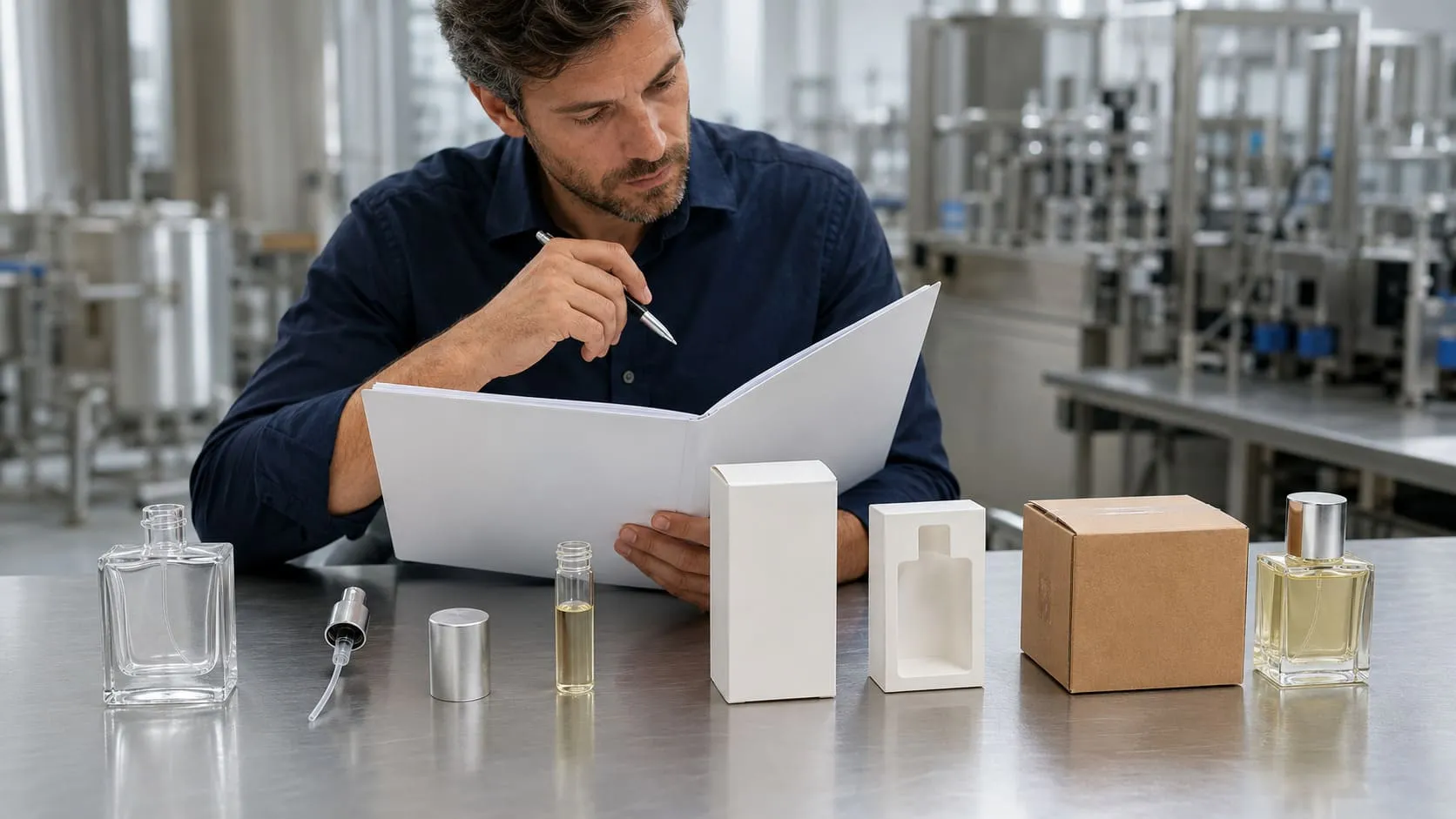
The unit price alone does not explain why one quotation is higher or lower than another. The final cost usually combines product components with formulation development, filling, packaging, and preparation services, and these can vary considerably between manufacturers. To identify where you can negotiate with a perfume manufacturer and potentially reduce perfume manufacturing cost without sacrificing product quality, break the quotation down into its main components:
- Fragrance formulation development and sample preparation.
- Fragrance liquid, concentration, and bottle size.
- Bottle, pump, and cap.
- Label, printing, and box.
- Filling, packaging, and outer cartons.
- Inspection, certifications, and order preparation.
- Documentation and shipping, when included.
Ask for an itemized quotation that clearly states quantities, specifications, and the cost of each component, while separating included services from additional charges. A single “price per bottle” figure does not show the true cost of private label perfume manufacturing or the full financial commitment required from your brand.
You should also separate the unit price from the total order value before comparing offers. A larger order may reduce the cost per bottle, but it also increases your total cash outlay and requires more storage space, stronger cash flow, and sufficient sales capacity to move the inventory.
Hidden cost items in manufacturing quotations can make it extremely difficult for a new perfume brand to understand the true price of production. Contact us to review your cost structure and identify where your budget can be optimized without compromising your product.
Read also: Perfume Label Requirements: Avoid Costly Errors Before Printing
How to set negotiation priorities and acceptable limits with the manufacturer
A lower price is not necessarily a better deal if achieving it means compromising the elements that define your product. Before asking a manufacturer for a quotation, you need to separate the features that are essential to your brand identity from those that can be simplified. This gives the manufacturer enough direction to suggest practical ways to reduce perfume manufacturing cost without weakening the product. Before requesting a quote, define:
- Your total available budget.
- The quantity you can realistically finance and sell.
- The number of fragrances and bottle sizes you plan to launch.
- Your target market launch date.
- The level of product customization you require.
- The amount of inventory your business can reasonably carry.
- The balance between unit cost and total investment.
- Your alternative plan if the quotation exceeds your budget.
Next, rank your requirements according to how much changing them would affect the finished product and your launch schedule:
- Non-negotiable elements that must remain unchanged to protect brand identity and product quality.
- Elements that can be simplified to lower costs while still meeting market requirements.
- Features that can be postponed and introduced later once sales performance has been measured.
Do not allow the manufacturer to determine your budget or the inventory level that suits your sales channels. Those are commercial decisions that belong to your brand. When you share your priorities with Jasmine Factory in Turkey, we use them to develop clear alternatives that reduce costs in flexible areas without compromising the elements that matter most to your product.
Key terms to negotiate with a perfume manufacturer
Not every project component has the same impact on your total manufacturing cost. Adjusting some elements can generate meaningful savings, while changing others may affect product quality or production continuity. When you negotiate with a perfume manufacturer, focus first on the areas where costs can be reduced with the least impact on the finished product. These typically include the following:
How to negotiate perfume MOQ
The minimum order quantity depends on factors such as the number of fragrances, bottle sizes, packaging type, and level of customization. A relatively small total order can quickly become more complex and expensive when it is divided across too many product variations. If you need to negotiate perfume MOQ for an initial launch, consider simplifying the range by:
- Reducing the number of fragrances.
- Launching one bottle size instead of several.
- Using the same bottle design across multiple fragrances.
- Allocating more of the budget to your core products.
- Postponing secondary products until a later order.
Base your order quantity on your available capital and expected sales velocity rather than on the size of the discount offered. A large production run may reduce the unit price, but it can become a financial burden if the inventory remains unsold for too long.
Ask the manufacturer to explain how the number of SKUs and total production quantity affect the unit price. This allows you to compare alternatives based on your total investment rather than simply choosing the lowest cost per bottle.
How to optimize perfume packaging cost
Packaging is often one of the best areas for controlling expenses, particularly during the first product launch. You can optimize perfume packaging cost by avoiding custom molds and unnecessary printing techniques while still protecting the fragrance and maintaining a strong visual presentation. Practical options include:
- Choosing a stock bottle instead of developing a custom mold.
- Selecting pumps and caps from existing supplier options.
- Standardizing outer-box dimensions across products.
- Reducing complex printing methods and premium finishes.
- Postponing non-essential decorative elements.
- Simplifying internal packaging when appropriate for the product.
Identify the visual details that genuinely communicate your brand identity and direct your packaging budget toward them rather than spending on minor finishes with little commercial impact. At Jasmine, we present packaging and bottle alternatives along with their direct effect on appearance, lead time, quantities, and cost before you make the final approval.
Negotiating perfume factory payment terms and production timelines
Perfume factory payment terms may not directly change the cost of the finished product, but they can have a major impact on your cash flow. Allowing enough time for sourcing and production can also expand your options and help you avoid the additional cost of rushed manufacturing. Before production begins, make sure the following terms are clearly documented:
- The required deposit amount.
- The due date for the remaining balance.
- Any production milestones linked to individual payments.
- The final deadline for fragrance and design approval.
- How late revisions affect cost and lead time.
- The expected sourcing and production schedule.
Meet your approval deadlines and avoid expecting a highly customized project to be completed quickly at the lowest possible price. Every additional restriction reduces the manufacturer’s sourcing and production flexibility and may increase the final cost.
At Jasmine, we define payment stages, production timelines, and the responsibilities of both parties according to the specific requirements of your project before component sourcing and manufacturing begin. Contact our team to identify where costs can be reduced safely without compromising the final product.
Read also: Perfume Manufacturing RFQ: What to Include for an Accurate Quote
Quality standards to protect when you negotiate with a perfume manufacturer
Do not accept a lower price if it means changing the fragrance, weakening the packaging, or producing a batch that does not meet your target market requirements. Before approving any cost-saving alternative, define the standards that must remain unchanged regardless of adjustments to quantity, packaging, or production schedule.
Lock In the formula and approved reference sample
Use the final approved sample as the production reference instead of relying on verbal descriptions or unapproved versions. You can establish clear fragrance specifications by:
- Approving the final formula and fragrance concentration.
- Testing the sample before final approval.
- Providing clear and specific feedback.
- Keeping an approved reference sample.
- Documenting every change made to the formula.
- Rejecting ingredient substitutions unless their impact on scent and stability is clearly understood.
- Confirming that the fragrance can be reproduced consistently to the same specifications.
The manufacturer should produce the commercial batch according to the approved sample and specifications and notify you before making any change that could affect the finished product.
Verify the pump and packaging components
An attractive bottle is not enough to confirm that the packaging is suitable for production. All components must work together without leakage, performance issues, or damage during transportation. Test the final version using the same components intended for commercial production and check:
- Consistency of spray performance.
- Secure pump fitting.
- Proper fit between the cap and bottle.
- Absence of leakage.
- Compatibility between the fragrance liquid and packaging materials.
- Durability of labels and printing.
- Integrity of the internal assembly.
- Protection of the product inside the box.
- Strength of the outer cartons during transport and storage.
Define the acceptance level required by your brand before commercial production begins. The manufacturer is responsible for verifying component compatibility and documenting specifications, while you approve the appearance and performance expected from the finished product.
Document inspection and acceptance criteria
Agree on how the finished batch will be inspected and accepted before manufacturing starts. This reduces the risk of disputes once the order is complete. The agreement should clearly define:
- The scope of pre-shipment inspection.
- The number of units to be inspected.
- Acceptable filling-level tolerances.
- Standards for appearance and final packaging.
- The documents to be supplied by the manufacturer.
- How non-conforming units will be handled.
- Responsibilities for labeling information and registration requirements.
- Conditions for accepting or rejecting the batch.
- The scope of any third-party testing.
- Corrective procedures if recurring defects are identified.
Inform the manufacturer of your target market requirements before requesting a quotation, because additional documentation or testing can affect both cost and lead time. At Jasmine, we explain what can be included within the project and what may require separate testing or procedures before the quotation is approved.
Read also: Perfume Manufacturing Quality Control Before Production
Key pricing strategies for your perfume project
Your target market, sales channels, and available budget determine the right level of customization for your brand. Choosing a product range that you can finance, market, and reorder sustainably requires comparing different production approaches rather than focusing only on the lowest unit price.
The cost-efficient model
This model is suitable when you are testing the market with one fragrance or a limited fragrance range and want to reduce your initial capital requirement without compromising the core quality of the perfume. It typically relies on:
- Stock bottles and readily available components.
- A limited number of fragrances and bottle sizes.
- Simple, practical packaging.
- Standard printing specifications.
- Greater flexibility in production schedules.
- Components that can be sourced again for repeat orders.
This approach reduces customization and launch costs without compromising essential standards such as the approved fragrance formula, pump performance, or required inspections. It can also help reduce perfume manufacturing cost while keeping your first production run commercially manageable.
The balanced cost-and-brand model
This option is better suited to brands with defined sales channels that need a recognizable identity without fully customizing every component in the first order. It combines:
- Targeted fragrance development.
- Stock packaging with distinctive visual elements.
- Labels and boxes designed to reinforce brand identity.
- A carefully selected number of SKUs.
- Premium finishes concentrated on the most visible elements.
- A cost structure that supports repeat orders and future expansion.
The balanced model strengthens your brand presentation while directing the budget toward details customers are most likely to notice. It also helps optimize perfume packaging cost by avoiding unnecessary customization in areas that add little value to the initial launch.
The premium customization model
This model is appropriate when your project requires a custom-developed fragrance, distinctive packaging, or specialized finishes that give the product a stronger and more exclusive market presence. It may include:
- More extensive fragrance and formula development.
- More distinctive bottles and components.
- Additional printing and finishing techniques.
- Decorative details and specialized assembly.
- Larger production quantities where required.
- Longer and more detailed testing and inspection procedures.
- Additional time for material sourcing and production.
This level of customization requires a larger budget and a longer lead time. Make sure your expected selling price and projected order volume justify the additional investment before committing to it.
Always choose a production level that your business can finance, market, and reorder sustainably. Ask the manufacturer to explain exactly how specifications, quantities, lead times, and costs change between each option before approving the quotation.
Common negotiation mistakes in perfume manufacturing
The lowest-priced quotation may appear to be the most economical option, but it can increase your actual costs if it leads to slow-moving inventory, production delays, or difficulty placing repeat orders. To avoid these problems, steer clear of the following practices:
- Negotiating price before finalizing technical specifications, which can lead to unexpected cost changes later.
- Increasing order quantities simply to reduce the unit price beyond what the market can realistically absorb.
- Comparing quotations that are not based on the same fragrance concentration, packaging specifications, or inspection requirements.
- Reducing the quality of pumps and caps to the point where leakage or performance complaints become more likely.
- Removing quality inspections to save money, only to discover defects after the shipment is completed.
- Changing decisions after sourcing has started, creating additional costs and longer lead times.
- Ignoring shipping and storage costs when calculating the true total cost of each quotation.
- Choosing materials or components that may be difficult to source again, making future reorders more complicated.
- Failing to document agreed terms, each party’s responsibilities, and product acceptance criteria.
Never accept a discount without understanding where it comes from. Ask exactly which component or condition has changed and whether that adjustment affects product quality, lead time, MOQ, or your ability to place repeat orders.
How to prepare a clear request for quotation for your perfume project
A manufacturer cannot prepare an accurate quotation when the project brief is incomplete or too general. Missing details can directly affect pricing, lead time, and minimum order quantities, so your request should be organized around clear and professional project requirements.
Define your project details and priorities
Bring all your project requirements together in one document so the manufacturer can understand the actual scope without relying on assumptions. Your brief should include:
- Target market and audience.
- Sales channels.
- Number of fragrances and bottle sizes.
- Required quantity for each product.
- Total available budget.
- Bottle and packaging requirements.
- Required level of customization.
- Target launch date.
- Non-negotiable and flexible elements.
Avoid asking for a final price based only on a general concept. The clearer your specifications are from the beginning, the lower the risk that the quotation will change once sample development and component sourcing begin.
Compare manufacturing quotations on the same basis
Do not compare quotations based on unit price alone. One manufacturer may include development, inspection, and packaging in the quoted price, while another may charge for those services separately. When reviewing each offer, check:
- Unit cost.
- Total order value.
- Minimum order quantity.
- Included and excluded items.
- Actual level of customization.
- Production lead time.
- Perfume factory payment terms.
- Inspection and documentation requirements.
- Reorder terms and conditions.
Do not automatically choose the lowest quotation until you understand the reason for the price difference. Determine whether it results from changes to the fragrance formula, packaging, service level, production terms, or other specifications.
When you share your project details and priorities with Jasmine, we explain how order quantity, bottles, packaging, and customization affect the final cost. We then prepare cost-efficient, balanced, and premium options, each clearly showing what is included, the required quantity, expected lead time, and level of customization, so you can compare them on the same basis. Contact us to prepare a clear and professional request for quotation for your perfume project.
Jasmine: Your manufacturing partner in Turkey from concept to product launch
Jasmine Factory in Turkey is your strategic perfume manufacturing partner in Turkey, providing integrated solutions designed to support your brand from the earliest stages of development. We guide you through a structured process that starts with shaping the initial concept, moves through product development and approval, and continues until your perfume is ready to launch in the market to professional quality standards.
We do not treat your idea as an isolated manufacturing order. Instead, we turn it into a clearly structured project with defined stages and responsibilities. You define your target market, audience, budget, and brand identity, while our team helps translate those requirements into a manufacturable product by:
- Defining the product scope, including the number of fragrances, bottle sizes, and quantities.
- Selecting the fragrance direction and developing samples through final approval.
- Coordinating the bottle, pump, cap, label, and box.
- Finalizing specifications, cost, and timeline before production begins.
- Handling filling, packaging, and shipment preparation for the target market.
This process gives you a clear understanding of what you are paying for, reduces costly late-stage changes, and helps preserve consistency in the fragrance, packaging, and brand identity as the project moves from concept to a market-ready product. Jasmine also clarifies what can be handled within the manufacturing scope and what may require separate approval, testing, or additional procedures before production and shipping.
FAQs about how to negotiate with perfume manufacturer
When does a perfume manufacturing quotation become final?
A quotation becomes more accurate once the formula, quantity, bottle, packaging, and included services have been finalized. If any of these elements change before production, the quotation may need to be revised.
Does the manufacturing cost automatically include samples and molds?
Not necessarily. The quotation should clearly state whether samples, molds, design work, and shipping are included in the price or charged separately.
What happens if I change the packaging after approving the quotation?
The manufacturer will need to recalculate the component cost, confirm compatibility, and revise the sourcing plan. The change may also affect the MOQ, production timeline, and unit price.
Can the price of a repeat order be fixed in advance?
That depends on whether the specifications and quantities remain unchanged, as well as on component costs and the agreed commercial terms. The contract should therefore explain how repeat orders will be priced instead of assuming that the original price will remain unchanged automatically.
Who is responsible for label information and market requirements?
Responsibility should be defined in writing. The brand provides the applicable market requirements and required product information, while the manufacturer clarifies which documents and services can be provided within the scope of the project.