Many hotels invest in interiors, lighting, staff uniforms, music, and room design, then leave fragrance to random sprays or generic diffusers. The result is a lobby that looks premium but does not feel memorable, a room experience that feels disconnected, and a brand identity guests cannot take home. For hotel suppliers, importers, and entrepreneurs, this gap is a clear opportunity.
This guide explains how hotel scent marketing works across lobbies, rooms, suites, spas, and take-home products, with a clear focus on guest journey planning, branded product formats, and private label hotel fragrance development. It also shows how Jasmine can help global businesses develop products such as room sprays, reed diffusers, hotel small diffusers, mini sprays, air fresheners, car fresheners, and gift sets, without treating any satisfaction percentage as a guaranteed result.
For more specific needs, buyers can read our hotel lobby fragrance guide for lobby-only scent directions, or review our wholesale hotel lobby air fresheners guide for bulk sourcing from Turkey.
What is hotel scent marketing?
Hotel scent marketing is the strategic use of fragrance across hotel spaces to shape the guest experience, support brand memory, and create a consistent atmosphere from arrival to departure.
It is different from simply making a hotel smell good. A strong fragrance can feel intrusive. A random fragrance can confuse the brand message. Professional scent marketing in hotels focuses on subtlety, consistency, placement, and emotional fit.
For businesses, hotel scent marketing also creates a product opportunity. A hotel can use one signature scent in the lobby, then extend that same identity into room sprays, reed diffusers, mini sprays, VIP amenities, car fresheners for transfer fleets, and retail gift sets.
When you see claims such as a 20% improvement in guest satisfaction, treat them as a hypothesis to test, not as a promise. Real results depend on scent quality, intensity, placement, guest profile, ventilation, staff execution, and product consistency.
A boutique hotel group, for example, may want one elegant signature scent for its lobbies and a softer matching private label room spray for VIP suites. A hospitality distributor may want a hotel collection for resorts, serviced apartments, boutique properties, and hotel retailers. For room-spray-specific planning, see our private label room spray guide.
Send us your hotel type, target country, scent mood, and preferred formats to discuss a private label hotel scent marketing project via WhatsApp.
Why does scent marketing for hotels matter for guest satisfaction?
Scent Marketing for Hotels matters because fragrance affects how a guest feels inside a space. A clean, elegant, well-balanced hotel lobby scent can support comfort, perceived care, and emotional memory. A poorly selected scent can create the opposite effect.
Hotels invest in guest experience as a system:
- Lighting, service
- Music
- Interior design
- Cleanliness
- Texture
- Smell all work together.
Fragrance should support that system, not compete with it.
For global clients, the commercial value is repeatability. A distributor or hospitality supplier can package the same scent direction across several SKUs, adapt labels for different markets, and supply hotels with a consistent brand experience.
- A stronger first impression at arrival
- A more memorable brand identity
- A feeling of cleanliness and care when the scent is subtle
- A calmer spa or wellness atmosphere
- Better continuity between public areas and guest rooms
- A take-home memory through branded fragrance products
The important point is control. A scent that works in a large lobby may be too strong in a guest room. A fresh citrus note may suit a coastal hotel, while amber, musk, oud, softwoods, or elegant florals may fit a luxury urban property. The scent should support the brand promise and the guest profile.
ِAlso read: Spa Scenting Fragrance Guide for Global Wellness Brands and Distributors
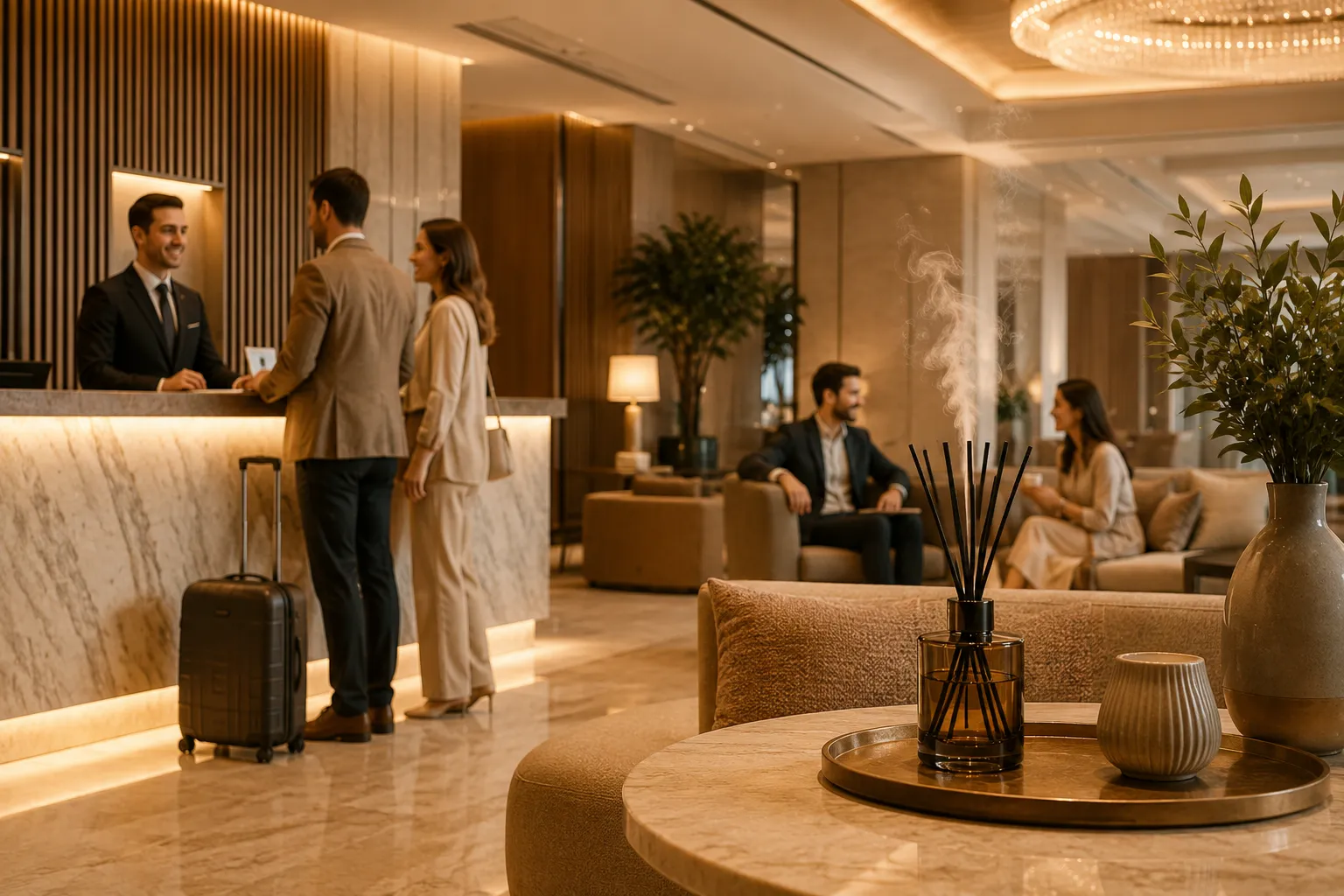
How does scent shape the hotel guest journey
Scent marketing in hotels works best when each touchpoint has a clear role. The guest journey usually begins before the room is seen, and fragrance often becomes part of the first emotional impression.
At arrival, scent should welcome the guest and communicate the hotel character. During check-in, it should feel clean, premium, and calm. In elevators and corridors, fragrance should remain light because these are transitional spaces. In rooms and suites, scent should become softer and more personal. In spas, scent can support relaxation. In restaurants, fragrance must be handled carefully so it does not conflict with food aromas.
The key is coherence. A hotel does not need the same scent everywhere, but the scent system should feel connected. Random fragrance choices across different areas weaken the brand experience.
Scent marketing for hotel lobbies
Scent Marketing for Hotel Lobbies is one of the most important parts of hospitality scent strategy because the lobby is the first branded scent moment. Buyers comparing lobby formats can also review our related article on wholesale hotel lobby air fresheners from Turkey for product examples and import-oriented thinking.
A hotel lobby scent should communicate positioning immediately. A luxury hotel may choose amber, musk, oud, woods, or soft florals. A wellness resort may use lavender, green tea, eucalyptus, or herbal notes. A coastal hotel may prefer citrus, aquatic, peach, coconut, or fresh green directions.
The goal is not intensity. The goal is recognition. Guests should feel that the space is welcoming and refined without feeling that fragrance has been forced into the air.
A signature scent for hotels can become part of the brand language when it is repeated in guest amenities, room sprays, reed diffusers, retail products, or VIP gift sets.
Guest rooms, suites, and VIP amenities
Guest rooms require a softer approach than lobbies. A scent that feels elegant in a large entrance space may feel too concentrated in a bedroom. For rooms, the fragrance should support comfort, cleanliness, and relaxation.
This is where product format matters. Hotels and hospitality suppliers can extend hotel scent marketing through:
- Hotel room spray for housekeeping or VIP suites
- Small hotel diffusers for boutique rooms or premium suites
- Mini sprays for welcome gifts
- Reed diffusers for long-lasting visual scent products
- Branded gift sets for hotel boutiques or loyalty programs
Packaging also matters. A private label hotel fragrance product should look aligned with the hotel identity. Bottle shape, label design, cap style, box finish, and color palette all influence perceived value.
ِAlso read: Hotel Lobby Fragrance: Top 15 Scents for Luxury Hotels
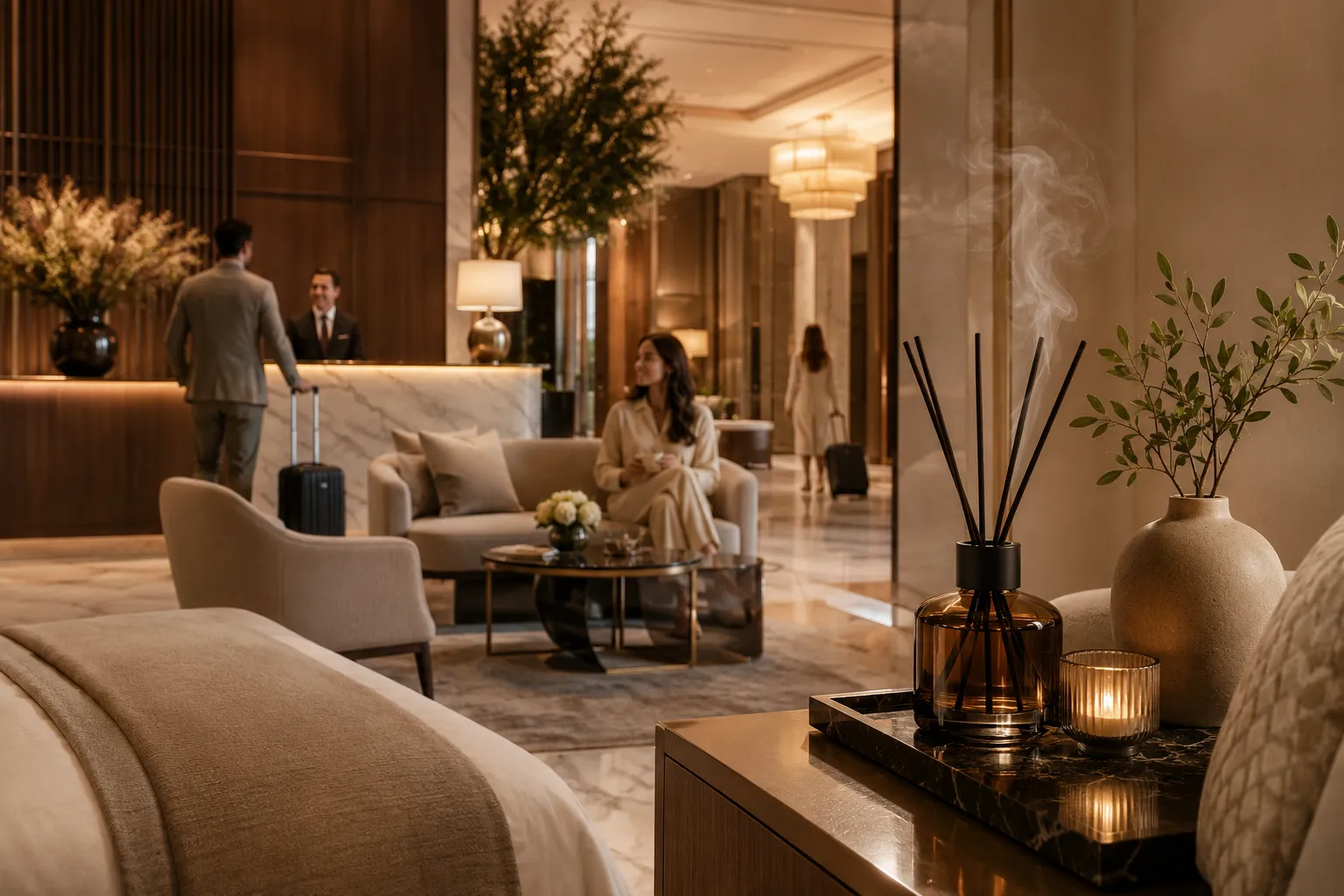
Hotel scent marketing product formats
Hotel scent marketing becomes commercially stronger when the scent strategy turns into a product system. The right mix depends on hotel category, guest profile, target market, distribution channel, and export route. For broader product-line planning, read our private label home fragrance manufacturing guide.
Some hotels may need only lobby diffusion and room sprays. Others may want a full private label hotel fragrance line with reed diffusers, mini sprays, retail gift boxes, and car fresheners for transfer fleets.
| Product Format | Best Hotel Area | B2B Use Case | Branding Potential | Notes for Buyers |
| Room Spray | Guest rooms, suites, housekeeping | Fast refresh and retail product | High | Useful for private label hotel scent lines and VIP room care. |
| Reed Diffuser | Lobby, suites, boutique rooms | Constant low-maintenance scent | High | Works well as a premium visual product and retail item. |
| Mini Spray | VIP gifts, amenities, retail shelf | Take-home scent memory | High | Strong for branded guest gifts and loyalty packages. |
| Air Freshener | Public areas, service zones | Practical ambient freshness | Medium | Needs careful scent selection and intensity control. |
| Car Freshener | Hotel cars, transfers, rental fleets | Brand extension during travel | Medium | Useful for resorts, chauffeur services, and travel agencies. |
| Gift Set | Retail boutique, VIP welcome | Upsell and brand memory | Very High | Can combine spray, diffuser, and mini fragrance formats. |
Buyers searching for hotel small diffusers should think beyond the device itself. The diffuser is only one part of the scent system. The fragrance, packaging, refill logic, safety documentation, and brand consistency are equally important. Our air freshener manufacturing blog can help buyers understand how product formats connect to manufacturing and branding.
Want to turn a hotel scent idea into a product line? Request Jasmine catalogs and discuss which formats fit your market: room spray, reed diffuser, mini spray, air freshener, car freshener, or gift set.
Choosing the right signature scent for a hotel brand
A signature scent for hotels should match the hotel positioning. It should not be selected only because it smells pleasant in isolation. A scent that works for a beach resort may not work for a business hotel. A fragrance that suits a luxury spa may feel too heavy for a family resort.
Strong scent selection begins with brand questions:
- What emotions should guests feel at arrival?
- Will the scent be used only in the lobby or across products?
- Will guests be able to buy the fragrance as a branded item?
- Should the scent feel fresh, elegant, relaxing, warm, clean, oriental, or local?
- Is the hotel luxury, wellness, coastal, urban, boutique, family, or business-focused?
- Which destination markets and label languages should be planned from the beginning?
The best hotel scent marketing strategy connects scent with interior design, guest expectations, service style, and product format. For inspiration across popular air-freshener notes, review our article on top scents for air freshener sprays.
Scent families by hotel positioning
Luxury hotels often work well with amber, musk, oud, softwoods, and elegant florals. These notes can communicate warmth, depth, and premium comfort.
Wellness resorts may choose lavender, green tea, eucalyptus, herbal notes, or gentle green accords. The goal is calm, freshness, and relaxation.
Beach resorts may prefer citrus, aquatic notes, peach, coconut, or fresh green directions. These scents support openness, brightness, and vacation energy.
Business hotels often need clean linen, tea, subtle woods, or soft fresh notes. The scent should feel professional, calm, and not distracting.
Boutique hotels can benefit from a custom blend connected to local identity, interior style, or brand story. This approach can make the fragrance more memorable and more suitable for private label retail products.
Jasmine brand and product directions for hotel buyers
When a hotel scent marketing project needs ready inspiration, we can discuss product directions across its fragrance and freshener families. The goal is not to copy a product blindly, but to use real scent and format examples to build a clearer brief.
- Vilara Reed Diffuser 110ML (Peach): a soft fruity direction for reception areas, waiting corners, or boutique hospitality spaces.
- Jasmine Niche Room Spray 500ML (Magic): a premium room spray direction for hotels that want a more distinctive lobby or suite atmosphere.
- Pure Passion Room Spray 280ML (Cherry): a bright scent direction for boutique hotels, salons, or energetic hospitality concepts.
- Marota Reed Diffuser 110ML (Paradise): a relaxed diffuser direction that can suit wellness, coastal, or spa-related environments.
- Cavayelo Room Spray 260ML (Secret): a deeper scent direction for executive lounges, luxury suites, or refined hotel corners.
- Luveal Room Spray 500ML (Joury): a floral-oriental direction for hotels that want softness, elegance, and cultural warmth.
For private label brands, these examples can lead into a custom hotel collection with three or more scent territories: lobby elegance, spa calm, room comfort, and travel freshness.
Explore our product collections to compare scent directions, formats, and packaging ideas.
From scent strategy to private label hotel fragrance products
Hotel scent marketing becomes a business opportunity when it moves from atmosphere into branded products. Hotels, hospitality suppliers, and entrepreneurs can turn a scent strategy into a private label hotel fragrance line.
- A lobby scent concept
- A guest room spray
- A reed diffuser for suites
- A mini spray for VIP guests
- A branded gift set for hotel boutiques
- A car freshener for hotel transfer fleets
For businesses, the advantage is brand ownership. A private label approach allows the buyer to control scent direction, packaging style, label identity, and product mix. It also creates opportunities for wholesale distribution, hotel supply, and retail resale. Learn more about our private label model before finalizing your project route.
At Jasmine, we can support this type of project through concept direction, scent selection, packaging planning, production, quality checks, packing, and shipment preparation. The buyer still needs to define the commercial route: private label, wholesale, or agency and distribution inquiry.
A hospitality distributor, for example, could create a private label hotel collection with three scent directions: lobby elegance, spa calm, and room comfort. Each scent can then be matched with the right format and packaging.
ِAlso read: How to Choose a Hotel Signature Scent for Private Label Growth
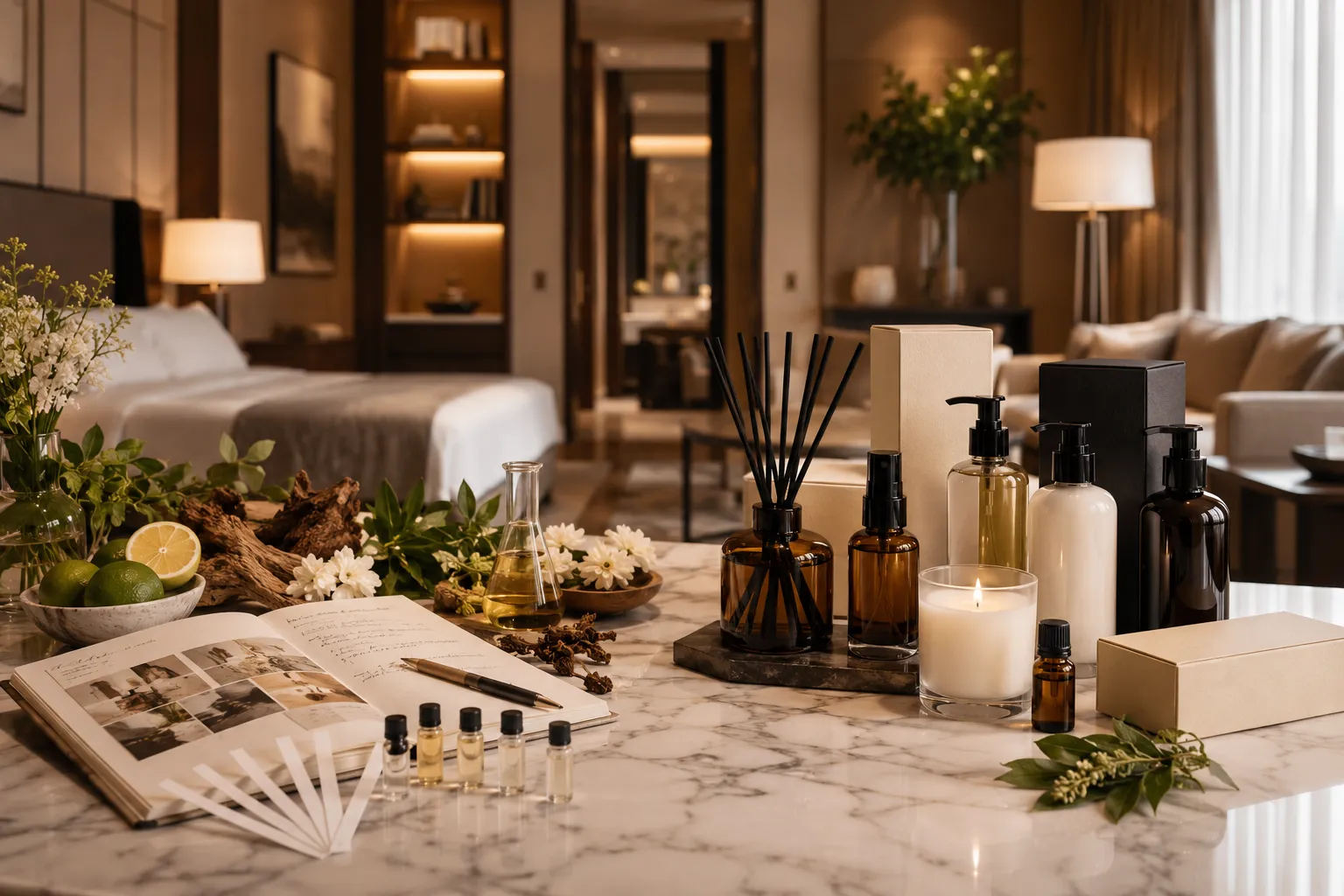
How does the hotel scent product development process work?
A successful private label hotel fragrance project needs a clear workflow. Without structure, buyers may approve a scent without checking packaging, or select packaging before confirming the destination market label and documentation requirements.
The process should move from business brief to scent direction, then sampling, packaging, approval, production, quality control, packing, and export preparation.
Sample approval is especially important. A scent can smell different on a blotter, in a spray format, and inside a reed diffuser format. Packaging can also affect perception. Before production, the buyer should confirm scent, bottle, label, box, cap, carton, and documentation requirements.
Step-by-step: Brief to sample to shipment
- Define the hotel type, target guest, and scent mood. A luxury hotel collection needs a different scent direction from a beach resort or business hotel line.
- Choose the product formats. Decide whether the project needs room sprays, reed diffusers, mini sprays, gift sets, air fresheners, car fresheners, or a mixed SKU plan.
- Select the scent direction. The buyer may start from an available scent library or request custom fragrance development.
- Align packaging components. Bottle, cap, label, box, outer carton, color, and finish should match the hotel or brand identity.
- Approve samples and artwork. Approval should cover scent, packaging, logo placement, label language, and visual consistency.
- Plan production, filling, labeling, and packing. Confirm product format, packaging scope, carton requirements, and order route.
- Check documentation and shipment requirements. Buyers should ask what documents are available and what their destination market requires.
- Prepare reorder logic. A successful hotel scent line should be repeatable, consistent, and easy to restock.
If you already know your hotel type, target market, and preferred product formats, send our experts a short brief to discuss the right private label or wholesale path.
Manufacturer selection checklist for hotel scent marketing projects
Choosing a manufacturer for hotel scent marketing projects should not depend on scent alone. A good fragrance may fail commercially if the packaging is weak, the format is wrong, or the documentation is incomplete for the buyer market.
Before discussing production planning, buyers should prepare a clear project brief. This helps the manufacturer recommend the right product route and avoids confusion during sampling.
A useful manufacturer checklist should cover:
- Scent customization options
- Product formats available
- Packaging and branding support
- Sampling and approval process
- Label and artwork requirements
- Documentation availability
- Export and packing readiness
- Reorder and SKU planning
- Ready scent library versus custom development
- MOQ logic without assuming fixed numbers
Because MOQ, cost, and lead time depend on many variables, buyers should not rely on generic assumptions. Product type, packaging customization, label complexity, destination country, carton requirements, and order scope can all affect the final recommendation.
What to prepare before contacting a manufacturer
Prepare the following before contacting Jasmine or any hotel fragrance manufacturer:
- Launch timeline
- Label language
- Required documents
- Expected SKU count
- Preferred product formats
- Scent mood or scent references
- Branding and packaging direction
- Hotel type or target buyer category
- Target market or destination country
- Wholesale, private label, or agency and distribution path
Useful questions to ask the manufacturer include:
- How should I plan future reorders?
- How does sample approval work?
- What packaging options fit my brand positioning?
- What information is needed for labels and artwork?
- What factors influence MOQ and production planning?
- What documents can be prepared for my destination market?
- Can I start from existing scents or request custom development?
- Which product formats are most suitable for my hotel scent marketing goal?
For a faster consultation, send us your hotel type, product formats, destination country, packaging direction, and scent mood through the contact or WhatsApp channel.
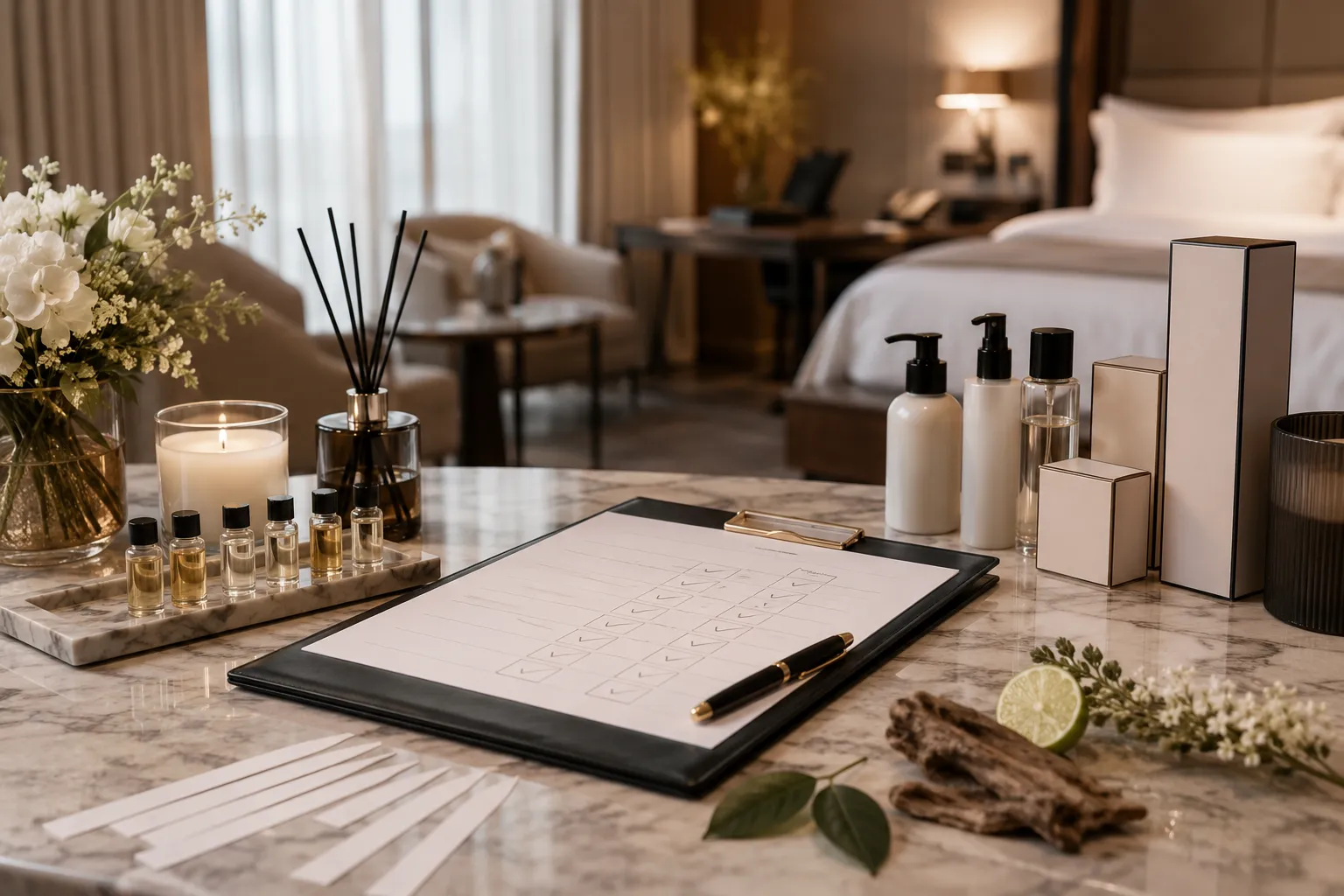
Top 6 Common mistakes in hotel scent marketing
- Using a scent that is too strong. A hotel scent should feel welcoming, not aggressive. Overpowering fragrance can make guests uncomfortable and may damage the experience.
- Choosing a scent that conflicts with hotel positioning. A heavy luxury scent may not suit a family resort. A tropical scent may not fit a formal business hotel.
- Using different scents randomly across hotel areas. Scent variation can work, but it should be intentional. Lobby, rooms, spa, and amenities should feel connected.
- Ignoring guest sensitivity. Hotels serve many guest profiles, so scent intensity should be controlled carefully, especially in enclosed areas.
- Treating scent as only a diffuser issue. Hotel scent marketing is a brand system. It includes fragrance, touchpoint planning, product formats, packaging, documentation, and reorder logic.
- Launching private label products without packaging and documentation planning. A good scent is not enough if the bottle leaks, the label is incomplete, or the carton is unsuitable for export.
A better approach is to plan scent, product format, packaging, documentation, and market route together from the beginning.
How Jasmine can support hotel scent marketing brands
At Jasmine, we support businesses and brands that want to turn hotel scent marketing into sellable fragrance products. The best fit is for importers, hospitality suppliers, distributors, hotel-related entrepreneurs, and private label buyers who need fragrance products with branding and export-oriented planning.
Relevant product directions can include perfumes, reed diffusers, room sprays, air fresheners, car fresheners, mini sprays, and gift sets. Depending on the goal, the route may be private label manufacturing, wholesale supply, or agency and distribution inquiry.
The process can start with catalogs, then move into a project discussion. Buyers can share their hotel type, scent direction, packaging idea, product format, destination country, and preferred route. From there, the project can move toward sampling, approval, production planning, packing, and shipment preparation.
At Jasmine, we are a practical partner for buyers who want to connect fragrance manufacturing with commercial product planning. The strongest projects treat scent as a branded guest experience, not just a fragrance item. Start from our website or contact our team with a clear brief.
Turn hotel scent marketing into a branded guest experience
Hotel scent marketing works best when scent, space, product format, and brand identity are aligned. The lobby creates the first impression. Guest rooms require softer comfort. Spas need calm. Retail and gift products turn the scent into a memory guests can take home.
The 20% satisfaction angle should be treated carefully as a claim to validate, not a guaranteed result. Real outcomes depend on fragrance selection, placement, intensity, guest profile, packaging quality, ventilation, and consistency of execution.
For importers, hospitality suppliers, and entrepreneurs, the real opportunity is to turn Scent Marketing for Hotels into a private label hotel fragrance line: room sprays, reed diffusers, mini sprays, air fresheners, car fresheners, and gift sets.
Prepare your brief, define your target market, choose your product formats, and contact us via WhatsApp to discuss private label, wholesale, or agency options for your hotel scent marketing project.
FAQs about hotel scent marketing
What is hotel scent marketing?
Hotel scent marketing is the strategic use of fragrance in hotel spaces such as lobbies, rooms, corridors, spas, and guest amenities. The goal is to create a consistent atmosphere that supports comfort, memory, and brand identity.
Can hotels create a private label signature scent?
Yes. A hotel, hospitality supplier, or distributor can develop a private label scent line through formats such as room sprays, reed diffusers, mini sprays, and guest gift sets. The process usually starts with a scent brief, samples, packaging, and approval gates.
What products are suitable for Scent Marketing for Hotels?
Common options include room sprays, reed diffusers, hotel small diffusers, mini sprays, air fresheners, car fresheners, and branded gift sets. The best choice depends on the hotel area, scent intensity, branding goal, and guest profile.
How does lobby scent fit into hotel scent marketing?
Lobby scent is usually the first branded scent moment, but it should be planned as part of the wider hotel scent marketing system. The scent direction, intensity, airflow, guest profile, and product extension should all work together before the fragrance is used in rooms, amenities, or private label hotel products.
What should B2B buyers prepare before requesting hotel scent products?
Prepare the hotel type, target market, scent mood, preferred product formats, packaging direction, destination country, label language, and expected SKU plan. This helps Jasmine recommend the right private label or wholesale route faster.