Confusion often arises around concepts such as fragrance exclusivity, confidentiality agreements, and intellectual property rights when starting a private label perfume project. Misunderstanding these terms can easily lead to commercial disputes—many of which can be avoided by defining perfume formula ownership, usage rights, confidentiality, and exclusivity clearly before production begins.
In today’s Jasmine article, we aim to simplify these concepts and explain how to negotiate clearly with manufacturers so you can protect your brand’s rights. We will cover several key points, including:
- The difference between perfume formula ownership, usage rights, confidentiality, and exclusivity
- When an exclusive fragrance formula becomes important for your brand
- The essential questions to ask before signing an agreement
- The most common mistakes that lead to disputes over fragrance formula rights
- How to define your perfume formula and exclusivity requirements with Jasmine
We will also cover other practical points that can help you approach private label manufacturing with clearer expectations and better-defined rights.
Why fragrance usage rights should be defined before manufacturing
You may think that choosing the fragrance is the only major decision involved in launching a perfume. In practice, you also need to understand what rights you have to use that fragrance after approving it—especially when placing repeat orders, expanding the product line, or moving production to another manufacturer.
This is where confusion often begins, because several different rights and assets are commonly treated as though they were the same:
- Ownership of the brand name and logo: These belong to your brand identity.
- Ownership of the packaging design: This may include design files, label artwork, and related materials, depending on the agreement.
- The right to sell the product: This allows you to market and sell the perfume directly under your own brand.
- Perfume formula ownership: This concerns the fragrance composition, technical files, and any ownership rights specifically defined in the contract.
- Usage rights: These determine whether and how you may manufacture, reorder, or use the fragrance within an agreed scope.
Choosing an existing scent from the manufacturer’s catalog and customizing the bottle, cap, and label makes the finished perfume part of your brand collection. However, this does not automatically give you perfume formula ownership or make it an exclusive fragrance formula. The manufacturer may still retain control over the technical formula even after you approve the sample.
These distinctions become particularly important when you want to:
- Place another order for the same perfume.
- Modify the fragrance based on market feedback.
- Launch the perfume in a different concentration or bottle size.
- Use the same scent in body, home, or car fragrance products.
- Expand into new international markets.
- Move production to another manufacturer.
Without an early discussion about these points, each party may develop a different understanding of what the project includes and what rights have actually been granted. This is also why matters such as fragrance formula rights, private label IP, and whether a perfume manufacturer NDA is required should be clarified before the commercial relationship moves too far.
When planning a private label perfume project, define what you are looking for from the outset: a ready-made fragrance sold under your brand, a modified scent, or a fully custom development. A bespoke project may require a more detailed custom perfume contract covering usage, modification rights, confidentiality, formula ownership, and exclusivity.
Perfume formula ownership vs. licensing vs. Confidentiality, vs. Exclusivity
These terms describe different aspects of the relationship between your brand and a perfume manufacturer, and one does not automatically grant the rights covered by another. To determine what your project actually requires, start by distinguishing perfume formula ownership from the right to use a formula, then separate the confidentiality of project information from fragrance exclusivity in the market.
Perfume formula ownership vs licensing
Perfume formula ownership means that the agreement grants your brand specific rights to the formula itself or to its development file. The scope of those rights depends on how the fragrance was developed and what the parties documented in the agreement. They may include the right to:
- Retain the formula file.
- Modify the formula at a later stage.
- Use the formula in other fragrance products.
- Transfer its production to another manufacturer.
- License its use under defined terms.
Usage rights, on the other hand, allow you to manufacture and sell the perfume under your brand and reorder it from the manufacturer without requiring the formula file to be handed over or its ownership transferred to you.
This arrangement may be suitable when your brand is testing a new product or selecting an existing fragrance from the manufacturer’s options. If you are building a long-term collection or intend to use the fragrance across several product categories, however, you will need to discuss broader fragrance formula rights, including modification, expansion into other products, and the ability to transfer manufacturing.
Before approving the final sample, clarify the following points with the manufacturer:
- What rights your brand receives after development
- Whether the agreement covers only the finished product or also the formula
- Whether the fragrance can be modified after launch
- Whether it may be used in another fragrance product
- Which party retains the development file and reference sample
- What happens to these rights when the business relationship ends
These questions prevent the word “ownership” from being used as a broad or ambiguous term and turn it into clearly defined rights that can be referenced when reordering or expanding your collection. Ideally, these rights should be documented in a custom perfume contract that clearly defines fragrance formula rights and the limits governing use, modification, repeat orders, and the transfer of manufacturing.
Confidentiality protection and fragrance exclusivity
A perfume manufacturer NDA protects the information exchanged between your brand and the manufacturer during product development. This may include the fragrance brief, sample feedback, technical data, packaging files, and commercial information related to the product launch or distribution.
Confidentiality prevents covered information from being disclosed or used beyond the agreed purpose. It does not, however, automatically prevent the manufacturer from offering the same fragrance—or a similar one—to another client.
An exclusive fragrance formula, by contrast, concerns whether the use of a fragrance or formula is restricted for the benefit of your brand within a defined scope, such as:
- A specific country or geographic region
- A particular product category
- A defined sales or distribution channel
- An agreed period of time
- A particular version of the fragrance or its modifications
Your project information may therefore remain confidential while the fragrance itself is non-exclusive. Your brand may also receive exclusivity for a specific market or product category without obtaining full perfume formula ownership. Likewise, approving a sample or paying development costs does not by itself establish exclusivity unless the terms have been explicitly discussed and documented.
Confusing ownership, confidentiality, and exclusivity can carry significant commercial consequences for your brand. Contact our team today to define your formula rights clearly and protect your brand before production.
Also read: Private Label Manufacturing Agreement for Perfume Brands
How perfume development routes affect your brand’s fragrance formula rights
The scope of your fragrance formula rights depends partly on the route used to develop the fragrance. It is therefore important to understand the main perfume development options available to your brand before considering how modifications and repeat orders will be managed after the formula is approved.
Perfume formula development routes
- Ready-made formula: You select an existing fragrance from the manufacturer’s available options, and at Jasmine Factory we customize product elements such as the name, bottle, and packaging. In this model, discussions generally focus on usage and reordering rights, while perfume formula ownership or exclusivity requires a separate agreement.
- Modified formula: An existing fragrance is adjusted according to your feedback, such as changing the balance between particular fragrance facets. In this case, documenting the final approved version becomes especially important, along with defining whether it can be reordered or used in other product categories.
- Custom-developed formula: A fragrance is developed from a brief that defines your brand identity, target audience, and desired olfactory direction. This route provides greater scope for discussing the development file, future modifications, and an exclusive fragrance formula, but it does not automatically transfer ownership of the formula to your brand.
None of these development routes automatically gives your brand ownership or exclusivity over the formula simply because you selected the fragrance or paid its development costs—even when the fragrance was created specifically for your brand. The extent of your fragrance formula rights depends on what you negotiate with the manufacturer and document in the project agreement or its annexes. This distinction is particularly important when defining private label IP, because ownership of your branding and packaging does not necessarily mean ownership of the underlying fragrance formula.
Managing modifications and repeat orders
Once the fragrance has been approved, your brand needs a clear reference point that can be used for all future production batches. This should include:
- Assigning a reference code to the final sample and recording its approval date
- Identifying the exact version that entered commercial production
- Recording the modifications that resulted in the approved formula
- Defining how the same reference should be reordered accurately
- Identifying which party retains the reference sample
- Establishing a process for approving any future modified version
One important point to keep in mind is that your right to use a fragrance in a perfume does not automatically extend to body fragrances, home fragrances, or car fragrances unless those product categories are specifically covered by the agreement.
Also read: Stock Formulas vs Custom Perfume Formulation: B2B Decision Guide
When does an exclusive fragrance formula become necessary for your brand?
Exclusivity is not equally important for every perfume project. Whether your brand needs it depends on the role the fragrance plays in the product’s identity and on your plans for future growth. An exclusive fragrance formula becomes particularly important when you are:
- Building your brand identity around a signature scent
- Investing heavily in a major launch campaign
- Distributing the product across multiple markets
- Using the fragrance as part of a coordinated product collection
- Relying on a distinctive scent as part of your market positioning
- Developing a custom edition for a specific sales channel
If you are testing the market with a ready-made fragrance, however, flexibility in reordering and modifying the scent may be more valuable than securing broad exclusivity. The right approach depends on how strategically important the fragrance is to your project and what your brand intends to do after launch.
The scope of an exclusive fragrance formula
Requesting an exclusive fragrance without defining the limits of that exclusivity can leave both parties uncertain about their obligations. To turn an exclusive fragrance formula into a practical contractual requirement, discuss the following points:
- Whether exclusivity applies to the entire formula or to a specific version
- The geographic scope, whether one country or multiple markets
- The product categories covered, such as perfumes, body fragrances, or home fragrances
- The exact start and end dates of the exclusivity period
- The sales channels covered, including wholesale, retail, and e-commerce
- How modifications and derivative versions will be treated
- The conditions required to maintain exclusivity
- What happens to the fragrance when the exclusivity period ends
The commercial scope of fragrance exclusivity
Approving a sample or paying development costs does not establish that the fragrance is exclusive to your brand. Likewise, modifying an existing fragrance does not automatically prevent the manufacturer from using it or developing a similar version for another project.
Exclusivity therefore needs to be documented in terms that clearly define:
- The fragrance or specific version covered by the agreement
- The target market and product categories
- The start date and duration of exclusivity
- The conditions for maintaining the agreement
- How modifications and derivative versions are treated
- The procedure if the project ends or orders stop
General wording or verbal discussions are not enough to manage this part of a perfume project effectively. The more precisely the scope of exclusivity is defined, the easier it becomes for both your brand and the manufacturer to understand what is restricted and what remains outside the agreement.
Pursuing absolute exclusivity without a clear commercial strategy can impose unnecessary restrictions on your project. Contact our team now to assess whether fragrance exclusivity is genuinely necessary for your brand and define an appropriate scope.
Questions to ask before approving samples and signing contracts
These questions fall into two main groups: those concerning the formula, samples, and continuity of the project, and those concerning information protection and the scope of exclusivity. Addressing them early helps you understand exactly what your brand will receive after sample approval and how future modifications and repeat orders will be managed.
About the perfume formula and samples
Choosing a fragrance you like from an olfactory perspective is not enough. You also need to understand the type of formula involved, the fragrance formula rights associated with its use, and the reference the manufacturer will rely on when producing future batches. At Jasmine, we can structure this review around the following areas:
Formula and usage rights
- Is the fragrance ready-made, modified, or custom-developed for the project?
- Who owns the formula or development file?
- What usage rights does your brand receive?
- Does the agreement allow the fragrance to be used in other products?
- Can production be transferred, or can the formula be used with another manufacturer?
- Which files will your brand receive once development is complete?
Samples and modifications
- How will the final sample be recorded under a clear reference code?
- Who will retain the reference sample?
- Can the fragrance be modified after the product launches?
- How will a modified version be documented and approved?
- What happens to samples your brand does not approve?
Repeat orders and project continuity
- Can the same fragrance be reordered for future production batches?
- How will changes to the reference or ingredients be handled?
- Will the reference sample and development files be retained if the project is paused and later resumed?
- What happens when the business relationship between the parties ends?
- Do usage and reordering rights remain valid after the agreement expires?
There is no single set of answers that suits every project. A brand testing one product may simply need a clearly defined right to reorder it. A brand building a long-term fragrance collection may instead need broader discussions covering modification rights, product-line expansion, and the use of the scent across additional categories. These requirements should be reflected clearly in the custom perfume contract rather than left to assumptions.
Protecting information and defining exclusivity terms
Once you have defined the formula usage rights and the way samples will be managed, the next step is to identify which information needs protection and what restrictions you expect to apply to the fragrance itself. A perfume manufacturer NDA protects confidential details relating to your project, while fragrance exclusivity requires a separate and clearly defined scope.
When you discuss your project with us at Jasmine, we help structure these requirements by clarifying points such as:
- Whether there will be a standalone NDA or a confidentiality clause within the main agreement
- Which information, samples, and files are covered by confidentiality protection
- Who is authorized to access the project files
- Whether the fragrance may be made available for other projects
- Whether fragrance exclusivity applies, and to which market, products, and time period
- Whether exclusivity also covers modified versions and derivative fragrances
- The exact start and end dates of the exclusivity period
- What procedures apply when exclusivity expires or the project is discontinued
Also read: Perfume Manufacturing Quality Control Before Production
Common mistakes that lead to disputes over fragrance Formula rights
Disputes often begin with points that were never discussed or documented before the final sample was approved. At Jasmine Factory in Turkey, we help clarify the details surrounding the formula, samples, and repeat orders, while you determine which rights your project requires and review what has been agreed before moving into production.
Some of the most common mistakes we help you avoid include:
- Treating branding as proof of ownership: Placing your brand name and logo on a product does not transfer perfume formula ownership to your brand.
- Confusing confidentiality with exclusivity: Protecting project information through a confidentiality agreement does not automatically prevent the manufacturer from offering the fragrance to another client.
- Approving a sample without a clear reference: Failing to record the approved version and its reference code can make accurate repeat orders difficult.
- Overlooking modification rights: Your brand may later need to adjust the fragrance after testing it in the market.
- Failing to define product categories: Approval to use a fragrance in a perfume does not necessarily extend to body, home, or other fragrance products.
- Using vague terminology: Describing a fragrance as “private” or “exclusive” without specifying the market, duration, or exact rights leaves room for different interpretations.
- Ignoring what happens after the project ends: Brands should understand what happens to samples, development files, and usage rights if the relationship with the manufacturer ends.
- Reviewing the agreement too late: Discussing fragrance formula rights after the product has launched is generally more difficult than addressing them before production begins.
There is no need to turn every perfume project into a complicated legal discussion. The objective is to document the expectations of both parties in clear language that your brand team and our team at Jasmine can understand and refer back to throughout the project.
Jasmine: Defining your perfume formula and exclusivity requirements before manufacturing
Jasmine Perfumes & Fragrances is an Istanbul-based manufacturer specializing in private label projects for brand owners, importers, and distributors. We coordinate the fragrance with the bottle, cap, label, and packaging so that all elements of the finished product align with the project identity and target market. This process starts with a clear understanding of what your brand wants to develop rather than selecting a fragrance in isolation from the rest of the product.
Before development begins, it helps to send us a concise project brief covering:
- The product type, target market, and intended audience
- The current stage of the project and the number of fragrances you plan to launch
- The olfactory direction or reference you would like to start from
- The preferred development route: ready-made, modified, or custom-developed
- The level of customization required for the bottle, cap, label, and packaging
- How samples will be reviewed and the final version approved
- Your plans for repeat orders, future fragrance modifications, or use across other product categories
- Your confidentiality requirements and the rights you want to discuss
- The required scope of exclusivity in terms of market, products, and duration
If confidentiality is important to the project, this is also the right stage to discuss whether a perfume manufacturer NDA or a confidentiality clause within the main agreement is appropriate. Likewise, if your brand requires an exclusive fragrance formula, its commercial scope should be defined before development progresses too far.
The more specific your brief is, the easier it becomes for us to focus the discussion on the appropriate fragrance development route, samples, customization requirements, and the aspects of private label IP relevant to the services we provide.
Send Jasmine’s team via WhatsApp your product type, target market, preferred development route, and the level of exclusivity you would like to discuss so we can review the project requirements with you before perfume development begins.
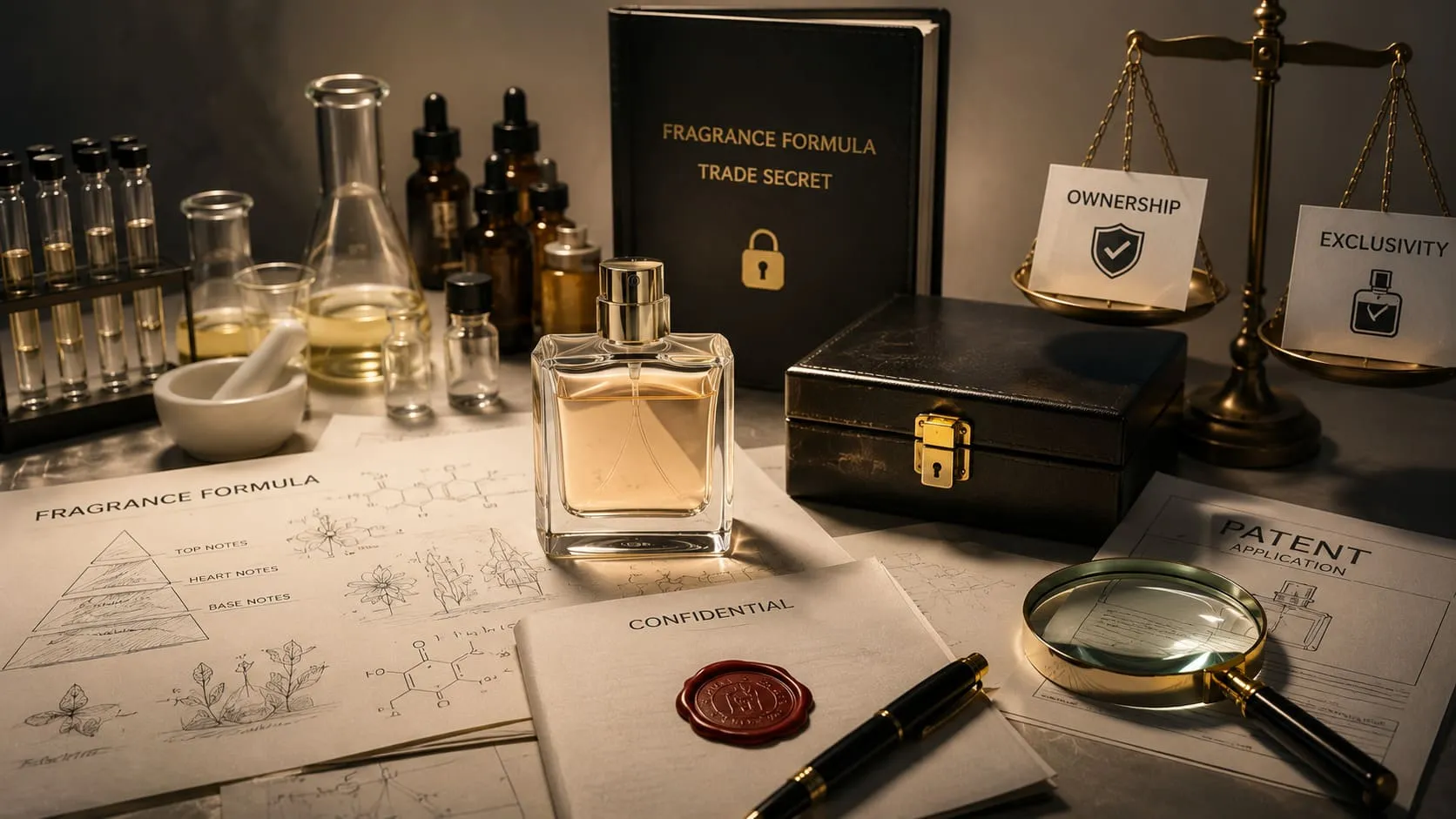
FAQs about perfume formula ownership
Does owning the brand mean you own the perfume formula?
No. Owning the brand name, logo, and packaging does not automatically give you perfume formula ownership. Ownership depends on the development model and the fragrance formula rights defined in the agreement.
Can you reorder the same fragrance after the first production batch?
That depends on how the reference sample is stored and on the agreed reordering terms. Make sure the final approved version has a clear reference code and that the process for reordering the same fragrance is documented.
Does a perfume manufacturer NDA make the fragrance exclusive?
Not automatically. A perfume manufacturer NDA protects confidential information, while an exclusive fragrance formula requires separate terms defining the fragrance, market, duration, and product categories covered by the exclusivity.
Can a perfume formula be modified after product launch?
Yes, depending on the type of formula and the approved reference. Any new version should be documented clearly, including how the modification affects future reorders and any exclusivity terms.