When importing perfume from Turkey, factory quotations should not be evaluated based on the price per perfume bottle alone. The actual cost must be calculated according to the delivery term stated in the quotation, as Incoterms determine what you pay the supplier and the point at which responsibility for the goods and the associated risks transfers to you.
Understanding these terms helps you protect your profit margin and avoid unexpected customs or logistics expenses. This guide from Jasmine will help you choose the delivery term that best fits your financial capacity and logistics capabilities by explaining:
- What Incoterms mean and how they divide responsibilities between the supplier and importer
- The differences between EXW, FOB, CIF, and DDP perfume shipments
- How to convert different supplier quotations into a final landed cost
- How shipping methods and container shipping affect the choice of Incoterms for perfume imports
- How to choose a shipping term based on your importing experience and logistics capabilities
Incoterms and perfume importer and manufacturer’s responsibilities
Incoterms, or International Commercial Terms, are standardized trade rules issued by the International Chamber of Commerce (ICC). They define how costs, risks, and logistics responsibilities are divided between you and us at Jasmine—or any other perfume manufacturer in Turkey—when carrying out an international purchase.
Incoterms are not separate shipping methods or complete supply contracts. Instead, they form part of the commercial agreement by defining each party’s obligations at the agreed delivery point.
How are shipping responsibilities, costs, and risks divided?
Under Incoterms® 2020, Incoterms for perfume imports define the limits of each party’s responsibility and the point at which the risk of loss or damage transfers from the seller to the buyer. When reviewing a perfume factory quotation, focus on three main areas:
- Execution: Which party is responsible for arranging each stage of transport and cargo handling.
- Cost: Which expenses are included in the quoted price and which costs you will need to pay separately.
- Risk: The exact point at which responsibility for the safety of the shipment transfers to you.
The Incoterm should always be stated together with the named place or port rather than simply writing FOB (Free on Board) or CIF (Cost, Insurance and Freight). The named location matters because it determines the actual delivery point and affects how responsibilities are divided between the parties.
What incoterms cover in perfume import transactions
Incoterms do not cover every commercial aspect of a perfume transaction, nor do they replace contractual terms governing payment methods, perfume formulation and packaging specifications, transfer of ownership, or customs clearance requirements in the importing country. Their role is limited to the following areas:
- Defining the agreed place and point of delivery.
- Clarifying the transport stages associated with the selected term.
- Allocating logistics costs between the manufacturer and buyer.
- Defining the point at which responsibility and risk transfer.
- Allocating export and import customs-clearance responsibilities according to the selected Incoterm.
For this reason, you should read the selected Incoterm within the wider context of the supply contract rather than treating it as a substitute for the contract itself.
Your role is to review the obligations and costs that begin from the agreed delivery point and make sure they fit your logistics plan. At Jasmine, we specify the applicable supply term and named port or delivery point when preparing your commercial quotation. Contact our experts to determine the most suitable Incoterm for your perfume order.
Read also: Guide to Importing Perfumes from Turkey: Steps and Documents
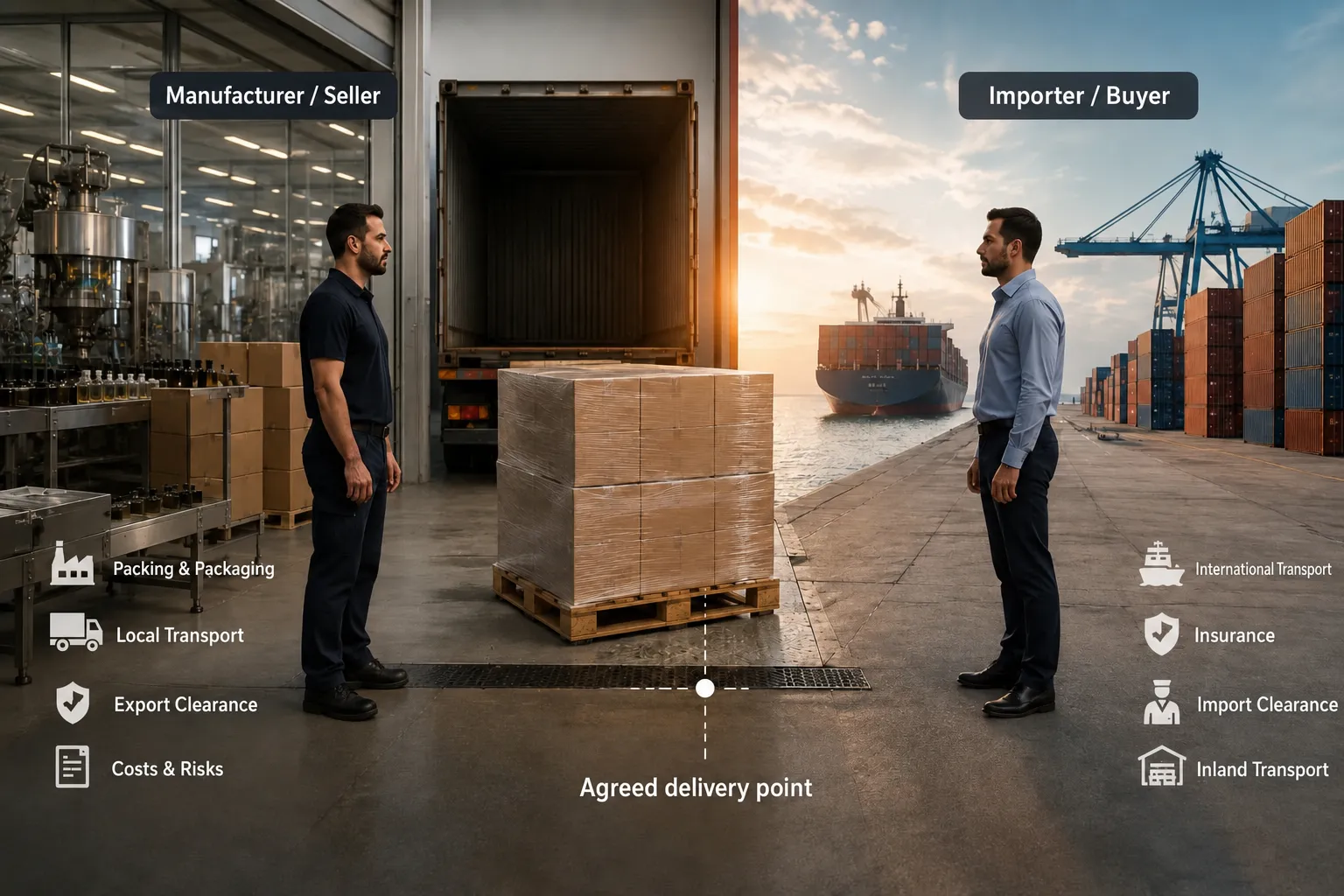
EXW vs FOB vs CIF vs DDP when importing perfume from Turkey
Each of these Incoterms changes how the shipment is managed and how responsibilities are divided between the perfume manufacturer and the importer. Before accepting a quotation, you therefore need to understand each term in its proper commercial and logistics context. The main differences are as follows:
EXW
Under EXW, the agreed delivery point is normally the specified location at the supplier’s premises. Choosing an EXW perfume arrangement means you are responsible for:
- Arranging collection of the shipment from the specified manufacturing location.
- Organizing loading and shipping operations where these are not covered by a separate agreement.
- Managing inland transport from the factory to the port or other point of departure.
- Handling the applicable export customs procedures and associated costs.
- Adding all subsequent logistics expenses to the factory price when calculating your total import cost.
The International Chamber of Commerce (ICC) notes that FCA (Free Carrier) may be more suitable for certain export transactions, particularly when delivery requires the goods to be loaded or handed over to a nominated carrier before the main transport begins.
FOB
FOB applies specifically to sea and inland waterway transport and must therefore be linked to a named port of shipment. In an FOB perfume Turkey transaction, responsibilities are divided between you and the perfume manufacturer as follows:
- Manufacturer’s responsibilities: Delivering the shipment to the named port, completing export clearance, and loading the goods on board the vessel.
- Importer’s responsibilities: Arranging the main ocean freight and contracting with the shipping line or freight provider.
- Transfer of risk: The risk of loss or damage transfers to you once the goods are on board the vessel.
When working with your own freight forwarder, make sure the quotation clearly states the port of shipment and the exact operational stage at which your forwarding agent will take over after the goods have been delivered on board.
CIF
CIF perfume shipping is based on an important distinction: the seller may continue paying certain transport costs beyond the point at which the risk of loss or damage has already transferred to you. The responsibilities are divided as follows:
- Ocean freight: The manufacturer books and pays for the main sea freight to the named destination port in your country.
- Insurance: The manufacturer obtains the minimum insurance cover required under CIF unless you request broader coverage.
- Transfer of risk: The risk of loss or damage transfers to you once the goods have been loaded on board the vessel at the port of shipment.
- Arrival procedures: You are responsible for import customs clearance, applicable duties, taxes, and other destination charges when the shipment arrives in your country.
When reviewing a CIF quotation, distinguish between the freight and insurance costs included in the supplier’s price and the point at which the shipment itself becomes your risk.
DDP
A DDP perfume arrangement places the broadest range of delivery obligations on the supplier among these four terms. However, whether DDP can be used effectively depends on the import and customs regulations in your destination market. Under DDP, the manufacturer is generally responsible for:
- End-to-end transport: Arranging transportation until the goods reach the agreed destination in your country.
- Import customs clearance: Completing the documentation and customs formalities required for the shipment to enter the destination country.
- Duties and taxes: Paying the applicable customs duties, import taxes, and other legally required charges.
- Transfer of risk: Bearing the transport risk until the goods are placed at your disposal at the named destination, ready for unloading.
Before agreeing to DDP, verify that the supplier is legally and operationally able to act as required for import clearance and tax or duty payments in your market.
How to calculate the final cost to import perfume from Turkey
An accurate calculation of the cost to import perfume from Turkey requires more than comparing the figures shown on supplier quotations. All offers should first be converted to the same financial basis so that you can move from the quoted factory price to the actual landed cost you will pay by the time the shipment reaches your selected destination. The calculation should include the following elements:
Cost elements based on the selected incoterm
Start by identifying the named delivery point in each quotation. Then separate the expenses covered by the manufacturer from those you will need to pay yourself. Depending on the selected Incoterm and shipping method, the final cost of importing perfume may include:
- Product value and basic manufacturing costs.
- Inland transportation within the country of manufacture.
- Handling and preparation charges at the export terminal or port.
- International sea or air freight charges.
- Cargo insurance against transport-related risks.
- Destination port and terminal charges.
- Import customs-clearance fees.
- Applicable customs duties and local taxes.
- Final inland transportation to your warehouse or designated delivery location.
Not every quotation includes all of these charges. The costs you pay separately depend on the selected Incoterm and the named place stated in the commercial agreement. This is why Incoterms for perfume imports must always be considered when comparing supplier prices.
Converting supplier quotations into a final landed cost
To compare suppliers fairly, use the same final destination for every quotation and calculate the total cost required to bring each shipment to that point. The following two simplified examples show how this works:
EXW quotation
- Factory price of the goods: 10,000
- Additional logistics costs to the warehouse: 2,400
- Total landed cost: 12,400
CIF quotation
- Quoted CIF price: 11,600
- Remaining costs to the warehouse: 600
- Total landed cost: 12,200
This comparison shows why a CIF quotation can ultimately result in a lower landed cost even though its initial quoted price is higher than the EXW offer. Once both quotations are calculated to the same final destination, the true cost difference becomes clear.
When you request a quotation from Jasmine, we clearly specify what our price covers and the agreed delivery point. You can then add any remaining logistics charges, customs duties, or local fees applicable after that point. Contact us on WhatsApp for a detailed cost breakdown.

How shipping method and delivery point affect the choice of incoterm
Choosing the right Incoterm does not depend only on the general shipping method. It also depends on how and where the goods are actually handed over during the shipment journey. Before including a term in the contract, you therefore need to match it carefully with the physical delivery point and the agreed transport arrangements. The most important scenarios are outlined below:
FOB and CIF for sea freight
FOB and CIF are intended for sea and inland waterway transport and should be applied according to the following principles:
- Scope of application: Both terms are designed specifically for sea and inland waterway transport.
- Completion of delivery: Delivery takes place once the goods are loaded on board the vessel at the agreed port.
- Delivery stage: FOB or CIF may not be appropriate when the goods are handed over before they are actually loaded onto the vessel.
- Named location: The port of shipment and the relevant delivery point should be clearly identified before the term is agreed.
For this reason, both FOB perfume Turkey shipments and CIF perfume shipping arrangements should be assessed according to the actual point at which the goods are delivered, rather than simply because the shipment includes an ocean-freight leg.
Container shipping when FCA preferable to FOB
The appropriate Incoterm may change when a container is handed over to the carrier before it is loaded directly onto the vessel. In such cases, the following points should be considered:
- Use FCA when the container is delivered to a freight terminal, container yard, or consolidation facility before vessel loading.
- Base the Incoterm on the actual handover point rather than only on the transport method used later in the journey.
- Do not treat FOB as the automatic choice simply because the main transport leg is by sea.
- Coordinate with your freight forwarder to confirm the exact handover point before finalizing the contract.
Technical requirements for shipping perfume
Some transport requirements depend on the technical characteristics of perfume products and the carrier’s own acceptance policies rather than on Incoterms for perfume imports. These requirements include:
- Informing the freight forwarder of the nature and applicable classification of the perfume shipment before confirming the booking.
- Checking the carrier’s acceptance requirements and applicable standards according to the transport mode and route.
- Avoiding the assumption that the selected Incoterm also covers the technical requirements for transporting perfume.
- Keeping commercial delivery responsibilities separate from the carrier’s operational and technical requirements.
Read also: Perfume Shipping from Turkey: The Best Options for Traders
How to choose an incoterm based on your importing experience and logistics setup
There is no single delivery term that works for every perfume importer. In practice, the most suitable option usually depends on how your logistics operations are organized and who will manage the shipment after the goods leave the supplier. Two common situations illustrate the difference:
Shipping with your own freight forwarder
If you already work with a freight forwarder capable of managing logistics from Turkey, you can retain greater control over the shipment. This allows you to:
- Select the carrier or shipping line that best suits your requirements.
- Negotiate freight and insurance rates directly.
- Arrange broader insurance coverage according to your needs.
- Manage booking dates and shipping schedules.
- Coordinate directly with the destination agent in the importing country.
In this situation, compare EXW perfume, FOB perfume Turkey, and FCA options according to the actual handover point and the selected transport method rather than choosing solely based on your level of importing experience.
Delegating shipping arrangements to the manufacturer
When you prefer the manufacturer to manage a larger share of the logistics process, you should evaluate Incoterms that extend the supplier’s responsibilities. The main options may include:
- CIF perfume shipping: The supplier arranges and pays for the main sea freight and required insurance to the named destination port, while you remain responsible for import customs clearance and destination procedures.
- DDP perfume: Your operational involvement is reduced significantly because the supplier manages delivery to the agreed destination, provided the supplier can legally and practically complete import clearance and pay the required duties and taxes in your country.
Do not choose an Incoterm simply because it makes shipment management easier. Compare it against the final landed cost and the exact point at which risk transfers from the supplier to you.
Before accepting any delivery term, verify the following points:
- The Incoterm is clearly stated in the quotation.
- Incoterms® 2020 is identified as the applicable version.
- The named port, place, or delivery point is specified clearly.
- The services and charges included in the quoted price are defined.
- The party responsible for arranging the main transport is identified.
- Insurance responsibility and the level of coverage are stated where applicable.
- The exact point at which risk transfers is clearly defined.
- Export and import customs-clearance responsibilities are specified.
- It is clear whether customs duties and taxes are included or excluded.
- The final landed cost of the shipment is calculated.
- The selected Incoterm matches the actual transport method and delivery point.
When discussing delivery terms with Jasmine, we explain the Incoterms that can be implemented within the scope of your perfume project and clarify what each quotation includes. You can then decide how much control you want to retain and which logistics stages will be managed by your own freight forwarder.

Jasmine: Select the supply term based on your shipping lan and final destination
At Jasmine Factory in istanbul, we put our long-standing experience in perfume manufacturing at your service to provide you with a high-quality product and a clear, well-planned shipping process that protects your investment. The success of your perfume project depends not only on product quality, but also on transparency in managing costs and logistics until the shipment reaches your warehouse. For this reason, we align the delivery term stated in our quotations with the actual shipping plan for your project, ensuring that each term is practical and suitable for your intended destination. Before we finalize the quotation, we therefore need you to specify:
- The destination country, city, or port.
- The expected shipping method for the order.
- Whether you already work with your own freight forwarder.
- The point at which you want to receive the shipment.
- Any specific requirements set by your freight forwarder or carrier for the selected route.
Based on this information, we state the applicable Incoterm for your perfume import, the named place or port, and the scope of our delivery obligations in the quotation. This allows you to know from the outset where our responsibilities end and where the arrangements managed by you or your freight forwarder begin.
If the destination or transport method changes before the order is confirmed, we review the delivery basis before issuing the final quotation so that it remains aligned with the revised shipping route.
Connecting supplier quotations with your distribution plan and final destination helps ensure a smoother movement of goods from the factory to the agreed location. To define the named delivery point and confirm that your order is ready to move forward to production, contact the Jasmine team to start planning your supply process.
Read also: A Trader’s Journey with a Turkish Perfume Manufacturer
FAQs about Incoterms for perfume imports
Can the Incoterm be changed after receiving a quotation?
Yes. The Incoterm can be changed by mutual agreement before the transaction is formally concluded. Changing the delivery term affects the supplier’s scope of responsibility as well as the quoted price and associated logistics costs. For this reason, the supplier should issue a revised quotation based on the new term rather than simply replacing the Incoterm code in the existing offer.
Do I have to use the same incoterm for every irder from the manufacturer?
No. An importer does not need to use the same Incoterm for every order. The most suitable option may change depending on shipment volume, transport method, destination, and whether you use your own freight forwarder for a particular order.
Does the incoterm determine how I pay the perfume manufacturer?
No. Incoterms for perfume imports do not regulate how or when you pay the manufacturer. Their purpose is to define delivery responsibilities and allocate transport-related costs and risks between the parties. Payment terms are established separately through the sales contract or other commercial agreements.