In the global fragrance market, speed-to-shelf isn’t just an advantage;it’s survival. If you are weighing private label vs white label perfume, you aren’t looking for a chemistry lesson; you are looking for a high-margin, low-risk strategy to launch your store-brand fragrance without the compliance nightmares that derail most startups.
At Jasmine, we’ve built this guide specifically for you – a retailer or a distributor- who demands a professional roadmap: from rapid rebranding to a signature exclusive line. We cut through the noise to show you the exact manufacturing workflows and B2B decision gates that turn “unbranded perfume for labeling” into a defensible brand asset that dominates the market.
Which perfume model fits your business now?
Use this quick chooser if you want a decision in under two minutes. Think in terms of SKUs, shelf speed, repeatability, and brand defensibility.
Choose White Label if you want to…
- Test demand fast with proven, ready-made scents and packaging (you add your branding).
- Launch a “core bestseller” assortment quickly and learn what your customers reorder.
Choose Relabeling/Rebranding Service if you want to…
- Rebrand an existing range (or unify multiple banners) while keeping the product stable.
- Move faster than full private label, but still manage the brand layer (labels, boxes, languages, barcodes) professionally.
Choose Private Label if you want to…
- Build a signature line with an exclusive scent identity that competitors can’t copy.
- Own a long-term brand asset (your margin story, your loyalty story, your differentiation).
Choose a staged “upgrade” strategy if you want to…
- Start with white label for speed, then upgrade the top sellers into private label once demand is proven.
Ready to move from idea to shelf? Send your brand concept and target market to Jasmine via WhatsApp and ask for the fastest route (white label, relabeling, or private label).
Decision signals to look at
Most buyers aren’t choosing “white label vs private label” in a vacuum; they’re trading off three real business levers:
- Speed-to-market: How fast do you need first stock for shelves or online listings?
- Control (product + brand layer): Do you only need your logo, or do you need control over concentration, olfactive direction, and presentation?
- Exclusivity & defensibility: Is your goal “a product under my name,” or “a brand asset only my business can sell”?
- Operational repeatability: Can your supplier support consistent batches, replenishment, and documentation as you scale?
- Compliance risk tolerance: Do you need a manufacturer who can support documentation and market-readiness processes (especially if you sell internationally)?
Also read: White Label Perfume Manufacturer for Fast Market Entry
Private label, white label, and relabeling/rebranding
Let’s define terms in fragrance-specific language, because perfume isn’t a generic commodity. What you choose changes how you manage scent identity, packaging execution, and market compliance.
White label perfume
White label is a ready-made product: pre-developed scent, standard bottle, and existing packaging formats, then you add your branding. It’s designed for speed and low complexity, especially when you want to test demand or expand assortment quickly.
Private label perfume
Private label is built around ownership and differentiation: a fragrance and presentation developed for your brand, with higher control over the scent direction and packaging identity. In Jasmine’s own framing, private label is the turning point for retailers who want exclusivity, stronger margins, and a brand customers return for.
Also read: White Label vs. Private Label Perfume: Key Differences
Rebranding
Relabeling is not a full product model by itself—it’s a service layer focused on the brand layer:
- Batch/lot coding approach
- Label files, box artwork, barcodes, languages
- Packaging hierarchy (value line vs premium line)
Where it becomes powerful: when relabeling is managed with the factory that controls production and documentation. Where it becomes risky: when it’s done DIY, after-the-fact, without traceability and market requirements in mind.
What does unbranded perfume for labeling usually mean in practice?
When buyers search unbranded perfume for labeling, they usually mean one of these two realities:
- Stock scents + your label (white label behavior): You choose from ready-made scents, apply your branding, and go to market fast. This is often the quickest path to an own-label fragrance when your priority is speed.
- Custom scent + your brand asset (private label behavior): You develop a distinctive fragrance direction and matching packaging identity—so your retailer brand perfume becomes defensible and harder to copy.
If your goal is a fast launch, stock-based labeling can work. If your goal is “a signature line, you’ll want a private label path or a staged upgrade plan.
Also read: Relabel Perfume Service for B2B Importers: Rebranding & Packaging
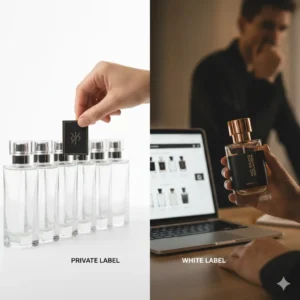
White Label vs Relabeling Service vs Private Label
Which model are you buying: product, brand layer, or a full custom line? Use the table below to map your business goal to the right manufacturing approach without guessing MOQs or timelines—those vary by project and market.
| Decision Factor | White Label | Relabeling / Rebranding Service | Private Label |
| What you’re really buying | Ready-made product | Brand/packaging layer execution | Custom line + brand asset |
| Uniqueness | Shared product base | Product may be shared; brand layer is yours | High uniqueness; built for your brand |
| Customization scope | Mostly branding/labeling | Labels/boxes/languages/SKU architecture | Scent direction + packaging identity (and broader control) |
| Exclusivity | Typically non-exclusive | Brand assets can be exclusive; product may not be | Designed for exclusivity and differentiation |
| Speed-to-market | Fastest (catalog-based) | Fast (depends on artwork/packaging readiness) | Longer (sampling + approvals + production) |
| Documentation support | Depends on supplier; ask early | Stronger when factory-managed | Typically strongest due to full project scope |
| Best for | SKU testing, quick range expansion | Rebranding, multi-banner retailers, compliance-first rollout | Signature collections, margin protection, long-term brand building |
Want the fastest path for your market and channels? Ask our team for a recommendation: white label, relabeling, or private label—based on your SKU plan and compliance needs.
White label vs Private label: Pros/cons
White label strengths
- Fast market entry with minimal development work
- Operational simplicity: easier to plan, quicker to list, easier to expand SKU count.
- Lower strategic risk at launch (because you’re not building from scratch).
White label limitations
- Low defensibility: similar scents can appear under multiple brands.
- Limited differentiation makes margin competition harder over time.
Private label strengths
- Differentiation: your retailer brand perfume becomes a brand asset, not just a product.
- Stronger loyalty: repeat purchase behavior attaches to your brand identity.
Private label trade-offs
- Requires clearer brand direction and more approvals (scent, packaging, compliance pack).
- Timelines depend on sampling, artwork, and production scheduling.
ِAlso read: Private Label Perfume Guide for B2B Business
How to build a store-brand fragrance line that sells?
As a retailer, to build a store brand fragrance line that performs, you don’t start with how many bottles?. You start with assortment logic and shelf roles.
1) Build a “core + seasonal” assortment
- Core best-sellers: your consistent volume drivers (the scents people reorder).
- Seasonal/niche drops: keep the line fresh, support gifting seasons, drive content and discovery.
2) Use a 2-tier packaging hierarchy (good / better / best)
- Value line: clean, simple packaging; easier entry price positioning.
- Premium line: stronger storytelling, elevated box design, more giftable presentation.
This helps you and all retailers control:
- Promo strategy
- Merchandising zones
- Margin mix and basket building
3) Match channel to product role
- Boutiques: fewer SKUs, stronger story, higher perceived uniqueness.
- Chains: reliable replenishment, consistent presentation, operational repeatability.
- Online: strong visuals and naming conventions; bundle sets; discovery kits.
So, use Jasmine’s Catalogs page to explore range directions and start building your core SKU shortlist before you request samples.
When relabeling makes sense and when it’s risky?
Relabeling makes sense when:
- You’re running multiple retail banners and need consistent brand architecture.
- You’re expanding into new markets and need multi-language labeling and market-ready packaging.
- You already know what sells, and you want to move quickly without changing the product direction.
Relabeling gets risky when:
- Labels are applied outside a controlled manufacturing workflow.
- Traceability (batch/lot logic), documentation, or market notification requirements are ignored.
- The brand layer promises things the product/records can’t support.
If you need relabel perfume service support, the safest route is to treat labeling and packaging as part of the factory-managed workflow, not a DIY afterthought.
Also read: Perfume Manufacturing: Wholesale and Private Label
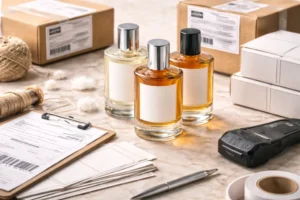
B2B workflow with a perfume manufacturer
This is the workflow most successful own label fragrance launches follow, whether you start from catalog-based scents or custom development.
Step 1: Brand brief (commercial, not “creative writing”)
A useful brief includes:
- Target customer and channel
- Price positioning (value/premium)
- Competitor shelf context (what you must look different from)
- Required SKUs and launch priority
Step 2: Scent direction (catalog or custom) + sampling
- White label route: shortlist from ready options.
- Private label route: define olfactive direction, then iterate with sampling until approval.
Step 3: Bottle/label/box coordination (where delays happen)
Manufacturing is rarely the slow part—approvals are.
You’ll align:
- Bottle format and closure
- Label dimensions and materials
- Box structure and print finishes
- Barcode + mandatory label elements (by market)
Step 4: Compliance pack + documentation (export readiness)
For global markets, documentation expectations vary. In Turkey-focused manufacturing requirements, Jasmine highlights GMP expectations and structured product documentation practices (including Product Information File concepts and notification requirements). You should verify what your market requires and ensure your manufacturer can support it.
Step 5: Production + quality checks + shipment planning
Once approved:
- Manufacturing follows controlled stages (formulation, aging, filling, packaging).
- Export/shipping planning depends on destination, labeling languages, and documentation.
If you want a smooth launch, ask Jasmine for the exact “idea → sample → artwork → production → shipment” checklist for your destination market before you finalize designs.
What should you prepare before contacting a perfume factory?
Bring this checklist to your first manufacturer call to get faster, more accurate answers:
- Initial SKU list: how many scents at launch + hero SKUs
- Packaging direction: bottle style, cap style, box finish level
- Target market(s): countries + channels (retail / online / distributor)
- Forecast logic: conservative first order + replenishment expectations
- Compliance expectations: what your retailers/marketplaces require
- Brand positioning: value / mid / premium and your “why buy us” story
- Product format: EDP/EDT preference, bottle size preferences (if known)
- Label requirements: languages, barcode standard, mandatory info by market
- Operational needs: dropshipping vs bulk delivery, multi-address distribution, etc.
- Scent direction: notes families you want (fresh, woody, gourmand, etc.) + references
Also read: Turnkey Private Label Perfume Manufacturing for B2B

How to choose the right perfume manufacturer for own-label projects?
Choosing the right supplier is less about promises and more about systems: repeatable quality, documentation support, and packaging execution.
What to evaluate:
- Manufacturing discipline & consistency: Ask how batches stay consistent over time and how quality checks are handled.
- Documentation and market-readiness support: For international selling, ask about the documentation they provide and what they can adapt for your market (requirements differ by country).
- Packaging capability (real-world execution): Can they coordinate bottles, caps, labels, and luxury boxes as one workflow—not separate vendors you manage?
- Communication and sampling workflow: Fast sampling and clear approvals reduce most launch delays.
Questions to ask to perfume supplier
| Area | Questions that reduce risk |
| Product & quality | How do you ensure batch-to-batch consistency? What checks happen before shipment? |
| Compliance & docs | What documentation can you provide for international selling (e.g., MSDS, IFRA-related compliance statements, export docs where applicable)? (Jasmine Perfumes) |
| Packaging | Can you support labels + boxes + bottle selection as a coordinated workflow? |
| Traceability | How do you manage batch/lot identification and records? |
| Sampling | What is your sampling/approval process before production? |
| Scaling | Can you support replenishment and SKU expansion without changing the product experience? |
For deeper selection criteria, Jasmine also outlines private-label manufacturing positioning and support from Turkey as an export-oriented base.
Also read: Leading Private Label Perfume Manufacturer in Turkey
Trust & compliance signals buyers should look for
Retailers and distributors don’t just buy perfume—they buy listing approval confidence.
Here are trust signals that protect your business:
- GMP-minded operations: clean production, controlled processes, consistent batches.
- Documentation readiness: ability to provide technical documents and export documentation where required.
- Packaging integrity: sealing, labeling accuracy, and box protection to reduce returns and damage claims.
- Traceability mindset: records that help you handle retailer requirements and customer issues professionally.
Jasmine also maintains a Certificates page you can review during supplier evaluation (always verify what’s relevant for your country and retail partners).
If your retailer or distributor approval process requires documentation, message Jasmine and request the compliance/documentation overview and available certificates for review.
Why is Jasmine built for B2B white label + private label fragrance launches?
Jasmine’s positioning aligns with what B2B buyers actually need: a clear path from concept to shelf, with packaging coordination and export-oriented support from Turkey.
Here’s how that maps to your options:
- White label route: ready-made, catalog-led options designed for speed and fast scaling.
- Private label route: concept support, custom fragrance development options, and packaging design support to build a differentiated line.
- Manufacturing reality: clear production stages (formulation, aging, filling, packaging) and a documented compliance mindset for market readiness.
If you’re exploring ranges now, start with Catalogs, then shortlist scents for sampling and brand direction.
If you’re ready to launch, the quickest next step is to share your market + SKU plan through the Contact page.
Also read: White-Label Perfume Manufacturer (Complete Guide)
Choosing private label vs white label perfume isn’t about picking a label—it’s about choosing the right business model for today and building the runway for tomorrow. White label helps you launch quickly and validate demand. Relabeling/rebranding helps you roll out a store-brand structure safely and consistently. Private label turns your top sellers into a defensible brand asset with stronger differentiation.
If you want the fastest, lowest-risk plan for your market, request Jasmine’s catalogs, shortlist your hero SKUs, and ask for a step-by-step sampling and packaging roadmap via WhatsApp.
FAQs about private label vs white label perfume
Is white label the same as unbranded perfume for labeling?
Yes. You choose ready-made products and apply your branding. If you need stronger exclusivity and differentiation, you’ll want a private label path (or a staged upgrade from white label to private label).
What’s the difference between relabeling service and private label?
Relabeling changes the brand layer (labels/packaging/artwork). Private label can also change the product itself—including scent direction and the overall exclusive concept—so you’re building a deeper brand asset.
Can retailers start with white label and later move to private label?
Yes, many businesses test demand with white label first, then upgrade best-sellers into a signature private label line for stronger differentiation and margin protection.
What should I prepare before contacting a perfume factory?
Your target market, brand positioning, scent direction, packaging style, compliance needs, and an initial SKU list—then request catalogs and samples to confirm product-market fit before production.