Launching a fragrance brand is not only about a great scent; it’s about reliable execution. Perfume contract manufacturing gives B2B brands a practical way to produce shelf-ready perfumes under their own name without owning a factory.
The key is choosing the right scope full-service vs partial-service, sending a clear brief, and locking approvals before production begins, so you avoid costly rework, label issues, or shipment delays.
What does perfume contract manufacturing mean?
In simple B2B terms, contract manufacturing of perfumes means a factory produces perfumes for your brand, based on your requirements and approvals. You own the brand and product direction; the manufacturer executes production.
Where it fits:
- You want to launch or scale without building manufacturing infrastructure
- You need a partner that can manage production + filling + packaging as a controlled workflow
- You prefer one accountable manufacturer over multiple disconnected vendors (formulator, filler, packer, printer, logistics)
What buyers commonly outsource in perfume contract manufacturing:
- Fragrance development or selection (depending on the model)
- Filling and production execution
- Packaging coordination (labels, cartons, pack-out accuracy)
- Quality checks that protect consistency across batches
- Export-readiness support, including documents and shipment preparation, as required by the destination.
Also read: OEM Perfume Manufacturer: Your Guide to OEM Perfume
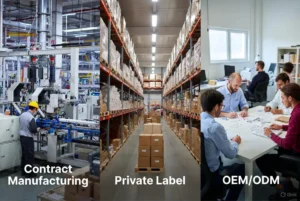
Contract manufacturing vs private label vs OEM/ODM
Buyers lose time when they choose the wrong model. The fastest way to remove confusion is to treat contract manufacturing as a scope umbrella, and then define what’s actually included.
Plain-language definitions
- Perfume contract manufacturing: A factory produces on your behalf—scope can be partial or full-service.
- Private label (often): A brand-led program where you choose or develop a product direction and brand it—usually implies more guided packaging and brand alignment depending on scope.
- OEM/ODM: Manufacturing frameworks used across industries. In fragrance, they typically describe who owns the brand and how much development/customization is requested.
Choose this if…
Choose contract manufacturing if you want:
- A defined production partner with clear responsibilities
- The flexibility to outsource only what you need (partial) or almost everything (full-service)
Choose private label if you want:
- A more guided “brand-ready” route with curated options and packaging pathways that fit your market and audience
Choose OEM/ODM if you want:
- A structured manufacturing partnership where the factory produces to your requirements and you run the brand and go-to-market
Where do relabel and white label fit?
If speed is the only priority, relabeling or white label can be faster pathways—but they are different models. Contract manufacturing typically implies broader control over specs and approvals, even when using ready directions.
ِAlso read: Private Label Perfume Guide for B2B Business
Full-Service vs Partial Contract Manufacturing
This table prevents the most common failure in third-party projects: expectation mismatch.
| Scope | Includes | You provide | Best for | Typical risks | Jasmine support notes |
| Full-service perfume manufacturing | Coordinated workflow from brief to shelf-ready packing (product direction support, packaging pathway, production/filling, QC gates, pack-out verification, export readiness support as needed) | Brand assets, market requirements, approvals/sign-offs | New brands, retailers, distributors who want one accountable partner | Slow approvals, unclear label requirements, late artwork changes | Factory-led workflow reduces handoffs and keeps milestones clear |
| Partial contract manufacturing | Production/filling (and selected add-ons you choose) | More management on your side: packaging sourcing, artwork coordination, specs control, sometimes logistics coordination | Experienced buyers with in-house packaging/procurement teams | Fragmented vendors, inconsistent specs, “missing owner” problem | Can be efficient when buyer has strong internal project control |
| Hybrid manufacturing | A mix: factory handles production + packing accuracy; buyer provides certain packaging elements or artwork | Shared responsibilities with defined checkpoints | Brands scaling quickly while maintaining control over certain brand elements | Gaps in responsibilities, unclear file versions, mismatched components | Works best with a written scope + approval checkpoints |
Want to avoid scope confusion? Message Jasmine via WhatsApp and ask for a full-service vs partial scope recommendation, based on your market, channel, and packaging level.
Also read: Private Label Perfume Guide for B2B Business
Who is perfume contract manufacturing best for?
Third-party manufacturing private label perfume projects typically succeed fastest when the buyer profile matches the model:
1) Importers & distributors
What they need:
- Stable supply and consistent SKU outputs
- Packaging that holds up in shipping and retail handling
- Documentation readiness aligned to destination requirements (confirm locally)
Why contract manufacturing fits:
- You can scale assortment and replenishment without building production capability.
2) Retail chains and store brands
What they need:
- Consistency, low complaint rates, reliable pack-out accuracy
- Clear approvals and repeatability across reorders
- Strong project management and accountability
Why it fits:
- A full-service partner helps the retailer move from brief to shelf-ready cartons with fewer vendors.
3) Brand founders and entrepreneurs
What they need:
- One partner that can guide the workflow, not just sell a product
- A clear roadmap (brief → sample → approvals → production → shipment)
- Practical support for packaging and label structure
Why it fits:
- Full-service perfume manufacturing reduces operational overwhelm and keeps decision-making structured.
If you’re an importer, retail buyer, or founder, send our team your market, channel, and target customer profile via WhatsApp, so the factory can propose the right scope and product path.
Also read: Turnkey Private Label Perfume Manufacturing for B2B

The full-service perfume manufacturing workflow
A reliable contract manufacturing project follows a controlled sequence. The exact cycle depends on your scope, approvals, packaging complexity, and destination needs, so avoid anyone promising a one-size timeline without reviewing your brief.
Phase 1: Project brief
- Define your market, channel, product direction, and packaging level
- Confirm label language and destination requirements you must verify locally
- Decide whether you need full-service perfume manufacturing or partial support
Phase 2: Sampling and approvals
- Scent direction approval (and documented final target)
- Packaging pathway approval (bottle/carton direction, label structure, artwork rules)
- Final SKU mapping (what goes into each carton, barcode placement, language versions)
Phase 3: Production and filling
- Manufacturing run aligned to approved specs
- Controlled line execution and batch tracking (process discipline matters for repeatability)
Phase 4: Packing accuracy + shipment preparation
- Pack-out verification (right SKU, right carton, right count, right labeling)
- Export readiness support, where applicable
Also read: Perfume Manufacturing: Wholesale and Private Label

Compliance & documentation for perfume buyers
Compliance is market-specific. A responsible manufacturer can support documentation readiness, but you still need to confirm the exact requirements for your destination market with your customs broker, importer-of-record process, or local regulatory consultant.
Common documentation requests in full-service perfume manufacturing projects
- Product and safety-related documents as required for your destination
- Export documents used in international trade (commonly invoice and packing list; others depend on shipment route and customs needs)
- Label structure and required language elements (market-dependent)
How to navigate smartly without guessing:
- Ask your broker what’s required before finalizing label artwork.
- Provide the factory with your destination requirements so the workflow is aligned early.
- Keep a single source of truth for label versions (avoid outdated files).
Request Jasmine’s Certificates plus a destination-oriented documentation discussion via WhatsApp so your procurement team can screen the project properly.
Also read: Leading Private Label Perfume Manufacturer in Turkey
How to choose the right Contract manufacturing of perfumes?
Choosing a manufacturer is a procurement decision, not a branding mood-board decision.
Use a scorecard that evaluates operational clarity and repeatability.
- Scope fit: Can they clearly define what’s included and what’s not?
- Sampling discipline: Do they structure sampling and approvals to prevent chaos?
- Packaging capability: Do they manage packaging pathways and artwork control responsibly?
- QC mindset: Do they explain checkpoints (label, pack-out, final verification) in plain language?
- Documentation support: Can they support export readiness and the typical paperwork flow (destination-dependent)?
- Export experience: Do they ask about destination constraints early?
- Communication: Are responses specific, fast, and process-driven?
- Repeatability: Do they talk about consistency across reorders and version control?
However, consider these red flags:
- “We can do everything” without defining scope
- No clear approval gates (everything is “flexible” until it becomes a problem)
- Vague answers about packing accuracy or label version control
- No interest in destination market requirements until the end

Partner with the best Third-party perfume manufacturer in Turkey
Partner with Jasmine Perfumes Factory as your trusted third-party perfume manufacturer in Turkey—built for B2B buyers who need fast, accurate, and repeatable execution. Our team runs perfume contract manufacturing as a controlled workflow, helping importers, distributors, retail chains, and private label brands move from brief to shipment-ready output with clear ownership at every step.
When you need full-service perfume manufacturing, we coordinate product direction, filling, packaging, QC checkpoints, and packing accuracy, so you reduce rework, avoid label or carton mistakes, and protect your rollout timeline.
Turkey is a strong base for contract manufacturing of perfumes, but results depend on a factory that manages scope and approvals professionally; that’s exactly how we support contract manufacturing private label perfume projects.
With Jasmine’s manufacturer-led process, third-party manufacturing private label perfume becomes a scalable route you can rely on—so you focus on distribution and growth while we handle production discipline and export readiness for your destination market.
If you want a manufacturer-led process that reduces handoffs and supports export readiness, start the conversation with Jasmine today via WhatsApp
FAQs about perfume contract manufacturing
What is perfume contract manufacturing in simple terms?
It’s when a factory produces perfumes for your brand based on your requirements, often including filling and packaging, depending on the scope. You sell under your brand; the factory executes production.
Is contract manufacturing the same as private label perfume?
Not always. Contract manufacturing is often an umbrella term that depends on scope, while private label commonly implies a more brand-driven route with guided packaging and product alignment.
What does full-service perfume manufacturing usually include?
Full-service typically covers a coordinated workflow from brief to shelf-ready packing, often including product direction support, packaging pathway coordination, production/filling, quality checkpoints, and export readiness support as required.
How do I start a third-party private label perfume project quickly?
Start with a clear brief (destination market, channel, product type, scent direction, packaging level, label language) and send it via WhatsApp. A strong brief reduces rework and speeds up correct scoping.