Whether you need deep OEM perfume production or faster ODM fragrance services, the choice dictates your margins. Choosing between OEM and ODM isn’t just a technicality; it’s a strategic move that dictates your margins and speed-to-shelf. For B2B importers, picking the wrong model can lead to supply chain bottlenecks or compliance nightmares.
This guide bypasses the theory to give you a practical blueprint: how to choose between OEM control and ODM speed, how to manage Quality Gates, and how to ensure your fragrance arrives shelf-ready and customs-compliant.
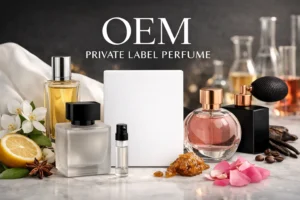
OEM private label perfume
OEM is often described as “custom manufacturing,” but B2B buyers should think of it as a responsibility split:
- You define the commercial direction (market, positioning, audience, channel rules).
- The factory executes formulation/scent work, packaging coordination, filling/packing, and release-to-ship under an agreed spec.
Jasmine defines OEM perfume as producing fragrances on behalf of another brand, where the client provides the vision (scent idea, bottle design, brand concept) and the OEM manufacturer turns it into a finished product.
Also read: OEM Perfume Manufacturer: Your Guide to OEM Perfume
What do you get in OEM perfume business?
- Brand control: scent direction and packaging are built under your brand, not the supplier’s.
- Differentiation: the goal is originality. At Jasmine, we explicitly frame OEM as building something original, not repackaging).
- Scalability mindset: OEM is usually chosen for a long-term line, not a one-off resale model.
OEM vs. relabel
If your priority is speed-to-shelf without changing the liquid, Jasmine positions relabel perfume service as a faster route, updating labels, cartons, and presentation on existing stock while keeping the fragrance unchanged.
Also read: Relabel Perfume Service for B2B Importers: Rebranding & Packaging
What’s included in OEM perfume production
“OEM perfume production” sounds simple, but buyers should force it into deliverables. Here’s a practical scope map you can use in your first conversation.
- Scent Development & Sampling in OEM Private Label
- Scent brief intake → sample proposals → feedback loops → final approval
Jasmine’s process content emphasizes samples and testing quality before moving to full production, and explains why buyers evaluate scent match, performance, and packaging component quality.
Also read: A Trader’s Journey with a Turkish Perfume Manufacturer
-
Packaging Design & Manufacturability for OEM
Packaging isn’t decoration—it must run on a line and survive shipping.
Jasmine’s manufacturing guide highlights bottle and luxury box manufacturing as a core part of brand-building, and describes a complete packaging service “from bottle design to luxury box creation” for private label.
Also read: Perfume Manufacturing: Wholesale and Private Label
-
Precision Filling & Batch Discipline in Perfume
Expect a defined packing method and checks around:
- Bottle/sprayer fit
- Label placement and adhesion
- Carton tolerance and protection
- Batch coding placement rules (varies by market/channel)
-
Quality Gates & Material Safety in Third-Party
A serious OEM project has approval gates before shipment—especially when importing.
Jasmine’s contact to shipment content notes that shipments include relevant quality certificates confirming the quality and safety of oils and raw materials used.
-
Export Readiness & Documentation for International
Requirements vary by destination. Your job is to share:
- destination country
- labeling language(s)
- importer documentation requirements
Then ask what Jasmine can supply as standard and what must be handled locally.
ODM private label fragrance
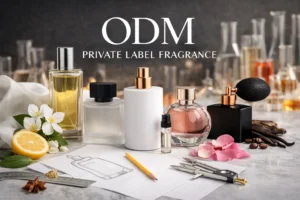
ODM is best understood as manufacturer-led development. Instead of you defining every detail from scratch, the factory brings a validated system: scent directions, packaging options, and production-ready workflows that reduce trial-and-error.
Even if buyers don’t use the word “ODM,” they often want the outcome: faster launch with fewer technical surprises.
At Jasmine, we don’t just provide ODM fragrance services; we act as your outsourced R&D department to ensure your brand stands out with a unique market edge.
When ODM private label fragrance win?
- You want to launch multiple SKUs quickly (assortment building is easier with factory guidance).
- You want validated packaging options that are already line-compatible.
- You’re building a first line and want a controlled path before investing in deeper uniqueness.
Where does Jasmine factory fit this need?
Jasmine describes preparing samples from existing perfume lines or custom-made formulations developed for private label, meaning buyers can choose a faster “selection” approach or a deeper custom route.
And when speed matters most, Jasmine’s relabel service is positioned as the most efficient launch route when a manufacturer aligns labeling, packing, and export documentation.
If you’re unsure whether you need OEM-level control or an ODM-style faster system, request our Catalogs first—then ask Jasmine to propose the best model based on your market and channel.
What’s included in ODM fragrance services (scope of work)
ODM fragrance services should feel like a launch system: fewer decisions, fewer vendors, and a clearer path to shipment-ready cartons.
What ODM fragrance services usually bundle
- A guided scent pathway (often using a curated library + controlled iterations)
- Packaging options that are already proven manufacturable
- A simplified approval structure (fewer open-ended choices)
We support both routes in practice: samples may be chosen from existing lines or developed as custom-made formulations for private label, depending on what you select.
How to avoid “sameness” in ODM-style projects
If you choose a factory-led system for speed, differentiate through:
- packaging finish strategy (matte/gloss/foil, premium caps, unboxing feel)
- brand story and naming architecture
- channel-ready SKU structure (retail vs wholesale assortment rules)
Where to start with Jasmine factory?
Jasmine provides downloadable catalogs (Jasmine, Luveal, All Brands, Cavayelo, Vilara). Asking for catalogs early helps you align scent direction and packaging expectations faster.
OEM vs ODM
Use this table to self-select in minutes—then confirm the final scope in writing.
| Model | Who owns formula/design direction? | Customization level | Speed-to-market | Exclusivity/IP | Ideal buyer | Typical risks | What to confirm in writing |
| OEM private label perfume | Buyer-led vision; factory builds to spec (Jasmine Perfumes) | High | Medium–Slow | Often higher potential | Distributors/brands building long-term assets | Scope creep, more approvals, packaging complexity | Approval gates, spec versioning, packaging responsibilities |
| ODM private label fragrance (factory-led system) | Manufacturer-led development framework | Medium–High | Medium–Fast | Varies by agreement | Retailers/founders scaling assortments quickly | “Sameness” risk if branding is weak | How you differentiate (packaging/positioning), any exclusivity terms |
- Choose OEM private label perfume when you want maximum brand control and long-term differentiation—and you’re ready for more approvals and deeper packaging decisions. Jasmine’s OEM guide frames this as fully customized under your brand, not repackaging.
- Choose ODM private label fragrance (factory-led development) when speed and reduced friction matter—especially when you need a scalable assortment and validated options.
- If speed-to-shelf is the priority and the liquid doesn’t need to change, consider the relabel route as Jasmine describes it (branding/packaging updates on existing stock).
The next step is always the same: start sampling with a clear brief, then lock packaging and approval gates before production.
Contact us and request the fastest recommended pathway (OEM vs ODM-style development vs relabel), plus the milestone roadmap from samples to shipment.
At Jasmine, OEM is fully customized under your brand (including custom bottles/boxes), while wholesale is pre-made under the supplier’s brand and usually lower MOQ—useful context when you’re choosing a model.
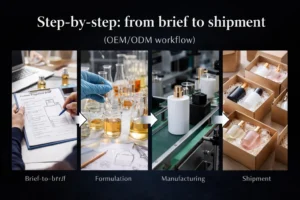
Step-by-step: from brief to shipment (OEM/ODM workflow)
This workflow matches how successful B2B projects run—without relying on vague promises.
- Discovery brief (buyer-led): Market, channel, SKU count, scent direction, packaging tier, label language(s).
- Scent pathway choice
- OEM-style: deeper custom direction
- ODM-style: guided selection + controlled development
Jasmine supports both “existing lines” and “custom-made formulations” in its sampling approach.
- Sampling + evaluation gate: Test scent match and performance expectations, and inspect packaging component quality.
- Packaging selection + proofs: Confirm bottle/cap/sprayer, carton structure, print proofs, barcode readability, and multilingual label layout.
- Pre-production confirmation: Final spec pack: approved sample reference + packaging references + label files + packing method.
- Production + in-process checks: Filling, packing, and line checks.
- QA release checkpoint: Ship only after final inspection/release logic is satisfied (agree what “pass” means).
- Export handover: Packing list/invoice coordination and any certificates your importer requests.
If you want a factory-led roadmap like this, message us via WhatsApp with your market + channel + SKU plan and request the “brief → sample → packaging → shipment” milestones for your project.
Manufacturer selection criteria for importers & distributors
Use this scorecard to compare suppliers objectively, without being distracted by glossy claims.
Supplier scorecard (Yes / No / Notes)
| Category | What “good” looks like | Yes/No |
| Sampling discipline | Clear sample versions + feedback loop | ☐ |
| Packaging integration | Line-compatibility guidance, not just design talk | ☐ |
| QA mindset | Defined checkpoints + shipment release step | ☐ |
| Documentation readiness | Will discuss importer requirements early | ☐ |
| Communication speed | Fast, structured answers to briefs | ☐ |
| Catalog depth | Can propose options aligned to your market | ☐ |
| Export awareness | Understands shipment durability + handover | ☐ |
Red flags (practical)
- “We can do anything” but no clear approval gates
- No clarity on who owns label compliance text for your country
- Packaging decisions treated as “later” (they should be integrated early)
Trust signals & export readiness for buyers to look for
Importers don’t just buy perfume—they buy repeatability + documentation + lower clearance risk.
Certificates and quality mindset
At Jasmine factory, we make a Certificates page that lists ISO 9001 and ISO GMP among its displayed certificates.
(Always verify what certificates apply to your specific product/category and what your destination market requires.)
Export readiness is a system, not a slogan
Jasmine’s manufacturing guide highlights the importance of GMP compliance as a manufacturing requirement and frames “market-ready” product expectations for retailers/importers.
Also read: Perfume Manufacturing: Wholesale and Private Label
What to request before you place an order
- Certificates relevant to production quality systems (as available)
- Your product’s documentation requirements list (share your country + channel)
- A packaging durability plan (especially for multi-touchpoint shipping)
- The factory’s “release-to-ship” checkpoint definition
Request our Certificates and Catalogs, then share your destination country so we can advise what documentation and labeling elements you must verify for your market.
FAQs about OEM private label perfume
What’s the difference between OEM and ODM in private label perfume?
OEM typically follows your detailed vision (you steer the product direction), while ODM uses a manufacturer-led development system to launch faster with validated options and fewer open-ended decisions.
Do I own the fragrance formula in an OEM private label perfume project?
Ownership and exclusivity depend on the agreement. Confirm in writing whether the formula is exclusive to your brand, in which markets, and how reorders are controlled.
What is the typical MOQ and lead time for OEM/ODM perfume orders?
It varies by customization level, packaging choices, production schedule, and shipment plan. OEM is often “typically higher” MOQ than non-custom routes because of customization requirements. Confirm exact MOQ and lead time with the factory after you submit your brief.
Can a factory help with export documents and shipping preparation?
Many manufacturers support export-ready packing and documentation workflows. Shipments include relevant quality certificates confirming the quality and safety of oils and raw materials used in production—share your destination requirements early so documentation and labeling align.