Bespoke perfume creation has become a practical growth lever for B2B brands that want control over product identity not just a fast launch. If you’re comparing bulk perfume production, exploring perfume formulation services, or considering fragrance blending services for quicker market tests, the real question is the same: Do you want a product you can scale and defend long-term?
In this guide by Jasmine, you’ll learn how bespoke fragrances are developed from brief to final formula, how to reduce risk during sampling and approvals, and how to move from small batches to mass production while protecting consistency, especially when selling across borders.
Why Custom Fragrance Development Matters in B2B?
The market is crowded with lookalike products and recycled scent profiles. When multiple sellers can offer something similar, price pressure rises, and customer loyalty becomes fragile. A brand-owned scent identity helps you escape that trap by making the fragrance part of what customers recognize and repurchase.
For B2B buyers, this matters because your competitive advantage typically comes from:
- Differentiation that customers can notice (and remember)
- Consistency that distributors can trust
- Repeatability so reorders match what the market already loves
B2B buyers don’t just need a nice-smelling product; they need a reliable business asset. When your fragrance strategy is built around ownership and controlled execution, you protect your rollout from common risks like inconsistent batches, packaging mismatch, or unclear approval steps.
Jasmine’s manufacturing content emphasizes structured stages (ingredients, formulation, aging, filling, final packaging) and treating production as a controlled workflow—not a single “mixing” step.
Bespoke perfume projects support growth because they allow you to build a scent platform you can expand:
- Launch a hero SKU, then add flankers (seasonal, intense, lighter)
- Tailor for channel needs (retail, wholesale, duty-free, online)
- Strengthen pricing power with a signature that isn’t easily comparable
Also read: Perfume Manufacturing: Wholesale & Private Label
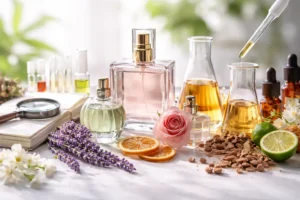
What Bespoke Perfume Creation Really Means for B2B Brands
In B2B manufacturing terms, bespoke means a fragrance developed against your brief through iterative sampling, then locked with defined specifications so it can be reproduced consistently at scale.
It’s not just custom as a label; it’s a process:
- A clear brief and scent direction
- Development versions and evaluation rounds
- Final approvals before commercial production
- Standards for consistency across batches
The perfume models are often confused, so here’s the practical difference:
- Ready-made (white label / off-the-shelf): choose an existing formula and brand it quickly.
- Private label (broad term): you sell under your brand; the scent may be selected or customized.
- Bespoke: the scent direction is built to your brief with refinement and controlled approvals.
In this regard, we recommend you to read our private label article that describes private label as developing an exclusive fragrance aligned with brand identity rather than simply buying a generic scent.
Bespoke becomes strategic not just nice-to-have when:
- You’re building a long-term brand and want a recognizable identity
- You need exclusivity for distributors/retailers
- You plan to scale into bulk perfume production after validation
- You want predictable reorders with fewer quality disputes
If speed is the only goal, a ready-made or relabel route can be quicker, but it won’t deliver the same defensibility as a bespoke identity.

Who Should Invest in Bespoke Perfume Creation?
Brand owners building a long-term fragrance identity
If your goal is to build a brand (not just list another SKU), bespoke is a strategic foundation. It creates a signature your customers can recognize and come back for.
Distributors launching exclusive product lines
Exclusivity reduces price competition. A bespoke direction can support distributor-only lines that strengthen negotiating power with retailers.
Retailers seeking private or signature collections
Retailers benefit when they control:
- Product identity (signature style)
- Packaging coherence on shelf
- Reliable supply for replenishment cycles
A bespoke approach supports stronger brand perception than generic alternatives.
How Are Bespoke Perfumes Developed?
Translating brand identity into an olfactory direction
A strong bespoke project starts with translating brand identity into decisions a factory can execute. The most effective briefs include:
- Target customer profile and channel (retail, wholesale, online)
- Scent family direction (fresh, floral, woody, amber, gourmand)
- Must-have notes and avoid notes
- Performance expectations (projection, intensity, climate fit)
- Packaging style and positioning (minimalist, luxury, bold, niche)
Ask your stakeholder to align on what success smells like before samples arrive, otherwise you burn time on conflicting feedback.
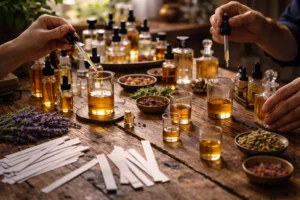
Scent design, evaluation rounds, and refinement
Bespoke development is iterative by nature. A clean evaluation process usually looks like:
- Directional options that interpret the brief in different ways
- Brand-aligned refinement (balance, sweetness, freshness, dry-down)
- Confirmation + performance alignment under realistic conditions
- Pre-production check that matches production conditions as closely as possible
To reduce unnecessary rounds, standardize how you test:
- Use the same method across decision-makers
- Evaluate at set time points
- Record feedback in consistent language
Final formula ownership and consistency standards
In B2B, the real value is not only the scent; it’s repeatability.
To protect consistency, your project should define:
- A gold standard reference sample for future batch matching
- Version control (no informal changes mid-production)
- Batch retention and traceability expectations
- A change-management rule if inputs must be adjusted
A professional approach is to clarify rights and exclusivity in writing as part of your manufacturing scope, contact our experts now via WhatsApp to get the optimal approach for your brand.
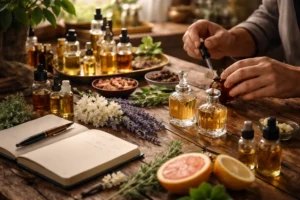
The Role of Perfume Formulation Services in Custom Fragrance Projects
Perfume formulation services are where creative direction meets manufacturing reality. A formula must be:
- Stable in its intended base and packaging
- Reproducible across batches
- Suitable for your destination market requirements
- Prepared for commercial filling, labeling, and shipment handling
B2B failures are often operational, not creative. Typical risk areas include:
- Juice stability over time and under heat/cold
- Compatibility with bottle/pump materials
- Unexpected changes in color/clarity (especially in clear packaging)
- Performance mismatch versus market expectation
A quality-minded manufacturer, like Jasmine, helps you plan the right checks for your product type and route-to-market—without skipping critical steps just to move fast. Contact us today!
If you’re outsourcing production, use a scope-first approach—our guide on Perfume Contract Manufacturing (Full-Service) explains how to lock approvals and avoid rework that causes label and shipment delays.
- Key differences in purpose, scale, and investment
- When bulk perfume production makes sense for B2B buyers
- How bespoke formulas can be scaled into bulk production
Bespoke Creation vs Bulk Perfume Production
Key differences in purpose, scale, and investment
Think of these as different business tools:
- Bespoke perfume creation: best for building an owned identity and long-term differentiation.
- Bulk perfume production: best for scaling a proven product reliably and efficiently.
Bespoke is about getting the product right. Bulk is about making the product repeatably at volume.
When bulk perfume production makes sense for B2B buyers?
Bulk perfume production is the right model when:
- Your market demand is validated and reorders are expected
- You’re supplying distributors who need reliable replenishment
- You want stronger cost structure through scale efficiencies
- Your packaging pathway and approvals are fully locked
This is where planning becomes a competitive advantage: forecasting, packaging coordination, and QC checkpoints protect your delivery dates.
How can bespoke formulas be scaled into bulk production?
The cleanest pathway is:
- Develop and approve the bespoke direction
- Validate in pilot runs and real-market feedback
- Lock the formula/specs and production method
- Scale into bulk with batch controls and reference standards
Fragrance Blending Services
Fragrance blending services typically sit between off-the-shelf selection and full bespoke development. They can involve:
- Adjusting intensity or balance (freshness vs warmth, sweetness vs dryness)
- Creating variations for limited collections
- Preparing test batches for market validation
- Aligning a selected direction with your brand positioning
Blending is powerful when you want speed and some level of differentiation.
Common B2B use cases include:
- Market testing before committing to large volume
- Retail exclusives or distributor-only lines
- Seasonal capsules or “drops”
- Regional tuning for climate or preference
Blending can reduce time-to-market while still improving distinctiveness versus generic options.
Blending vs full bespoke development: what you should know?
Blending isn’t less professional; it’s a different scope. The key is to define:
- What changes are allowed (notes, intensity, style direction)
- How many refinement rounds exist
- What approvals lock the direction
- How the final blend is standardized for repeat production
If your goal is a signature scent platform you’ll scale globally, bespoke usually offers stronger long-term control. Contact us today to discuss your goals
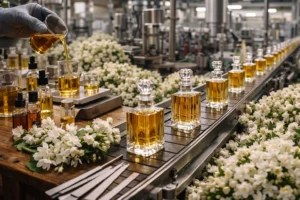
Scaling a Bespoke Perfume from Small Batches to Mass Production with Jasmine Factory
Moving from pilot runs to commercial volumes
Scaling is where many brands lose momentum—because the gap between “approved sample” and “shipped product” is filled with operational complexity.
A production-ready scale-up typically includes:
- Pilot run planning aligned with final packaging components
- Clear approval gates (juice match + packaging match + labeling match)
- A controlled workflow for filling, sealing, and final packing
Jasmine’s turnkey approach describes private label execution as a managed workflow that covers formulation direction, packaging selection, filling/labeling/packaging, and shipping from Istanbul, exactly the structure B2B buyers need to reduce handoffs.
Also read: Turnkey Private Label Perfume Manufacturing for B2B
Maintaining scent consistency at scale
Consistency is not a slogan. It’s a system:
- Retention samples for each batch
- Reference standards for scent matching
- Process discipline (mixing order, timing, controlled conditions)
- QC checkpoints before products leave the facility
This matters commercially because consistency reduces returns, protects distributor trust, and stabilizes reviews.
Production planning and quality control
For B2B buyers, production planning should connect:
- Demand forecast → production slotting → packaging readiness → shipping dates
- QC checkpoints at incoming components, in-process, and final inspection
- Clear responsibilities to avoid “it’s the other vendor’s problem”
If packaging is part of your differentiation strategy, Jasmine’s Perfume Bottle Manufacturer & Supplier page explains how bottle choices support branding and market perception.
Want to scale without surprises? Ask Jasmine for a production roadmap that connects pilot approvals, packaging selection, QC checkpoints, and shipment preparation for your destination market.
Export Readiness and Regulatory Compliance for B2B Buyers
Meeting international fragrance regulations
Regulatory needs vary by country and channel. Instead of assuming “one standard fits all,” treat compliance as a market-specific checklist you must verify (especially for labeling and restricted ingredients).
A smart compliance approach includes:
- Confirming destination-market requirements
- Aligning labeling language/format expectations
- Preparing documentation your importer or retail channel may request
Documentation, testing, and compliance support
Jasmine’s B2B materials explicitly position documentation and export readiness as part of full-service/contract manufacturing scope (depending on the program).
Because documentation needs vary, the best move is to ask targeted questions early:
- What documents can be provided for my destination?
- What stability/compatibility checks are recommended for my packaging?
- What labeling elements are required for my channel?
Preparing bespoke perfumes for global distribution
Export readiness is also physical:
- Packaging strength for long transit and stacking
- Seal integrity to prevent leakage
- Label durability against humidity and abrasion
- Carton and inner protection to reduce damage
When your first shipment arrives clean and shelf-ready, your brand looks stronger and reorder decisions become easier. Contact us to help you in this issue.
Also read: Perfume Contract Manufacturing: Full-Service Guide for Private Label
Why B2B Brands Partner with Jasmine Perfumes?
Here are the answer in details:
End-to-end manufacturing under one roof
Jasmine’s manufacturing content positions its offer as end-to-end: stages from formulation through filling and final packaging, built to produce market-ready products.
In-house formulation, blending, and production
Jasmine’s private label materials describe executing key steps in-house (blending, bottling, sealing) with quality control—important for consistency and speed.
Experience supporting international B2B clients
Jasmine describes shipping support and export/logistics assistance (customs, packaging requirements, labeling considerations) as part of its B2B support.
A manufacturing-first, brand-supportive approach
The strongest partners don’t just “sell perfume”—they reduce buyer risk through:
- Clear scope and approvals
- Controlled production discipline
- Packaging + documentation readiness
- A repeatable plan for scaling into bulk perfume production
Ready to brief your project? Use Jasmine’s Contact page to reach the team via WhatsApp/email and request the catalog and packaging options. (Jasmine Perfumes)
Also read: Leading Private Label Perfume Manufacturer in Turkey
FAQs About bespoke perfume creation
What is bespoke perfume creation in B2B terms?
Bespoke perfume creation means developing a fragrance based on your brand brief, through sampling and refinement, then locking the final formula with clear specs so it can be reproduced consistently for reorders and scale.
Is bespoke perfume creation the same as private label?
Not always. Private label can mean using an existing scent (or lightly adjusting it) under your brand. Bespoke is typically a deeper process: your scent direction is created and refined specifically around your identity, then standardized for future production.
Who should invest in bespoke perfume creation?
It’s best for:
- Brand owners building a long-term fragrance identity
- Distributors launching exclusive product lines
- Retailers creating signature collections
If you need defensibility and repeat purchase recognition, bespoke is usually worth it.
How do perfume formulation services support bespoke projects?
Perfume formulation services turn creative direction into a formula that can be manufactured reliably. That includes stability planning, consistency controls, and ensuring the fragrance performs as expected in the chosen base, packaging, and market conditions.
What information should I include in a fragrance brief?
A strong brief typically includes:
- Target customer + sales channel (retail/wholesale/online)
- Scent family direction (fresh/floral/woody/amber/gourmand)
- Notes you like and notes you want to avoid
- Performance expectations (intensity, longevity, climate fit)
- Positioning + packaging style (luxury, minimal, bold, niche)