Turning PPWR perfume packaging requirements into practical production specifications is one of the biggest challenges for any fragrance brand targeting Europe this year. Preparing early can help you avoid costly artwork changes, packaging rework, or product withdrawals later, while supporting smoother shipments into international markets.
Rather than getting lost in complex legal language, Jasmine breaks the requirements down into practical areas that can help you prepare your technical packaging file, including:
- How PPWR affects perfume packaging decisions
- Which perfume packaging components require review
- Key regulatory milestones between 2026 and 2035
- How to approve perfume packaging before production and printing
How PPWR affects sustainable fragrance packaging decisions
The impact of PPWR begins at the packaging selection stage, not after the finished product reaches the European market. To understand what needs to be reviewed, you should connect the scope of the regulation to every packaging component involved in filling, presenting, protecting, and transporting the perfume.
Regulation (EU) 2025/40 on Packaging and Packaging Waste, commonly known as the PPWR, entered into force on 11 February 2025, with its general application beginning on 12 August 2026. It covers packaging placed on the EU market and introduces requirements related to packaging weight and volume reduction, recyclability, material information, packaging labeling, and the responsibilities of economic operators placing packaging on the market.
These EU perfume packaging requirements can influence several decisions before the final pack is approved, including:
- Bottle material, weight, and coating or decoration
- Spray pump and cap components and how they are assembled
- Outer box dimensions in relation to the bottle
- Type of internal insert and whether it is actually necessary
- Label materials, adhesives, and printing inks
- Shipping carton dimensions and empty-space ratios
- Material and weight data supplied by packaging vendors
- Which party is responsible for approving the packaging and maintaining its technical file
The start of the packaging waste regulation 2026 does not automatically mean that every existing perfume pack must be replaced immediately. In some cases, the priority may be to complete missing supplier data, modify a specific component, or redesign packaging where unnecessary weight, excess space, or undocumented materials create a compliance concern.
For brands working toward sustainable fragrance packaging and more recyclable perfume packaging, early review of materials and design choices can reduce the risk of costly changes later and make perfume box compliance easier to manage before commercial production.
As packaging material requirements continue to evolve, understanding the design implications early can help reduce avoidable obstacles when products enter European markets. Talk to our team via WhatsApp now to discuss potential updates to your current packaging.
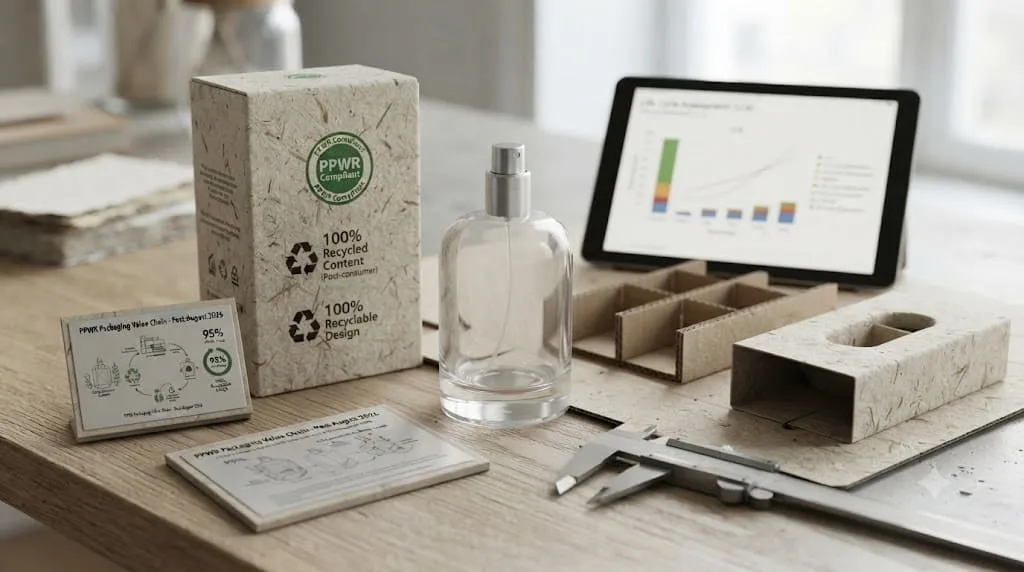
Perfume packaging components that require review and documentation
Reviewing perfume packaging does not mean looking at the bottle alone. It includes every component used to present, protect, group, or transport the product. These elements should be classified according to their function within the supply chain so that the data for each component can be documented separately.
- Sales packaging: bottle, spray pump, dip tube, gasket, collar, and cap.
- Grouped and transport packaging: shipping cartons, dividers, trays, and straps.
- Outer packaging: folding carton, insert, transparent window, cellophane, or any additional overwrap.
- E-commerce packaging: mailing box, void-fill materials, and additional protective materials.
- Labeling and finishing elements: labels, adhesives, inks, direct printing, coatings, and foil stamping.
The requirements for sales packaging, grouped packaging, and transport packaging can differ because each category performs a different function. A glass bottle, for example, may be recyclable, while the spray pump, cap, coating, or decoration can still affect the assessment of the complete packaging system.
For each component, document:
- Material composition
- Weight
- How the component is attached, assembled, or separated
- The relevant supplier documentation
This component-level approach is essential when assessing PPWR perfume packaging and planning more recyclable perfume packaging, since recyclability cannot always be judged by looking at the bottle alone.
Read also: Perfume Bottle Manufacturing: Design to Production & Filling
Timeline for applying PPWR perfume packaging requirements
Not all detailed EU perfume packaging requirements begin on the same date, even though the PPWR generally applies from August 2026. To make the transition easier to manage, the following timeline separates the initial requirements from later obligations.
| Date | Scope of Change | Packaging Area Affected | Recommended Action |
| 12 August 2026 | General application of the Regulation and the obligations effective at this stage | Packaging file and responsibilities of economic operators | Define responsibilities, collect component data, and organize documentation |
| 12 February 2028 | Reduce empty space in sales packaging to the minimum necessary | Outer box and internal insert | Measure empty space and document the protective function of packaging components |
| 12 August 2028 or the later applicable date | Introduction of packaging material-composition labeling | Packaging and labels | Prepare material data and follow the final EU specifications |
| 1 January 2030 or the later applicable date | Reduce packaging weight and volume and apply design-for-recycling criteria | All packaging components | Compare the current design with lighter alternatives that are easier to separate |
| 1 January 2035 or the later applicable date | Introduce recyclability-at-scale assessment | Packaging materials and recycling streams | Assess whether materials can be collected, sorted, and recycled in the target markets |
Some of these milestones depend on later implementing or delegated acts. For that reason, the version of the Regulation and any applicable secondary legislation should be checked before the final packaging design is approved.
Documentation to prepare for August 2026
By the time the general packaging waste regulation 2026 requirements begin to apply, your preparation should include:
- Identifying the manufacturer, brand owner, importer, and distributor
- Defining which party has authority to approve the final packaging design
- Preparing a complete list of packaging components
- Recording the material and weight of each component
- Collecting supplier specifications and test reports
- Reviewing environmental claims before they are used
- Assigning a packaging version number and maintaining a change log
- Defining who will retain the technical documentation and Declarations of Conformity
Article 15 requires the manufacturer to carry out the conformity assessment of the packaging, prepare the technical documentation, and issue the EU Declaration of Conformity where compliance has been demonstrated. The documentation retention period is five years for single-use packaging and ten years for reusable packaging.
Regulatory changes applying during 2028
The 2028 stage focuses on two practical areas:
- Reducing empty space in sales packaging to the minimum necessary to protect the product
- Using the EU packaging label for material composition once the relevant requirements become applicable
The practical step now is to start collecting reliable material data from suppliers. Avoid creating your own symbols or improvised packaging labels before the final European specifications are available.
Sustainability requirements for 2030 and 2035
- 2030: The focus moves further toward reducing packaging weight and volume and assessing packaging efficiency against design-for-recycling criteria. This can mean eliminating unnecessary layers, excessive walls, or other elements that do not perform an essential packaging function.
- 2035: The assessment expands to recyclability at scale, taking into account whether the relevant infrastructure in distribution markets can actually collect, sort, and recycle the packaging materials in practice.
For brands developing sustainable fragrance packaging, these later milestones mean that packaging decisions should consider not only appearance and product protection, but also material efficiency, separation, and real-world recycling performance.
Complete technical files and supplier declarations provide an important basis for reducing the risk of regulatory disruption, penalties, or shipment delays. Request technical support from our team to organize the required packaging documentation.
Read also: Perfume Development Timeline: From Concept to Shelf
Perfume packaging parts that need to be reviewed
Because each packaging component has a different function and a different impact on protection, weight, material separation, and recyclability, the review can be divided into three main areas.
Bottle, spray pump, and cap
Start with the bottle because it plays a central role in both product protection and packaging weight. Review:
- Glass type and bottle weight
- Wall and base thickness
- External coating or spray finish
- Foil decoration and direct printing
- Compatibility between the bottle neck and spray pump
- Drop, leakage, and transport test results
Do not reduce bottle thickness before testing the complete pack. A lighter bottle may require a larger insert or a stronger outer box, simply shifting the additional material elsewhere in the packaging system.
For the spray pump and cap, ask the supplier to provide information on:
- Materials used in the pump, spring, gasket, and dip tube
- How the collar is attached
- Materials used in the cap
- Presence of metal, magnets, or additional decorative components
- How the components can be separated
- Spray, closure, and leakage test results
These details can directly influence whether the final pack supports recyclable perfume packaging objectives under the broader PPWR framework.
Label, outer box, and insert
Do not treat the label as artwork alone. It is part of the packaging system and should be reviewed for:
- Label and adhesive materials
- Types of inks and varnishes
- Metallic finishes and foil-stamping details
- Their impact on material separation and recyclability
- Technical documentation supporting the materials used
For perfume box compliance, review:
- Box dimensions in relation to the bottle
- Amount of internal empty space
- The function of the insert
- Number of board layers
- Whether a window or additional overwrap is genuinely necessary
- Whether the design protects the bottle adequately during transport
You can remove layers that serve no clear function, but do not eliminate a necessary protective insert before testing the complete packaging system.
Shipping cartons and protective materials
Wholesale distribution and e-commerce involve different transport and handling conditions. Shipping cartons should therefore be assessed according to the actual logistics route, including:
- Outer carton dimensions
- Number of units and packing arrangement
- Orientation of the perfume boxes
- Type of dividers and trays
- Empty space between units
- Protective materials used
- Carton stacking strength
- Vibration, drop, and transport test results
Space filled with paper, bubble wrap, or air pillows still contributes to empty space within grouped, transport, and e-commerce packaging. A better approach is to optimize carton dimensions and unit arrangement first, rather than compensating for poor space efficiency by adding more void-fill material.
This approach supports both sustainable fragrance packaging and practical PPWR perfume packaging compliance by reducing unnecessary material while preserving the protection needed for the fragrance product throughout distribution.

How PPWR 2026 affects perfume packaging design
The Regulation does not prescribe one specific material or a single standardized format for perfume packaging. Instead, it requires brands to review recyclability, reduce unnecessary weight and empty space, reassess decorative finishes, and consider refill options where relevant.
Reviewing recyclability and component separation
When comparing two packaging designs, it is not enough to describe one as “more sustainable.” The assessment should be based on the structure of the packaging and how easily its components can be separated, taking into account factors such as:
- The number of different materials used
- How easily the cap, spray pump, and label can be removed or separated
- The impact of adhesives and coatings on the main packaging material
- The presence of metal components or magnetic parts
- Whether individual components can realistically be sorted
- Availability of technical documentation for the materials used
These points are especially important when developing recyclable perfume packaging, because a pack that appears simple visually may still contain multiple materials that complicate separation and recycling.
Reducing weight, volume, and empty space
The process starts by reviewing the function of each packaging component and testing any proposed changes before final approval.
A practical workflow includes:
- Identifying unnecessary layers or empty space
- Proposing a lighter or smaller alternative
- Preparing a sample using the revised design
- Testing protection, leakage resistance, and transport performance
- Comparing the effect of the change on filling, breakage, and cost
- Approving the version that provides the best overall balance
Do not assess the weight of the outer box in isolation from the rest of the packaging system. A smaller carton may allow more units to fit into each shipping case, while removing an insert without testing may increase breakage rates and returns.
Under PPWR perfume packaging requirements, packaging optimization should therefore be assessed as a complete system rather than as a series of unrelated components.
Reviewing luxury finishes and refill options
Sustainable fragrance packaging does not necessarily mean eliminating premium presentation. However, decorative elements should be assessed according to their function and their effect on packaging weight, separation, and recyclability.
Before approving a luxury finish, ask:
- Does the design genuinely require foil, metallic elements, or magnets?
- Could a similar visual effect be achieved through simpler printing or embossing?
- Does the coating interfere with separation or recycling of the underlying material?
- Can the supplier provide clear composition data for the finish?
- Can weight be reduced without compromising the intended product experience?
Refillability should not be treated as an automatic solution either. A refill system requires a bottle designed to withstand repeated use, a safe refill mechanism, and a practical commercial channel for supplying or managing refill units.
For brands working toward EU perfume packaging requirements, refill options should therefore be assessed as part of the wider packaging and business model rather than added simply as a sustainability claim.
Legal responsibility for perfume packaging in the EU market
Responsibility for perfume packaging in the EU market can be distributed across several parties. To manage this correctly, the roles of each operator should first be defined, then PPWR perfume packaging obligations should be separated from cosmetic product labeling requirements, while Extended Producer Responsibility (EPR) obligations should be determined for each country.
Defining the responsibilities of the brand owner, manufacturer, and importer
Packaging development, production, approval, and documentation responsibilities should be allocated clearly in the commercial agreement and product specification.
These responsibilities may include:
- Selecting bottle, cap, and carton suppliers
- Approving packaging design, materials, and finishes
- Reviewing environmental claims before they are used
- Maintaining the packaging file and supplier documentation
- Monitoring changes in materials or suppliers
- Implementing corrective action when a problem is identified
- Identifying which party imports the finished product into the European Union
One company may perform more than one of these roles, but each party’s responsibility should be documented before production is approved.
PPWR requirements vs. perfume label requirements
Before printing begins, two separate compliance tracks need to be completed:
- PPWR track: covers packaging materials, weight and volume, recyclability, packaging labeling, documentation, and environmental claims.
- Cosmetics compliance track: covers information such as the Responsible Person, nominal content, warnings, ingredient list, and fragrance allergens.
Although information from both regulatory tracks may appear on the same physical pack, they are governed by different requirements. Completing the PPWR perfume packaging review does not automatically mean that the cosmetic product label has been approved, and the reverse is also true.
For this reason, perfume box compliance should not be treated as a substitute for reviewing the legal labeling requirements of the fragrance product itself.
Who is responsible for packaging registration and EPR obligations?
Depending on the sales model and national rules, the responsible party may be the brand owner, importer, or distributor. The key question is which operator first places the packaged product on the market of the relevant EU country.
That party may be responsible for:
- Registering the packaging with the appropriate national system
- Reporting the quantities of packaging placed on the market
- Calculating packaging weights by material type
- Paying applicable fees or joining a Producer Responsibility Organisation where required
- Maintaining records of registrations and reports
Because EPR obligations may differ from one country to another, brands should not assume that one registration automatically covers every European market.
Clear allocation of regulatory responsibilities between the manufacturer, brand owner, and importer helps clarify accountability and can make compliance management more efficient. Contact our specialist team to discuss how packaging responsibilities should be allocated in your target market.
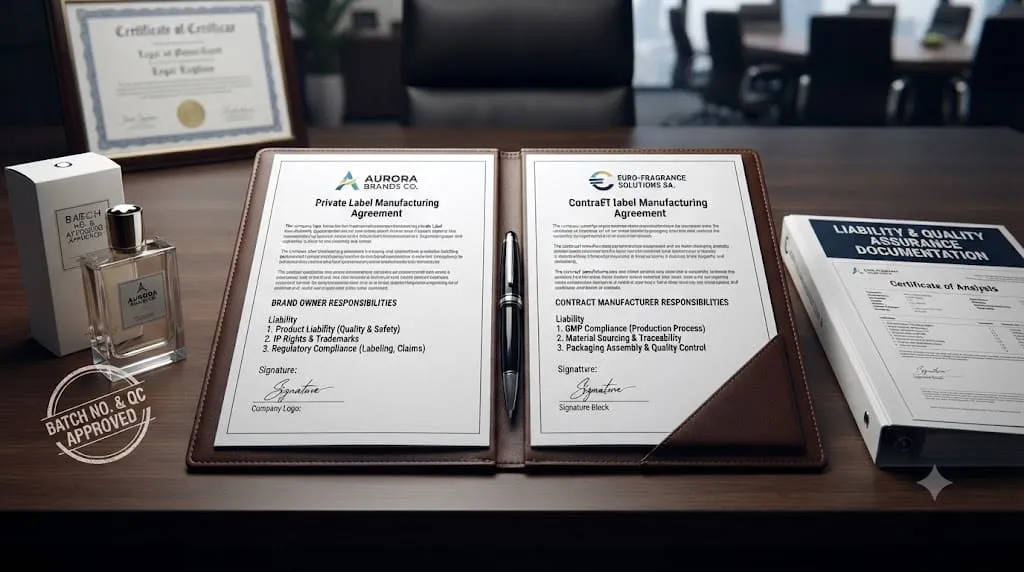
Official documentation required before approving perfume packaging
Material and Weight List
Create a component register that records the following details for each packaging part:
- Component name and internal code
- Approved supplier name
- Primary material type
- Actual weight
- Details of coatings or added materials
- Assembly and attachment method
- Whether the component can be separated mechanically or manually
- Percentage of recycled content, where such a claim is made
- Technical specification version number
- Date of the most recent data update
The register should cover inserts, cellophane, dividers, shipping cartons, and protective materials, not only the bottle and outer box.
A complete component register is particularly important for PPWR perfume packaging, because compliance assessment depends on the full packaging system rather than only its most visible parts.
Supplier declarations and test reports
For each relevant packaging component and production stage, request documentation such as:
- Material specifications
- Supplier declarations
- Details of coatings, adhesives, and inks
- Evidence supporting recycled-content claims, where applicable
- Spray and leakage test reports
- Drop and transport test reports
- Paper and board specifications
- Notification requirements for any change in material or supplier
Make sure each document relates to the exact component and version being used in production, rather than to a similar item or an older product previously supplied.
This level of traceability supports both EU perfume packaging requirements and the development of more recyclable perfume packaging by ensuring that material choices are supported by reliable supplier data.
Technical documentation and declaration of conformity
The technical file should explain what the packaging is, how it is intended to be used, and how its conformity has been assessed.
It should include:
- Description of the packaging and its intended use
- Drawings and dimensions
- Complete list of packaging components
- Materials and weights
- Applicable requirements
- Assessment methodology
- Test results
- Manufacturer details
- Version number and change history
- Declaration of Conformity, where applicable
- Evidence supporting environmental claims
For every environmental claim, clearly specify whether it relates to the bottle, outer box, another component, or the complete packaging system.
Avoid broad wording such as “sustainable” unless there is evidence identifying the specific environmental characteristic being claimed. This is especially important when communicating sustainable fragrance packaging, since general claims should be tied to measurable and documented packaging attributes.
Steps for final perfume packaging approval before production and printing
Before commercial production and printing begin, follow a structured approval process:
- Define the target market, distribution channels, and planned launch date.
- Allocate responsibilities clearly between the brand owner, manufacturer, importer, and any parties responsible for producer obligations.
- Create a complete packaging component list covering the bottle, spray pump, label, outer box, insert, and shipping carton.
- Collect supplier data, including material weights, technical specifications, declarations, and test reports.
- Review the design carefully for excessive weight, unjustified empty space, unnecessary finishing complexity, and problematic material combinations.
- Compare available options for modification, substitution, or redesign based on cost, order quantity, and performance.
- Carry out the required spray, leakage, and drop tests, while reviewing PPWR requirements and cosmetic product labeling requirements as separate compliance tracks.
- Approve production by fixing the technical specification version, reference sample, and change-control conditions before printing begins.
This final approval stage is where perfume box compliance should be confirmed alongside the wider PPWR perfume packaging file, so that box dimensions, material choices, inserts, decoration, and supplier documentation are all aligned before production.
A disciplined approval process can also make it easier to meet evolving packaging waste regulation 2026 requirements without forcing costly design changes after packaging has already entered mass production.
Common mistakes when reviewing PPWR perfume packaging requirements
A perfume pack may look suitable from a design perspective and still run into compliance problems because of one of the following mistakes:
- Assuming that all 2030 requirements already apply from August 2026
- Reviewing the bottle alone while overlooking the other packaging layers
- Using terms such as “sustainable” or “recyclable” without specific supporting evidence
- Accepting documentation that does not match the exact component or version used in production
- Changing a supplier after approval without updating the technical file
- Postponing EPR data collection until after the shipment has already been dispatched
- Reducing material thickness or protective performance without testing
- Automatically applying a 50% empty-space threshold to an individual perfume box
- Approving printing before both the PPWR file and cosmetic product label review are complete
- Treating ISO certificates as direct evidence of compliance with PPWR requirements
These errors can affect PPWR perfume packaging even when the packaging appears technically sound at first glance. For this reason, brands should review documentation, packaging structure, material claims, and regulatory timelines separately before production is approved.
They are also relevant when assessing perfume box compliance, particularly where box dimensions, inserts, protective materials, or environmental claims may need additional documentation.
Read also: Perfume Specification Sheet: 7 Costly Errors to Avoid
Jasmine: Your partner to define perfume export requirements for Europe
At Jasmine Factory in Turkey, we manufacture perfumes and fragrance products for brand owners, importers, and distributors from our facility in Istanbul. Our projects include private label solutions and product preparation tailored to the requirements of each project and target market.
When a project reaches the packaging stage, the packaging specifications should be reviewed separately before printing and commercial production are approved.
How can our factory help you review your packaging options?
The review begins with understanding the product type, target market, and proposed packaging design. Based on this information, we can discuss the available options within your private label project, while final legal and regulatory approval remains with the relevant parties responsible in the destination market.
Our private label perfume manufacturing service can include:
- Discussing the fragrance profile
- Selecting the bottle
- Finalizing labels and caps
- Developing the packaging design
- Filling and closing the finished product
- Preparing the shipment from Istanbul
When planning for EU perfume packaging requirements, identifying the destination market early also makes it easier to discuss packaging materials, dimensions, finishes, and supplier documentation before the final design is locked.
To begin discussing your packaging, send us:
- Perfume type
- Bottle size
- Target countries
- Sales channel
- An image of the current packaging design
- Packaging component list, if available
- Required level of customization
- Documents requested by the importer
Based on this information, we can discuss:
- Bottle and cap options
- Outer box and insert dimensions
- Label and printing coordination
- Sample preparation
- Final specification approval before production
- Product packing and shipping cartons
- The data that should be requested from packaging suppliers
This process can also support projects aiming for more sustainable fragrance packaging or recyclable perfume packaging, because materials and component structures can be discussed before the packaging design is finalized.
You can also review our catalogs to explore available product lines, then send your project specifications through the contact page.
Practical experience in managing private label projects and coordinating packaging can help reduce avoidable production changes and prepare your product more effectively for international markets. Contact our team to discuss your project and packaging requirements.

FAQs about EU PPWR perfume packaging
Do all PPWR requirements apply on 12 August 2026?
No. The Regulation generally starts to apply on 12 August 2026, while other requirements are linked to later milestones in 2028, 2030, and 2035, or to the entry into force of subsequent implementing or delegated acts.
For brands reviewing PPWR perfume packaging, this means the 2026 date should not be treated as if every later obligation becomes applicable at the same time.
Do I need to replace the perfume bottle and box immediately?
Not in every project. Start by reviewing the materials, weights, dimensions, coatings, component separation, and available documentation. Based on that assessment, you can determine whether the packaging only needs additional supplier data, a specific modification, or a complete redesign.
This review is particularly important for perfume box compliance and for brands moving toward more sustainable fragrance packaging and recyclable perfume packaging.
Who is responsible when a perfume is manufactured under a private label?
Responsibility depends on the respective roles of the brand owner, manufacturer, importer, distributor, and the party placing the packaged product on the market.
Before production begins, it should therefore be clear:
- Who approves the packaging
- Who maintains the technical documentation
- Who manages the applicable EPR obligations
Defining these responsibilities early is an important part of managing EU perfume packaging requirements for private label projects.
Does PPWR cover INCI information and fragrance alllergens?
No. The INCI ingredient list and fragrance allergen requirements fall under cosmetics legislation, while PPWR focuses on packaging-related obligations, including areas such as material use, packaging minimization, and recyclable perfume packaging.