As the new EU fragrance allergen labeling requirements approach their key implementation date after 31 July 2026, exporters to Europe may need to reassess their product documentation, artwork approval process, and packaging print workflows.
Understanding these rules is therefore both a regulatory and commercial priority, especially if you plan to export perfume to Europe. In this guide, Jasmine Factory walks you through the key points you need to review, including:
- Changes to EU fragrance allergen labeling
- Product types covered by the new requirements
- When allergens must be listed individually in the ingredient list
- Information required before packaging is printed
- Stock management and a pre-production compliance checklist
Changes to EU fragrance allergen labeling
The change involves far more than adding a few new names to a perfume label. It may require you to update the ingredient list, reassess the available label space, approve a revised version of the product documentation, and determine how previously printed or manufactured batches should be handled.
Regulation (EU) 2023/1545 expanded the list of fragrance allergens that must be individually declared when they exceed the applicable concentration thresholds in the finished cosmetic product. As a result, businesses reviewing EU perfume labeling requirements need to consider both the formula and the final artwork before approving production.
So, what should you do?
- Until 31 July 2026: Products that qualify for the transitional period may be placed on the market under the previous requirements.
- From 1 August 2026: Make sure products newly placed on the EU market comply with the updated EU fragrance allergen labeling requirements.
- Until 31 July 2028: Certain products that were already placed on the market may continue to be made available, provided they meet the conditions of the applicable transitional provisions.
The critical factor is the date the product is placed on the EU market, not simply the date it was manufactured or filled. Producing a fragrance before 31 July 2026 does not by itself prove that it was commercially placed on the EU market before the deadline.
To document the status of each batch, keep records of:
- Batch number and production date
- The formula version used
- The approved label version
- The date of first supply within the European Union
- Invoices and delivery documents
- A record of regulatory and artwork revisions
These records can be especially important when verifying a fragrance allergen declaration or updating a perfume INCI label under the revised requirements.
If you are planning to launch a fragrance after 31 July 2026 or export perfume to Europe, send our team via WhatsApp your target market, ingredient list, and packaging design so the manufacturing and labeling requirements can be reviewed before the artwork is approved for printing.
Read also: Importing Perfumes: Complete Checklist for Turkish Suppliers

Fragrance product types covered by EU labeling requirements
Do not start reviewing a fragrance label before confirming the product’s correct classification. Classification depends on the product’s intended purpose, where it is applied, how it is used, and the claims and information shown on the packaging. The first step is therefore to distinguish products intended for use on the body from products designed to fragrance rooms or vehicles.
Perfumes and body fragrance products
These products are generally classified as cosmetics and typically include:
- Personal perfume
- Eau de Parfum
- Eau de Toilette
- Body mist intended for use on the body
- Leave-on body splash
Once the product category has been established, you must determine whether it is a leave-on or rinse-off product, since the fragrance allergen declaration threshold differs between the two. Each fragrance or individual SKU should also be assessed according to its actual formula and ingredient concentrations rather than relying on one standard allergen list for every scent.
Home and Car fragrance products
Reed diffusers, room sprays, and car fragrances are not treated as personal perfumes because they are not intended for application to the human body. They therefore require a separate regulatory review covering:
- The product’s intended use
- Substances present in the formulation
- Instructions and claims shown on the packaging
- Required warnings
- The target market
- Regulations applicable to the product category
One important warning: never copy the ingredient list from a personal perfume and apply it to a home or car fragrance simply because the scent is similar. These product categories can differ substantially in their regulatory framework, substance concentrations, and routes of exposure.
So how do you determine the correct regulatory route?
Ask the following questions before beginning your label review:
- Is the product applied to human skin for a cosmetic purpose?
- Is it a leave-on product or is it removed by rinsing?
- Do the instructions on the packaging accurately reflect how the product is actually intended to be used?
If you are planning to export perfume to Europe and want to explore the product categories that could be considered for your project, review our perfume and fragrance catalogs, which feature a range of available product lines and brands.
Fragrance allergen declaration requirements in the ingredient list
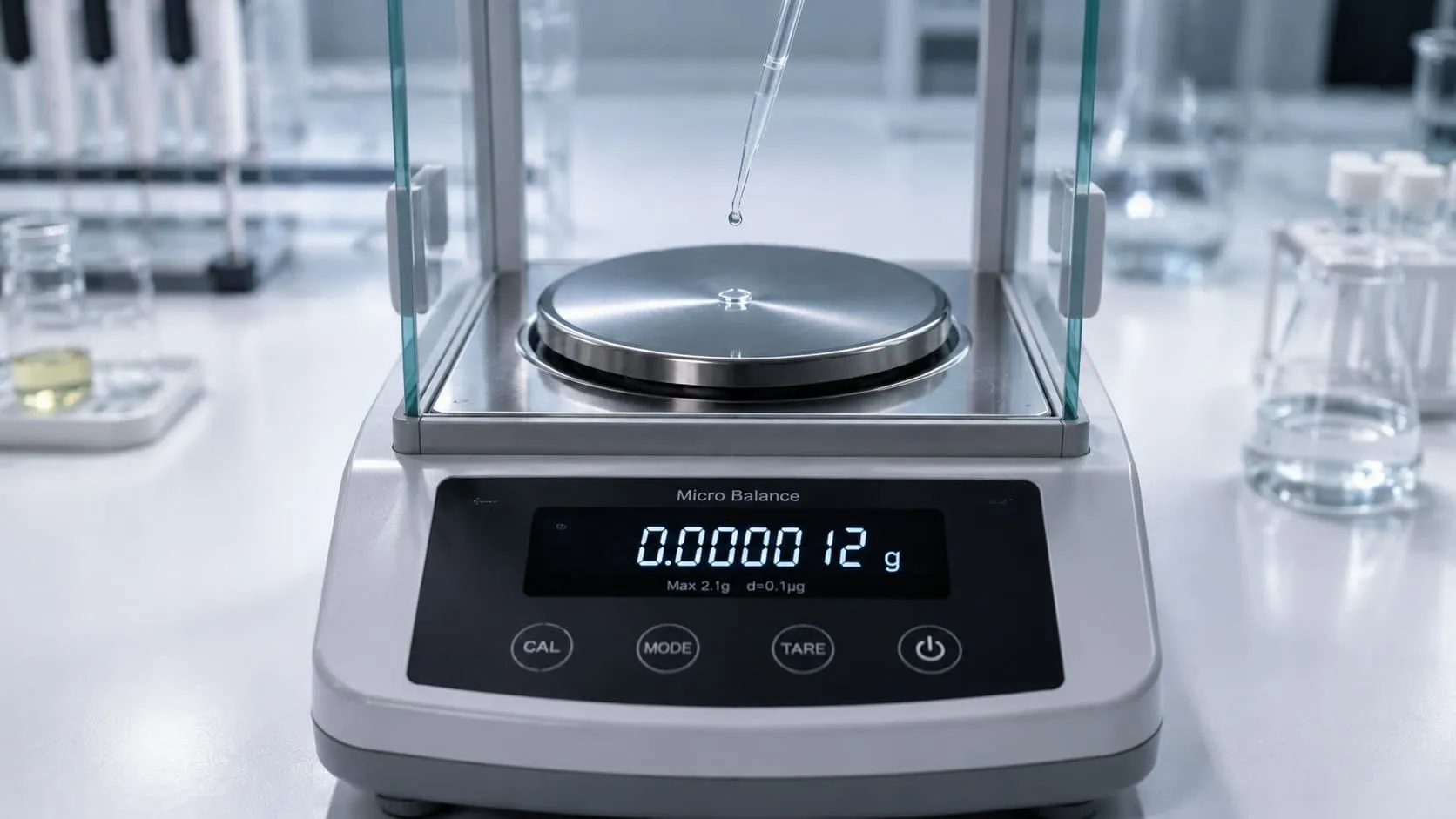
A fragrance allergen declaration is based on the concentration of the substance in the finished product. It is therefore not enough to confirm that an allergen is present in the fragrance compound itself; its concentration must be calculated after that compound has been incorporated into the final product formulation.
Under Annex III, an allergen must be listed individually when its concentration exceeds:
- 0.001% in leave-on products
- 0.01% in rinse-off products
These thresholds relate to declaration requirements. They do not mean that the substance is exempt from any applicable restrictions on use or concentration limits associated with the relevant product category.
So how can you determine whether an allergen exceeds the declaration threshold?
A supplier may state the percentage of an allergen in the concentrated fragrance compound, but this is not the same as its concentration in the finished perfume because the fragrance compound itself is used at a specific percentage in the final formulation.
You can calculate the finished-product concentration as follows:
Final concentration = allergen percentage in the fragrance compound × fragrance compound usage rate in the finished product
Consider this example:
- The fragrance compound contains 0.20% of the substance.
- The fragrance compound is used at 10% in the perfume formulation.
- The resulting concentration of the substance in the finished perfume is 0.02%.
This result exceeds the 0.001% threshold for leave-on products, which means the substance must be listed individually in the ingredient list. If the same allergen enters the formulation from more than one ingredient or source, all contributions must be added together before the final concentration is compared with the applicable declaration threshold.
This calculation is particularly important when preparing a compliant perfume INCI label under the updated EU fragrance allergen labeling framework and Regulation (EU) 2023/1545.
Is “Parfum” alone enough in the ingredient list?
No. The term Parfum identifies the presence of the fragrance composition, but it does not replace the requirement to individually list fragrance allergens that exceed the applicable declaration thresholds.
Listing these allergens also does not require disclosure of the perfume’s confidential formula. The label only displays the ingredient names required under the applicable EU perfume labeling requirements, while detailed percentages and the complete formulation remain within the product documentation.
Data required before preparing a perfume INCI label
INCI, short for the International Nomenclature of Cosmetic Ingredients, should only be prepared after the correct product and formulation data have been collected. To make the review process more reliable, it is useful to separate the required information into formulation data, fragrance compound documentation, and label approval records.
Formulation and product data
These details directly affect the ingredient list and fragrance allergen calculations:
- Product type and intended use
- Whether the product is leave-on or rinse-off
- Percentage of the fragrance compound in the finished product
- Formula number and version
- Target market and destination countries
- All ingredient sources that may contribute the same substance
Fragrance compound documentation
Request the following documents from the supplier:
- Fragrance compound code and version number
- An up-to-date fragrance allergen declaration
- Issue date of the declaration
- Percentages of substances subject to declaration
- An IFRA Certificate of Conformity for the intended use
- Safety Data Sheet (SDS), where required
- Technical Data Sheet (TDS), where required
INCI and label approval data
Before approving the packaging for printing, confirm that you have:
- An ingredient list linked to the approved formulation
- Completed fragrance allergen calculations
- The applicable official ingredient names
- The required safety assessment and supporting documentation
- The final approved label artwork
- Revision numbers for artwork and document control
You can use the relevant European database to verify ingredient names, while the applicable legislation should remain the final reference when confirming regulatory requirements.
When working on private label perfume manufacturing, Jasmine can help organize this information early in the process so that the formulation and perfume INCI label can be reviewed before production and packaging printing begin.
Read also: Perfume Manufacturing Quality Control Before Production
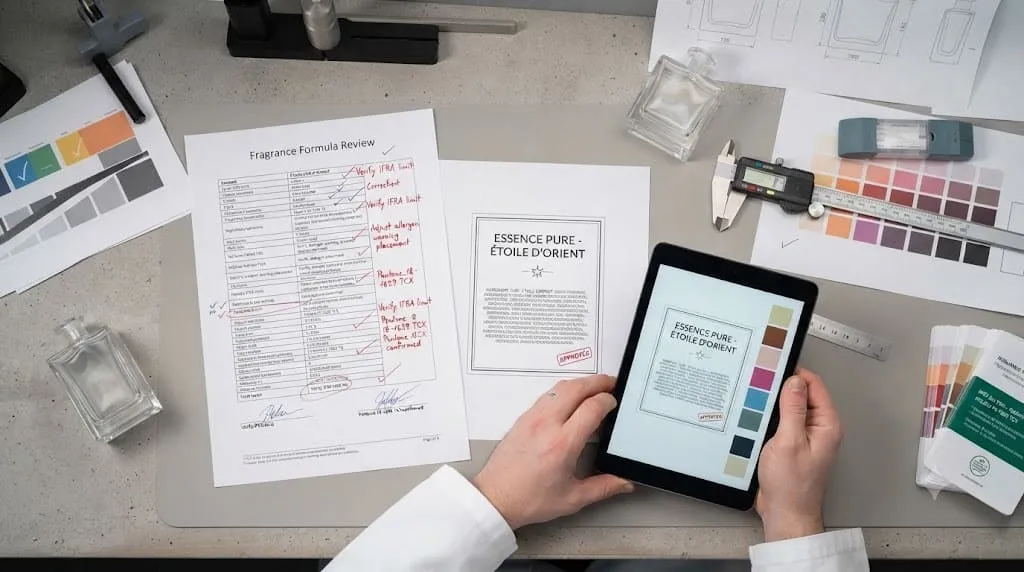
Steps for reviewing perfume formulas and labels before printing
The review should begin with the exact product that will actually be manufactured. Its formulation should then be linked to the supplier documentation, ingredient list, regulatory files, and final artwork.
Follow these steps:
- Confirm the product category, intended use, and destination countries to determine which requirements apply.
- Lock the formula number, formula version, and fragrance oil concentration before preparing the ingredient list.
- Verify that the fragrance oil code and version match the fragrance allergen declaration and the production order.
- Calculate each allergen concentration in the finished product by multiplying its concentration in the fragrance compound by the compound usage rate, then combine all additional sources of the same substance.
- Match the substances to the approved names used on the perfume INCI label and review any applicable conditions or restrictions.
- Confirm that the ingredient list reflects the formulation used in the safety assessment and other regulatory documentation.
- Review the accuracy of the list, required languages, text legibility, and available packaging space.
- Assign the artwork a clear version number and date, and do not begin printing before final approval.
- Repeat the review whenever there is a change to the supplier, fragrance compound, or its usage rate.
These checks are particularly important when preparing products under updated EU perfume labeling requirements and the broader EU fragrance allergen labeling framework.
Pre-printing checklist
Before ordering printed packaging, confirm that the following key approval points have been completed:
- The final formulation has been confirmed and assigned a clear version number.
- Supplier documentation matches the fragrance compound used in production.
- Fragrance allergens have been accurately calculated in the finished product.
- The ingredient list matches both the formulation and the product documentation.
- Required languages, label space, and information legibility have been reviewed.
- The final artwork version has received formal approval.
- A process is in place to review any later operational or formulation changes.
If any of these points remain incomplete, it is safer to delay printing the commercial packaging quantity. This is especially important when preparing to export perfume to Europe, where changes required under Regulation (EU) 2023/1545 may affect both the fragrance allergen declaration and the final label.
You can send our team your product type, target market, formulation status, and current artwork to discuss your private label project requirements before production begins.
How to handle existing stock and pre-printed packaging
The regulatory status of existing stock is not determined solely by its manufacturing date or product name. What matters is when the individual units were placed on the EU market.
To determine the appropriate action, assess each batch separately and link it to the documentation that proves its market status.
| Product Status | Placed on the Market? | Label Status | Records to Keep | Recommended Action |
| New product | No | Must comply with the new requirements before being placed on the market | Formula, allergen calculations, and artwork | Approve the label before production |
| Stock previously placed on the market | Yes | May qualify for the transitional period if its conditions are met | Evidence of market placement and distribution | Document the batch status before continuing sales |
| Stock manufactured but not yet placed on the market | No | The manufacturing date alone does not justify using the previous label | Production and inventory records | Assess whether relabeling or reprinting is required |
| Repeat production of an existing SKU | Only previous units | The new batch must be reviewed separately | Formula and new production order | Do not automatically reuse the previous label |
| Product with a changed formulation | Depends on each batch | The previous ingredient list may no longer be accurate | Change record and updated calculations | Update the perfume INCI label and artwork |
If the stock has not yet been placed on the market, or if its previous market placement cannot be documented, review whether relabeling or reprinting is required with the Responsible Person before distribution.
Clear evidence of the date on which a product was first placed on the EU market is therefore essential when determining how existing and stored batches should be handled under the updated EU fragrance allergen labeling requirements.
Contact us to discuss the status of your existing stock and determine the appropriate approach for previously printed packaging.
Read also: Relabel Perfume Service for B2B Importers: Rebranding & Packaging
Common fragrance allergen declaration mistakes that delay production
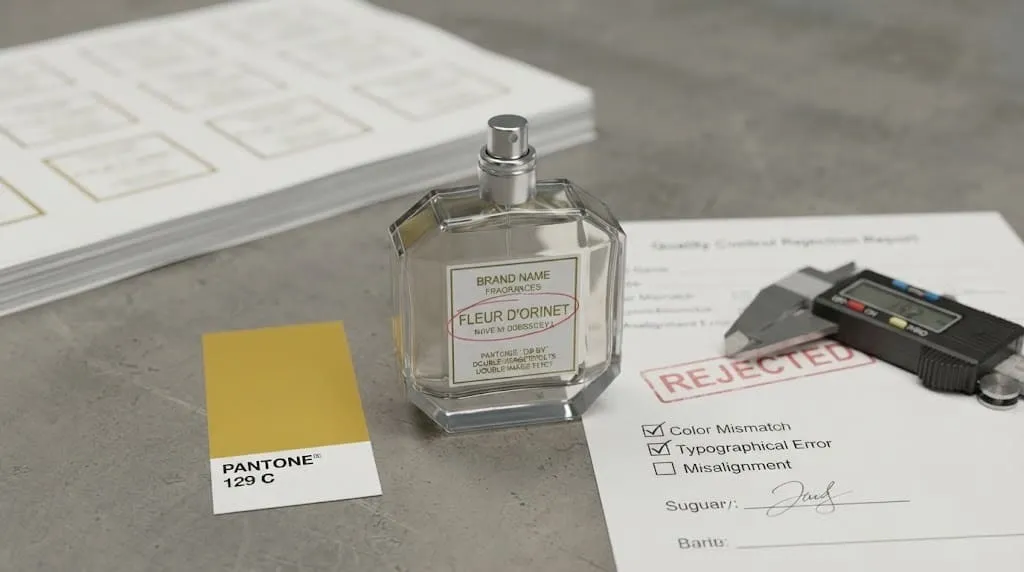
Production delays are rarely caused by one major error. More often, problems arise when the formulation, supplier documents, allergen calculations, and final artwork do not match.
Some of the most common mistakes to avoid include:
- Approving the artwork before the formula is finalized. Avoid this by locking the formulation before label approval.
- Changing the supplier or fragrance compound usage rate without repeating the review. Allergen calculations should be updated whenever either changes.
- Treating the IFRA Certificate as sufficient for label approval. An IFRA Certificate does not replace allergen calculations, the safety assessment, or other applicable EU perfume labeling requirements.
- Using an outdated or mismatched fragrance allergen declaration. Prevent this by matching the fragrance code, version number, and document date to the production order.
- Ignoring other sources of the same allergen. The contribution of a substance from all formulation sources must be combined before its final concentration is assessed.
- Using the same label for a personal perfume and a home fragrance product. Each product must be classified and reviewed independently.
- Confusing the manufacturing date with the date the product was placed on the market. Keep evidence showing when the product was first commercially placed on the EU market.
- Failing to maintain version control. At Jasmine Perfumes, this can be managed by using a consistent revision number across the relevant formulation, documentation, and artwork files.
- Calculating allergens only within the fragrance oil. The calculation must be based on the allergen concentration in the finished product after the fragrance compound has been incorporated at its actual usage rate.
Avoiding these errors becomes especially important when preparing products under Regulation (EU) 2023/1545, as an inaccurate fragrance allergen declaration can affect the ingredient list, artwork approval, and the ability to export perfume to Europe without unnecessary production delays.
How to prepare a perfume manufacturing order for the European market with Jasmine
At Jasmine Factory in Turkey, we work with brand owners, importers, and distributors to develop perfume and fragrance projects according to the requirements of each target market. Our process brings fragrance selection, bottle and packaging choices, artwork, filling, and packing together within one coordinated manufacturing workflow rather than managing each element separately.
The clearer your project information is from the beginning, the easier it becomes to identify suitable options before the formulation, packaging, and production are approved.
When you plan to export perfume to Europe, the destination market and product requirements should be defined before the fragrance and packaging are finalized. Doing so can reduce the risk of having to revise the ingredient list or packaging artwork after the project has already moved into production.
Through our private label service, your project workflow may include:
- Discussing the desired fragrance profile
- Selecting the bottle and cap
- Coordinating the label and packaging information
- Designing the outer packaging
- Filling and packing
- Preparing the shipment from Istanbul
Jasmine does not replace the Responsible Person, Safety Assessor, or any competent authority responsible for final EU compliance approval. However, identifying the intended sales market from the outset helps align manufacturing and packaging decisions with the documentation that will later be subject to final regulatory review.
To help us understand the scope of your project and its current stage, send us the following information:
- Target country or countries
- Product type and intended use
- Expected order quantity
- Number of fragrances or SKUs
- Bottle size
- Desired fragrance profile
- Whether an existing formula is available or a new fragrance needs to be developed
- Fragrance compound concentration, if already defined
- Status of the fragrance allergen declaration
- Status of the INCI list
- Status of the packaging and label artwork
- Whether you have existing stock or previously printed packaging
- Target launch date
This information helps determine whether your project is currently at the fragrance development, sampling, packaging approval, or final perfume INCI label preparation stage before production.
Send us your target market, product type, expected quantity, and the current status of your formulation and packaging. Jasmine’s team can then discuss a manufacturing route suited to your project stage and intended sales destination, while final regulatory approval remains with the relevant parties responsible for compliance in the European Union.
Read also: Private Label Manufacturing Agreement for Perfume Brands
FAQs about fragrance allergens
Do all fragrance allergens have to be listed on the packaging?
Not necessarily. A fragrance allergen declaration depends on which substances are present in the formulation, their concentration in the finished product, the product category, and the regulatory requirements that apply to it.
Under EU fragrance allergen labeling rules, substances that exceed the applicable declaration thresholds must be considered individually in the ingredient list.
Is an IFRA certificate enough to approve perfume labels in Europe?
No. An IFRA Certificate supports the assessment of fragrance compound use against the relevant IFRA Standards, but it does not replace fragrance allergen calculations, the required safety assessment, or a review of applicable EU perfume labeling requirements.
For products affected by Regulation (EU) 2023/1545, the updated allergen declaration requirements must also be considered when preparing the final label.
Does the deadline depend on the perfume manufacturing date?
No. The manufacturing date alone is not decisive. You need to determine whether the relevant units were actually placed on the EU market and retain documentation that supports their market status.
This distinction is especially important when assessing transitional arrangements under the updated EU fragrance allergen labeling requirements.
Does the label need to be reviewed again if the fragrance oil changes?
Yes. A new fragrance oil, supplier, or usage rate can change the concentration of individual substances and may therefore affect both the fragrance allergen declaration and the perfume INCI label, even when the product name and packaging remain unchanged.