Protective inserts, dividers, and shipping cartons work together to absorb impact and protect perfume bottles from breakage during transport. Conducting standardized transport tests before approving the final packaging helps protect your investment—and that of other brand owners and importers—from the risks associated with international shipping.
In this guide, we at Jasmine explain how perfume packaging transport testing can simulate real shipping conditions before export. The process covers several key areas:
- Preparing perfume packaging for transport testing
- How to protect perfume bottles and secure units inside a perfume export carton
- Performing a perfume box drop test and shipping-carton drop test
- Conducting a carton vibration test and assessing product stability during transport
- Evaluating how shipping heat affects perfume bottles and packaging materials
How to prepare perfume packaging for transport testing
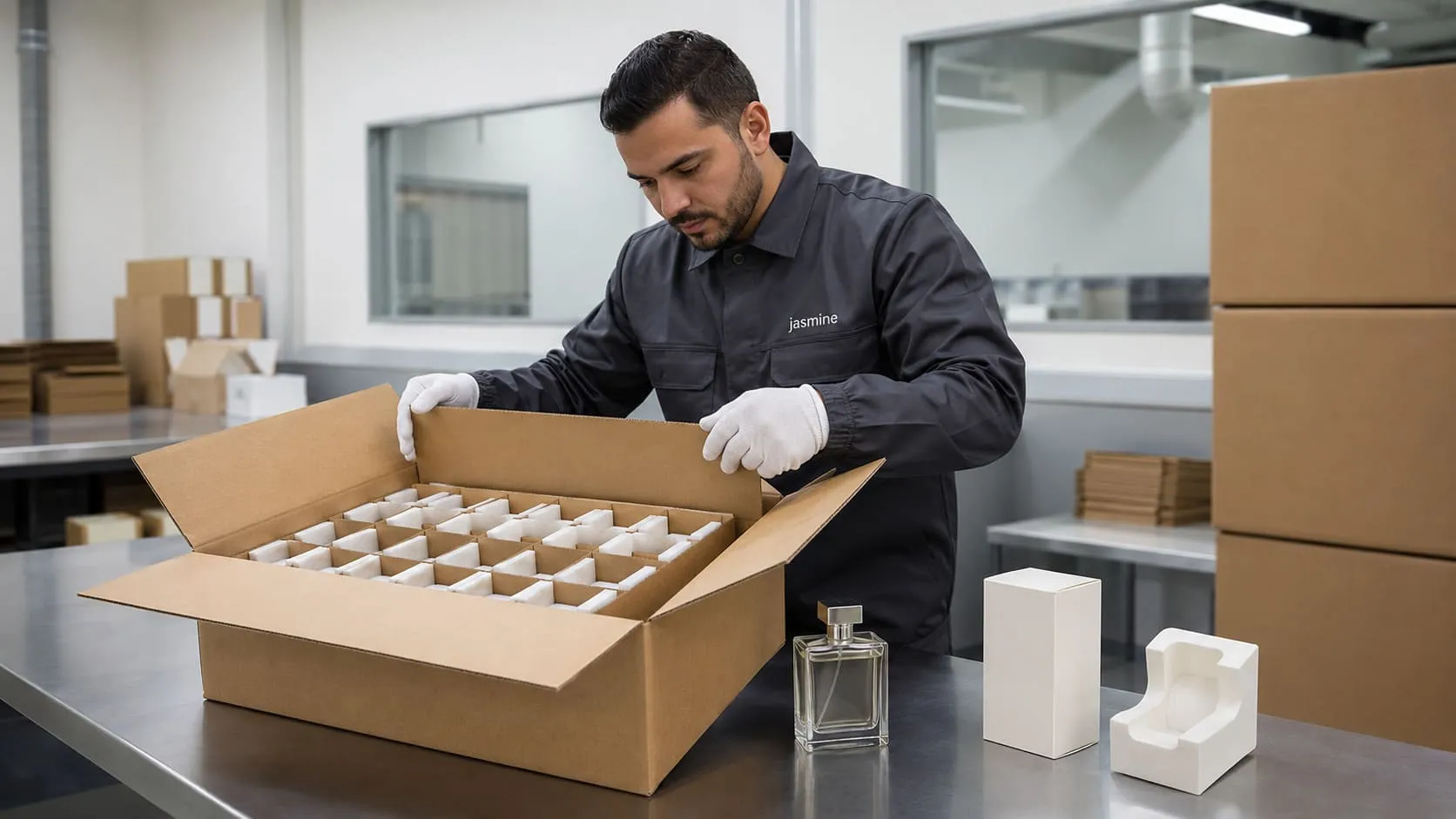
The test sample should match the final packaging configuration intended for the actual shipment, because the reliability of the results depends directly on the packaging materials and the way they are assembled. Preparation therefore begins by identifying every component that will be included in the test:
- The final perfume bottle used for the product.
- The individual retail box.
- The internal insert or protective cushioning.
- The dividers placed between individual units.
- The number of units packed inside the perfume export carton.
- The orientation and arrangement of the units.
- The specifications of the outer shipping carton.
- The method used to close and secure the carton.
Before perfume packaging transport testing begins, you should define the commercially acceptable level of damage for your product, especially when the retail box will be displayed immediately after arrival. We then confirm all bottle and packaging components intended for full production before preparing the shipping test sample. Testing the compatibility of the perfume formulation with the bottle, gaskets, and closure system is a separate assessment.
Using test samples that accurately reflect real export conditions is the first step toward reducing shipment damage and helping protect perfume bottles from breakage. Consult Jasmine’s experts to define the specifications of your test sample and confirm that it is ready for standardized transport testing.
Read also: Perfume Manufacturing Quality Control Before Production
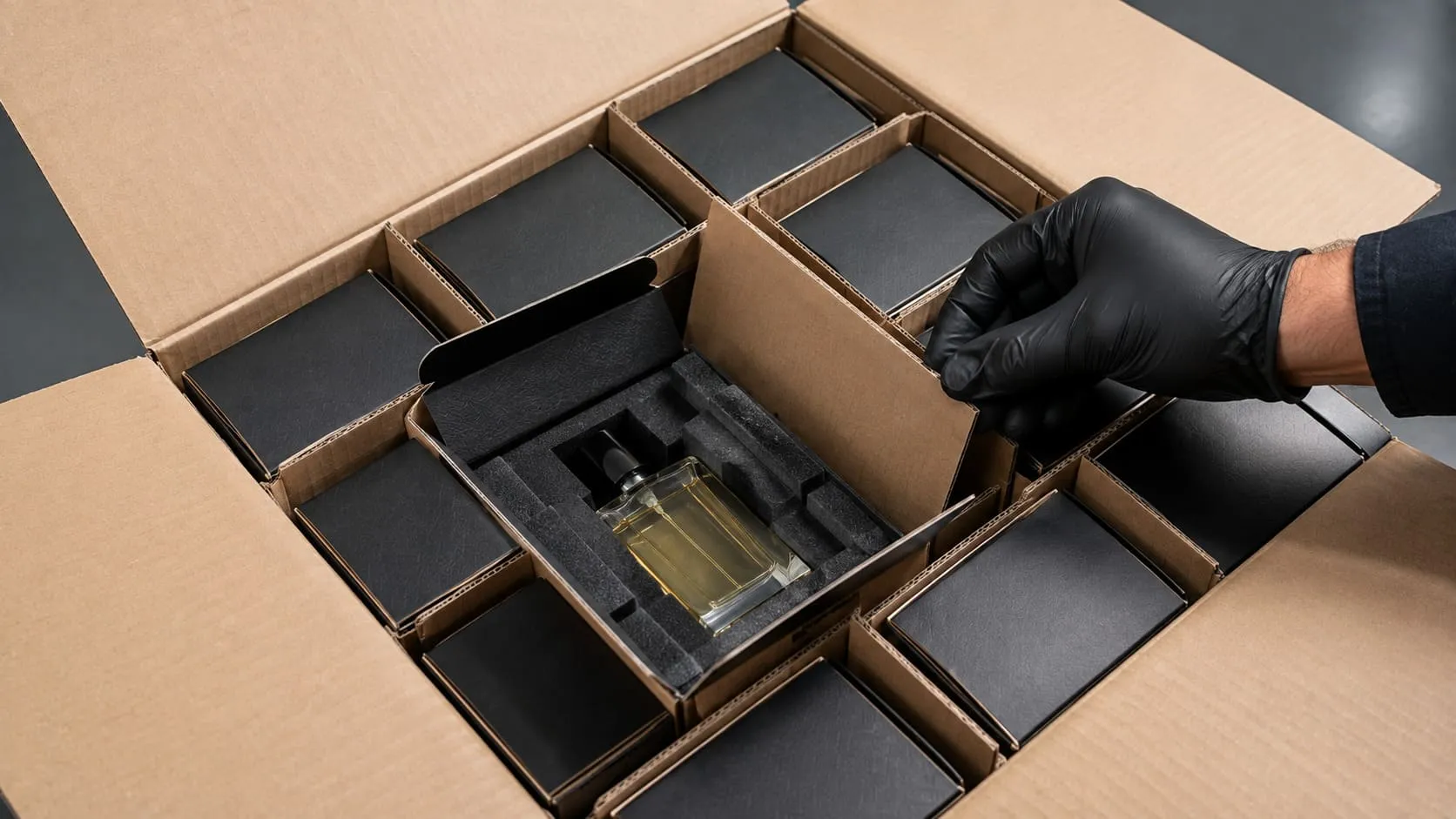
How to protect perfume bottles inside a perfume export carton
High-quality packaging materials alone are not enough to protect perfume bottles unless all packaging components work together effectively during transport. For this reason, the protection system should be reviewed first at the individual package level and then at the perfume export carton level as follows:
Securing perfume bottles and protecting contact points
The bottle, retail box, and internal insert are evaluated together to confirm that the securing method can be applied consistently during packing. The assessment should consider:
- The amount of bottle movement inside the retail box.
- Any empty space surrounding the bottle.
- The position of the insert or other protective components.
- Contact points between the glass bottle and surrounding materials.
- How pressure is transferred to the walls of the retail box.
- Whether the insert accurately fits the dimensions of both the bottle and the box.
Arranging boxes and dividers inside the export carton
Once the individual packages are secured, the arrangement of the units and internal dividers inside the shipping carton can be finalized. The approved packing configuration should account for:
- The specified number of units inside the carton.
- The orientation of each row.
- Spacing between individual units.
- The position of internal dividers and partitions.
- Any remaining empty space after packing.
- The possibility of row movement during transport.
- How pressure is distributed and transferred between boxes.
How to perform a perfume box drop test and shipping carton drop test
A perfume box drop test should be performed using a sample that accurately represents the final commercial shipment. This helps ensure that the results reflect the actual performance of the bottle, individual box, and perfume export carton approved for your order. The testing process typically includes:
- Preparing the test sample with all final components, including bottles, retail boxes, dividers, inserts, and the perfume export carton.
- Defining the test protocol through the responsible testing body according to the product characteristics, shipping route, and project requirements.
- Performing controlled free-fall drops onto the faces, edges, and corners specified in the technical test plan.
- Inspecting the packaging after each drop to evaluate carton integrity, internal protection, and the effect of impact on the bottles.
- Recording damage, deformation, and changes in product stability before deciding whether the packaging requires modification or can be approved.
After the perfume box drop test, the results should be reviewed against several indicators:
- Condition of the outer faces, edges, and corners.
- Stability of individual retail boxes inside the perfume export carton.
- The extent of deformation or compression of the outer carton.
- Condition of internal dividers and securing components.
- The overall appearance and position of each retail box.
- Bottle integrity and stability inside the package.
Read also: Perfume AQL Inspection: Will Your Order Pass?
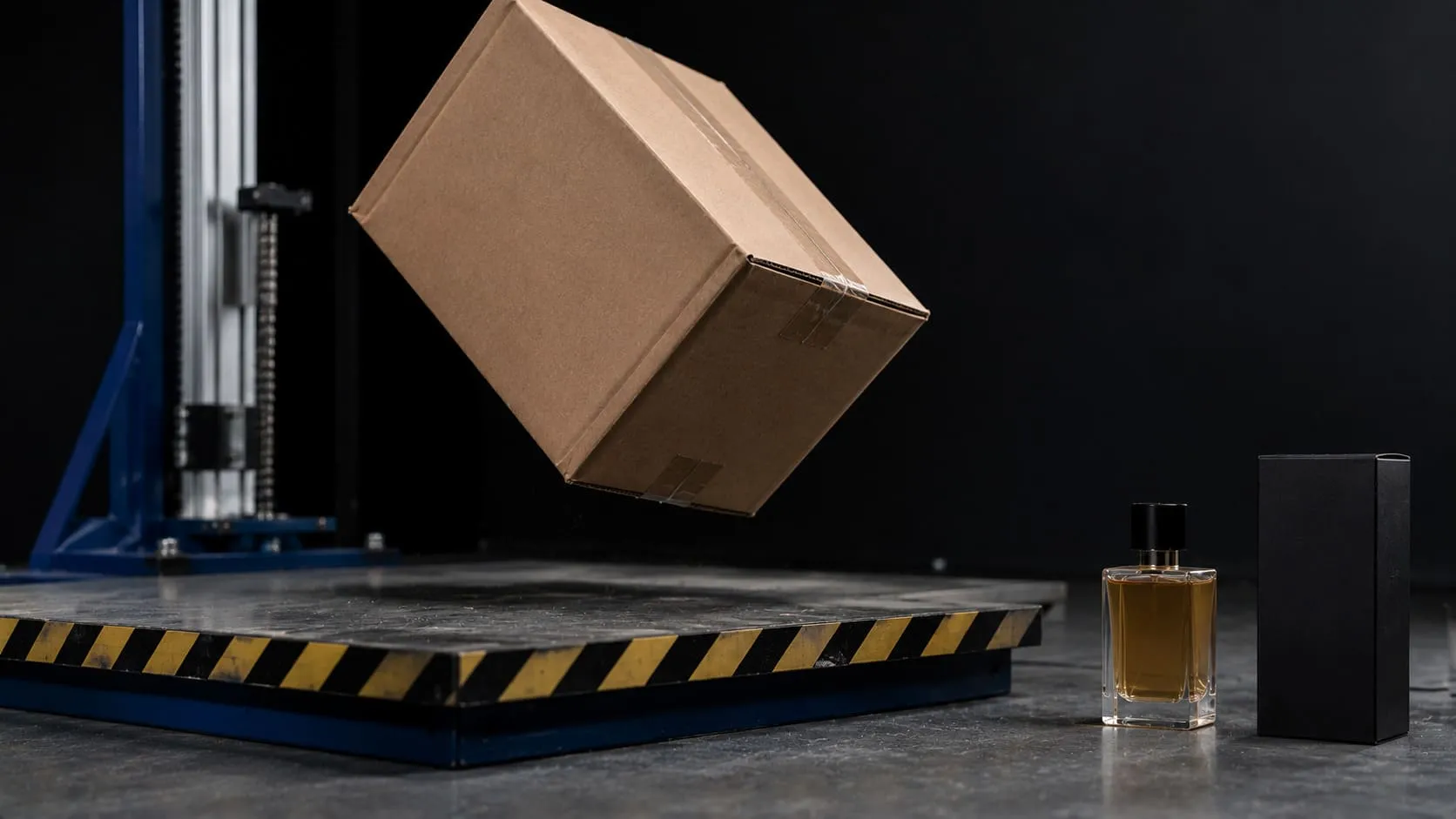
Carton vibration test standards and stability assessment during transport
A perfume shipping carton may respond differently to vibration depending on its construction, shipping route, and transport conditions. For this reason, a carton vibration test should be based on a scenario that reflects the actual distribution environment rather than applying the same test profile to every shipment.
ASTM D4728-17(2022) is used to evaluate the effects of random vibration on packaged shipments and assess the ability of the packaging system to protect its contents. When developing the test protocol, the responsible testing body considers shipment- and route-specific data, including:
- The construction of the export carton and the number of units packed inside.
- The arrangement of the units, dividers, and securing components.
- The transport modes used throughout the shipping route.
- The expected number of transport and handling stages.
- Available data on actual distribution conditions.
Performance indicators during a carton vibration test
During the carton vibration test, technical indicators are monitored to identify changes in packaging performance and product stability, including:
- Movement of individual units or changes in their position.
- Direct contact or friction between retail boxes.
- Displacement of internal dividers.
- Expansion of empty spaces inside the shipping carton.
- Compression or reduced performance of protective components.
- The extent to which movement and vibration transfer between rows.
- Visible damage to retail packaging caused by repeated friction.
To ensure that the test results reflect actual shipping conditions, provide the testing body with complete information about the transport route, shipping methods, and the acceptance limits you have defined for your product.
Maintaining package stability and preventing direct friction during transport helps preserve the commercial appearance of your products. Contact us to evaluate the performance of your perfume export carton and improve shipment stability throughout the distribution route.
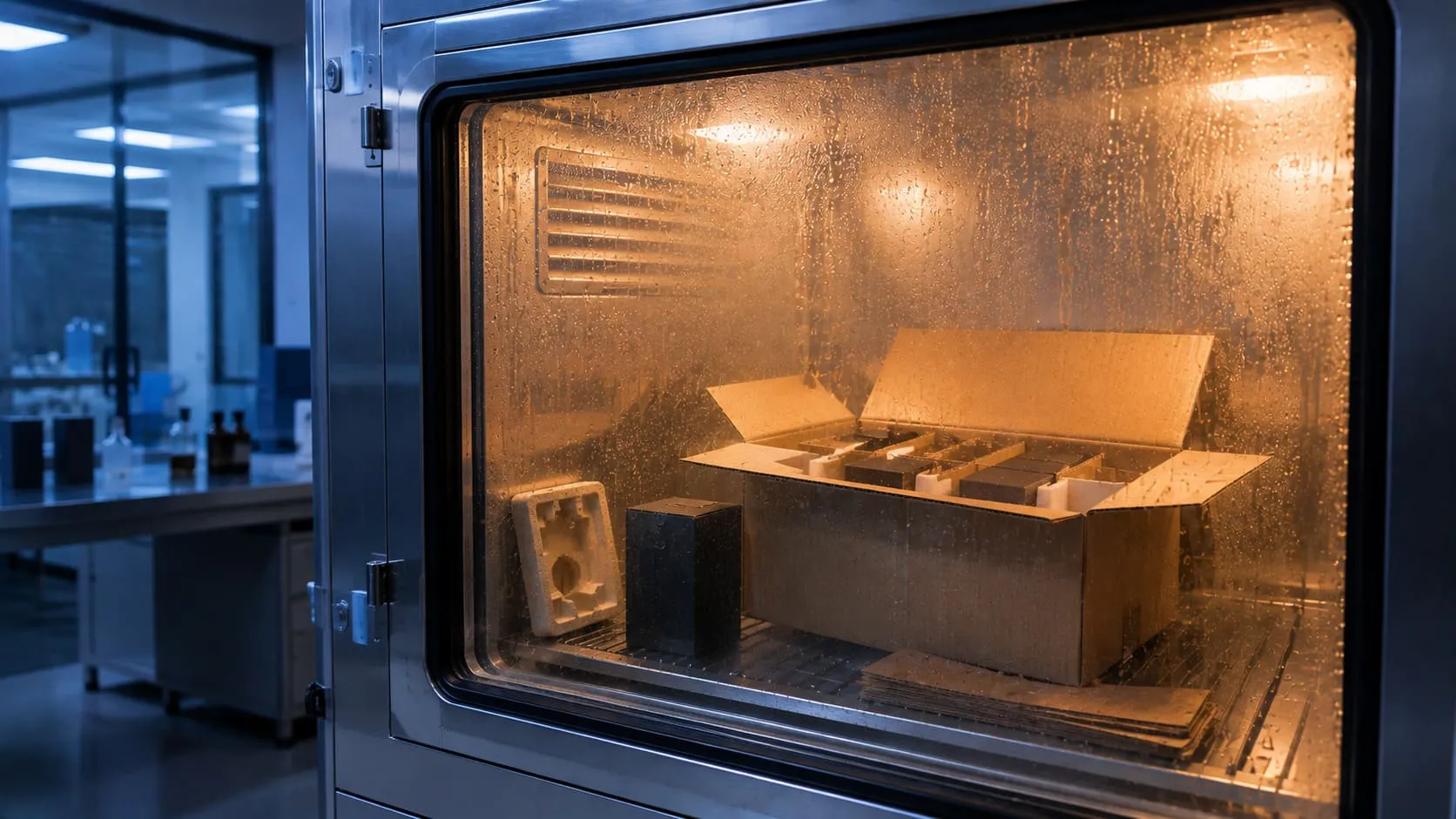
How shipping heat affects perfume packaging and materials
Perfume shipments do not remain under constant environmental conditions throughout their journey. They may move between warehouses, containers, and transport vehicles where temperature and humidity levels vary significantly. This makes it necessary to assess the packaging system under conditions that reflect the expected shipping environment before the final packaging configuration is approved.
Environmental conditioning before a shipping heat Ttst
Perfume formula stability testing should be kept separate from environmental conditioning of packaging materials because the two assessments serve different purposes. For a shipping heat test, ASTM D4332-22 can be used to condition boxes and shipping cartons under specified temperature and humidity conditions before testing. This helps evaluate changes in stiffness and other physical properties of the packaging materials, particularly paper- and board-based components.
The responsible testing body determines the appropriate conditioning conditions based on the test plan, shipment data, and the environment being simulated.
Carton performance under shipping heat conditions
After environmental conditioning, the assessment focuses on whether the different packaging components can maintain their performance and physical form. Key indicators include:
- The stiffness and structural integrity of the outer shipping carton.
- The stability and alignment of internal dividers.
- Deformation of individual retail boxes or changes affecting printed surfaces.
- The performance of inserts and securing components.
- Changes in spacing or compression between packed units.
Information about your destination market, together with the expected storage and transport conditions, helps define a testing scenario that more closely represents the environment your shipment may actually experience.
At Jasmine, we finalize the packaging materials and configuration that will represent your commercial order, then approve any required adjustments or improvements based on the findings of perfume packaging transport testing.
How to analyze perfume packaging transport testing results
The purpose of the analysis is to turn recorded observations into a technical basis for deciding whether the packaging configuration needs to be modified before final approval. This is done through the following steps:
Identifying packaging failures after testing
The assessment begins by reviewing the location and type of damage found within the shipment:
- Inspecting the condition of the perfume bottle, individual retail box, and internal insert.
- Checking the stability of dividers and the arrangement of boxes inside the carton.
- Identifying the type of damage recorded, such as breakage, excessive movement, external damage, or insufficient protection.
The recorded damage should then be compared with the commercial acceptance level defined for the product. An intact bottle does not automatically mean the result is acceptable if the retail packaging has been damaged or its appearance is no longer suitable for sale.
Adjusting dividers to protect perfume bottles
In some cases, the problem may be caused by poor securing, excessive empty space, or the way units are distributed inside the carton. Corrective actions may include:
- Reducing or redistributing empty spaces.
- Changing the shape or position of the divider.
- Adjusting the securing point.
- Changing the orientation of packed units.
- Changing the number of units inside the carton.
- Modifying the carton specifications if the test confirms that the carton itself is contributing to the problem.
Retesting perfume packaging after modifications
Once the packaging has been modified, it is no longer identical to the version that was originally tested. For this reason, the approval process should continue in the following sequence:
- Documenting test results and identified weaknesses.
- Applying the required changes to the packaging materials or configuration.
- Retesting the modified version according to the approved protocol.
- Approving the final version or introducing further changes if the problem continues.
Jasmine: From perfume manufacturing to an export-ready product
At Jasmine, we work with brand owners and importers to turn a perfume concept into a market-ready product through one integrated manufacturing process. This begins with defining the project requirements and selecting the right fragrance direction, then continues through product development, packaging preparation, and commercial-scale production.
Our services include private label perfume manufacturing, product filling, assembly of packaging components, labeling, and final wrapping. We organize each manufacturing stage according to the required quantities and approved specifications of your project.
Once production is complete, we also coordinate final order preparation so that the products are ready to move into export, shipping, and distribution. This allows you to manage your project through one manufacturing and preparation process instead of dividing production and export-readiness tasks between multiple suppliers.
Preparing a successful perfume line for international distribution requires coordinated manufacturing, packaging, and export preparation. Request a consultation today to discuss your project requirements and prepare your order for export according to the approved specifications.
Read also: Perfume Shipping from Turkey: The Best Options for Traders
FAQs about perfume packaging transport testing
Can transport test results be applied to a different distribution route?
Not automatically. Transport and handling stresses vary from one route to another, so the packaging system should be reassessed to confirm that it remains suitable for the new distribution route before final approval.
Do all projects require drop, vibration, and environmental testing?
No. There is no single testing program that applies to every project. The required scope is determined according to the risk assessment, packaging configuration, distribution route, and applicable technical testing protocols.
Can two test results be compared if the number of units per carton changes?
A direct comparison may not be valid if changing the number of units alters the internal spacing, pressure distribution, or movement of the products inside the carton. The structural differences between each packaging configuration should therefore be considered when analyzing the results.
Should the tested packaging configuration be documented?
Yes. Test results apply specifically to the packaging configuration that was evaluated. Documenting the retail boxes, perfume bottles, dividers, and carton specifications makes it possible to identify and reproduce the approved packaging system accurately.