Indonesia is one of Asia’s largest and fastest-growing perfume markets. However, successfully importing perfumes from Turkey into Indonesia requires more than simply selecting fragrances or calculating initial costs. Compliance with the Indonesian Food and Drug Authority (BPOM) regulations and choosing the appropriate importing entity are essential steps to prevent shipment delays, avoid customs clearance issues, and ensure smooth market entry.
To help you better understand these regulations and learn how to complete the procedures for importing perfumes from Turkey to Indonesia, today’s article from Jasmine Factory covers several key topics you need to know:
- Identifying the importer and the BPOM notification applicant.
- Preparing the perfume dossier and obtaining label approval.
- Translating Indonesian market requirements into specifications for the first order.
- Calculating landed costs and preparing the documents for the first shipment.
How to Choose the Importer and BPOM Notification Applicant in Indonesia
For perfume projects targeting the Indonesian market, the regulatory process begins with identifying the party that will be legally responsible for the product within Indonesia. The Turkish manufacturer does not submit the BPOM notification itself. Therefore, before entering into any agreement, you need to clearly understand the role of each party involved:
- Indonesian importer: Handles the entry of the product into the Indonesian market and manages the procedures related to importation.
- BPOM notification applicant: Manages the regulatory dossier for cosmetic products and submits the required BPOM notification applications.
- Brand owner: Manages the commercial rights to the brand and regulates the business relationship between the importer and the marketing entity.
- Perfume manufacturer: Produces the perfumes according to the agreed specifications and provides the required manufacturing data and technical documentation.
As a brand owner, your relationship with the Indonesian importer and the perfume manufacturer in Turkey may require documents that establish legal status and authorization. Additional documents, such as GMP certification or a Certificate of Free Sale, may also be required depending on the regulations applicable in Indonesia.
Clarifying these responsibilities before signing an agreement helps you determine which procedures must be arranged locally in Indonesia and which documents need to be provided by the manufacturer before the product can be approved. At Jasmine, we prepare the manufacturing-related documents and technical data within the agreed scope of your order. Contact our team now to coordinate the administrative and technical documentation required for your project.

Steps to Prepare the Perfume Dossier for Importing Perfumes in Bulk to Indonesia
A product submitted for approval in Indonesia must fully correspond to what is actually used in manufacturing. For this reason, at Jasmine, the process moves from finalizing the perfume specifications to preparing the following requirements:
DIP Dossier Documents from the Perfume Manufacturer
The DIP dossier is compiled using information provided by the various parties involved in the project. Our factory supplies the documentation related to the product and manufacturing process, including:
- Approved product information and specifications.
- Manufacturer details and manufacturing site information.
- Formula and technical information on the ingredients.
- Product quality specifications and related testing data.
- Certificate of Analysis (CoA), when required.
- Good Manufacturing Practices (GMP) documentation.
- Technical documentation supporting product safety and quality within the manufacturer’s scope of responsibility.
BPOM (Indonesia’s National Agency of Drug and Food Control) requires a DIP dossier for each cosmetic product, covering administrative, safety, and efficacy information. You are responsible for completing the local regulatory requirements in Indonesia, while we provide the documentation related to the product and its manufacturing process.
Perfume Label Approval Before Printing
Packaging should only be printed after the final label version has been reviewed and approved for the specific product. The packaging therefore does not move into production until the information required for the Indonesian market has been finalized. Under BPOM Regulation No. 18 of 2024, the label includes:
- Product name.
- Directions for use and product benefits.
- Full ingredient list.
- Warnings and precautions for use.
- Country of origin.
- Name and address of the registered party.
- Approved notification number.
- Batch number.
- Expiration date.
- Net volume or net weight.
- 2D barcode.
The regulation exempts perfumes from stating directions for use because their intended use is self-evident, while specific language requirements still apply. At Jasmine, we use the final label version approved by you without making changes to it.
Halal Certification for Perfumes
Halal certification is another requirement that should be reviewed as part of the product dossier before approval for the Indonesian market, particularly as mandatory requirements for imported cosmetic products begin to apply from October 18, 2026. The process requires coordination with the relevant local authorities to determine:
- The appropriate certification pathway for the products.
- Ingredient and raw material information.
- Details of the manufacturing processes and production lines.
- Documents required from the manufacturer.
Once these requirements have been identified, our factory reviews the elements related to the formula, manufacturing process, and available documentation before the final product is approved.
Read also: Perfume Manufacturing Quality Control Before Production
How to Turn Indonesian Market Requirements into Manufacturing Specifications
Once the local requirements are finalized, you can move from a general product concept to clear manufacturing specifications that we can evaluate and price based on the following details:
- Supply model: Choose between ready-made products and private label manufacturing for your brand.
- Product type: Specify the perfume or cosmetic product that will form the basis of the order.
- Number of products: Define the number of individual fragrances and SKUs included in the project.
- Product size: Confirm the required volume of each product in milliliters.
- Packaging components: Select the bottle, cap, and other packaging components.
- Outer packaging: Finalize the box and packaging materials used for presentation and protection.
- Label: Approve the final label version in line with Indonesian market requirements.
- Quantity: Specify the required quantity for each product in the order.
- Level of customization: Agree on any modifications to the fragrance, formula, and technical specifications.
- Reference sample: Approve a final sample that accurately represents the product intended for production.
- Approval authority: Identify the authorized person responsible for approving samples and designs.
- Launch date: Set the timeline for sampling, production, and shipment.
These specifications become the reference we use at Jasmine to assess what can be delivered in terms of manufacturing, filling, packaging, and customization. We can then prepare an offer based on the approved product requirements for the Indonesian market. Consult our production experts to turn your market requirements into a clear specification sheet and production-ready samples.
Read also: Perfume Specification Sheet: 7 Costly Errors to Avoid

How to Calculate the Cost of Importing Perfumes in Bulk to Indonesia
A manufacturer’s quotation alone does not show the final cost of your order, because some expenses fall outside the scope of manufacturing and continue until the goods reach their final delivery point. For this reason, your total cost estimate should be built using figures confirmed by each party within its area of responsibility:
| Cost Item | Source of Cost | Confirmed By |
| Product manufacturing | Agreed manufacturing quotation | Jasmine |
| Packaging and customization | Project specifications and quotation | Jasmine |
| Printing and order preparation | Approved final specifications | Jasmine |
| BPOM requirements | Local authority or regulatory consultant | Importer |
| Halal requirements, where applicable | Relevant certification authority | Importer |
| International shipping and insurance | Freight quotation and shipping terms | Importer / Freight forwarder |
| Customs duties and taxes | Relevant Indonesian authorities | Importer |
| Domestic transportation and storage | Local service provider | Importer |
At Jasmine, we provide a clear breakdown of manufacturing and order preparation costs. You can then complete your budget by adding quotations from freight companies and figures from the relevant authorities, giving you a more realistic estimate of the total investment and the target selling price for the Indonesian market.
How to Prepare Your First Perfume Shipment After BPOM Approval
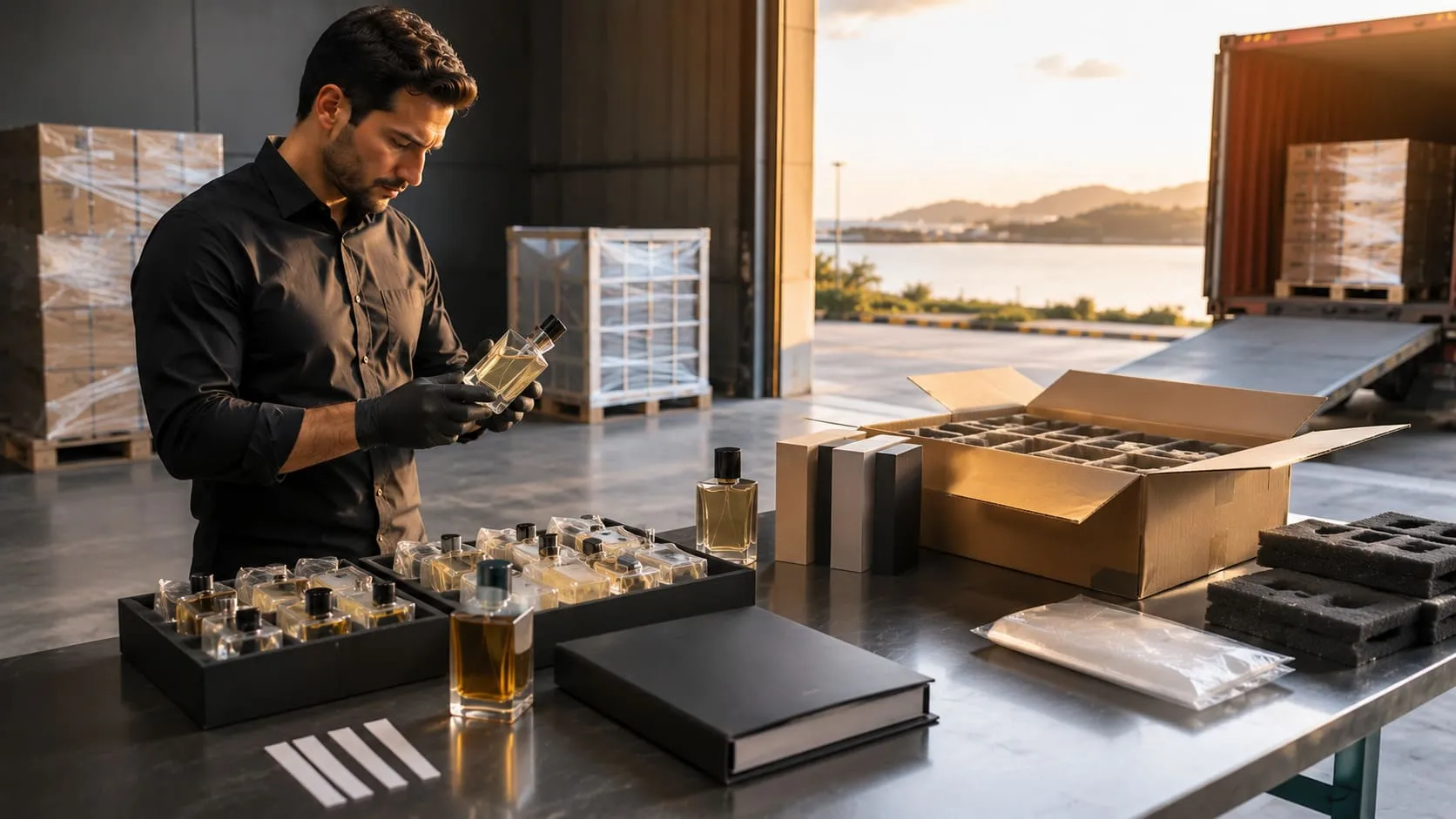
With the first shipment, the approved product becomes finished goods ready to leave the factory. Before handing the shipment over to the freight company, the entire order and the documents required for importing perfumes into Indonesia should therefore be reviewed carefully:
- Verify that the products and quantities match the approved production order.
- Ensure that the final packaging and labels approved for the Indonesian market are used.
- Confirm batch numbers and expiration dates and link them to the products included in the shipment.
- Inspect the finished packaging and shipping cartons to ensure they are in good condition before transportation.
- Record the number of units per carton, along with package weights and dimensions, for shipping arrangements.
- Prepare the commercial invoice and Packing List so they accurately reflect the actual goods in the shipment.
- Issue the Certificate of Analysis (CoA) for the relevant batch and include the agreed technical documentation.
- Coordinate the transport method, delivery point, and expected dispatch date with us and the freight company.
Data consistency is particularly important from a regulatory perspective. BPOM requires the product name and package size stated on the invoice to match the notification details, while the Certificate of Analysis must be linked to the relevant batch, lot number, production date, and expiration date.
SKI procedures, customs clearance, and other requirements for shipping perfumes to Indonesia are handled by you and the relevant local authorities once we have completed the shipment preparation on our side.
Ensuring that the packaging is secure and that invoices match the corresponding batch numbers helps the goods leave the factory smoothly. Consult our logistics support team to review your Packing List and CoA certificates.