The first real test of your launch does not happen in the factory or during the product shoot. It happens when a customer opens the parcel. If the bottle has moved inside the carton, the sprayer has leaked, or the product data does not match the listing, a good fragrance will not rescue the experience. The customer sees a damaged order, requests a return, and may leave a review that influences every buyer who follows.
That is why a private label perfume for marketplaces must be planned before production, not after the images are uploaded. A choice that looks minor today – bottle size, carton clearance, barcode ownership, or SKU structure – can later become a listing delay, a warehouse error, a higher fulfilment fee, or a return that removes the margin from the sale.
This guide by Jasmine Factory takes you through that sequence: channel choice, brand identity, perfume GTIN and SKU mapping, ecommerce perfume packaging, product images, perfume marketplace listing data, possible document review, and launch economics. You will also find a practical readiness checklist and a clear explanation of where Jasmine adds value before production begins.
Start with the channel before choosing the package
Before choosing a bottle, picture the route it will travel. A retail product normally moves from a master carton to a stable shelf. An ecommerce order may pass through warehouse receiving, picking, repacking, parcel movement, doorstep delivery, and a possible return. At every handoff, the bottle, sprayer, label, and carton face another opportunity for movement, pressure, scratching, or leakage.
Your fulfillment model changes the brief. If you plan to sell perfume on Amazon through FBA, or sell perfume on Noon through FBN, you need to verify the platform’s current receiving, product-review, and fulfilment requirements. If you fulfill orders yourself, you control the protective outer pack but also carry the responsibility for how each unit survives the courier route.
Ask the commercial questions before the design questions: Will the bottle ship alone or in a gift set? Is the formula alcohol-based? Will the listing be bilingual? Will each scent and size have its own identifier? What are the final packed dimensions? These answers turn packaging from a visual preference into a channel decision.
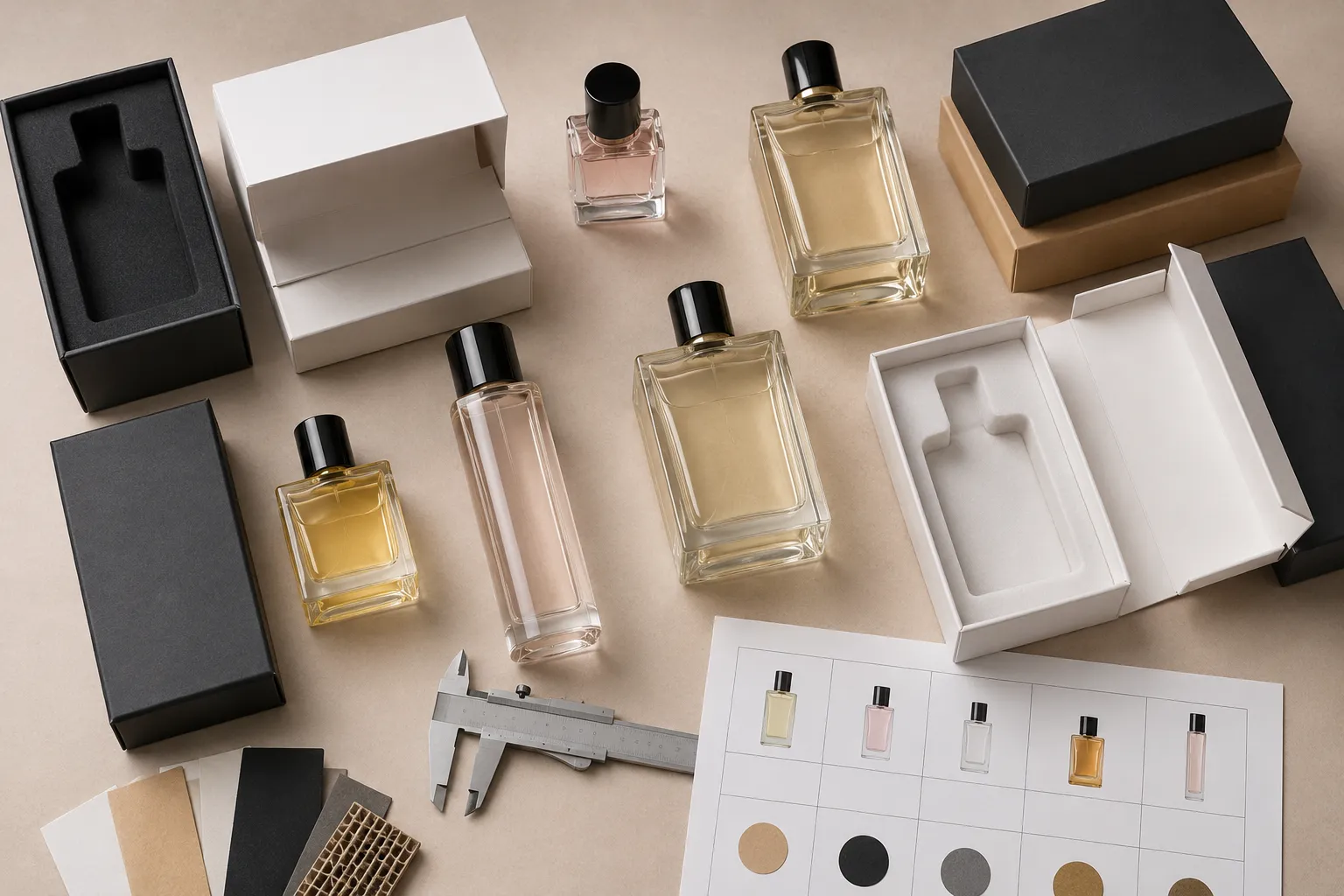
What do marketplaces usually need from a perfume product?
There is no universal checklist for every seller, country, and account. Amazon and Noon requirements can vary by market, product category, fulfilment model, and current platform policy. For that reason, a responsible manufacturer should not promise marketplace acceptance on the platform’s behalf.
What Jasmine can do is help you build stronger fundamentals before manufacturing: a consistent brand identity, a distinct product definition, controlled packaging information, images based on the approved unit, and carton data that the warehouse and ecommerce team can use. You then map that controlled product information to the fields and rules shown in your seller account.
The order matters. First define exactly what the product is. Then assign the identifiers that distinguish it. Only after that should the final packaging, images, and listing be approved around the same version.
1. Make brand identity visible and durable
A brand name may feel settled, yet small inconsistencies can confuse the marketplace, warehouse, and customer. If the bottle uses one spelling while the invoice, barcode record, or perfume marketplace listing uses another, the product can appear to belong to different brands. Mixing the brand name, fragrance name, and collection name creates the same problem.
Before artwork approval, lock the official brand spelling, where it appears, and how it relates to the fragrance and collection names. Use that structure across the bottle, retail carton, product specification, invoice, barcode record, and listing. Do not leave brand placement to a temporary last-minute label unless that route has been deliberately approved for the project and channel.
Our Private Label service connects fragrance direction, bottle and packaging selection, labelling, filling, and packing within the agreed project scope, which makes early identity decisions easier to carry through to the finished product.
2. Prepare GTIN, SKU and variation mapping
Once the identity is stable, define each sellable product. Imagine a launch with three scents in two sizes. Commercially, that is not one perfume; it is six finished units with separate stock, attributes, images, and reorder quantities. Each may need its own perfume GTIN and must have a distinct internal SKU.
A GTIN identifies the trade item when the marketplace requires one. An SKU is the code your business uses to distinguish and manage that item. They serve different purposes. Build one mapping file that connects brand, product name, scent, size, packaging version, GTIN status, internal SKU, units per carton, and listing name. Give the same approved version to Jasmine, the warehouse, and the ecommerce team.
- Never reuse one barcode for two different finished products.
- Create one SKU for every scent, size, and packaging version that stock teams must distinguish.
- Verify GTIN requirements or exemption eligibility in the relevant seller account before artwork is printed.
For a deeper product-control framework, read our guide to the perfume product specification sheet to connect approved SKU, fragrance, packaging, artwork, carton, and marketplace data.
3. Design packaging for parcel fulfilment
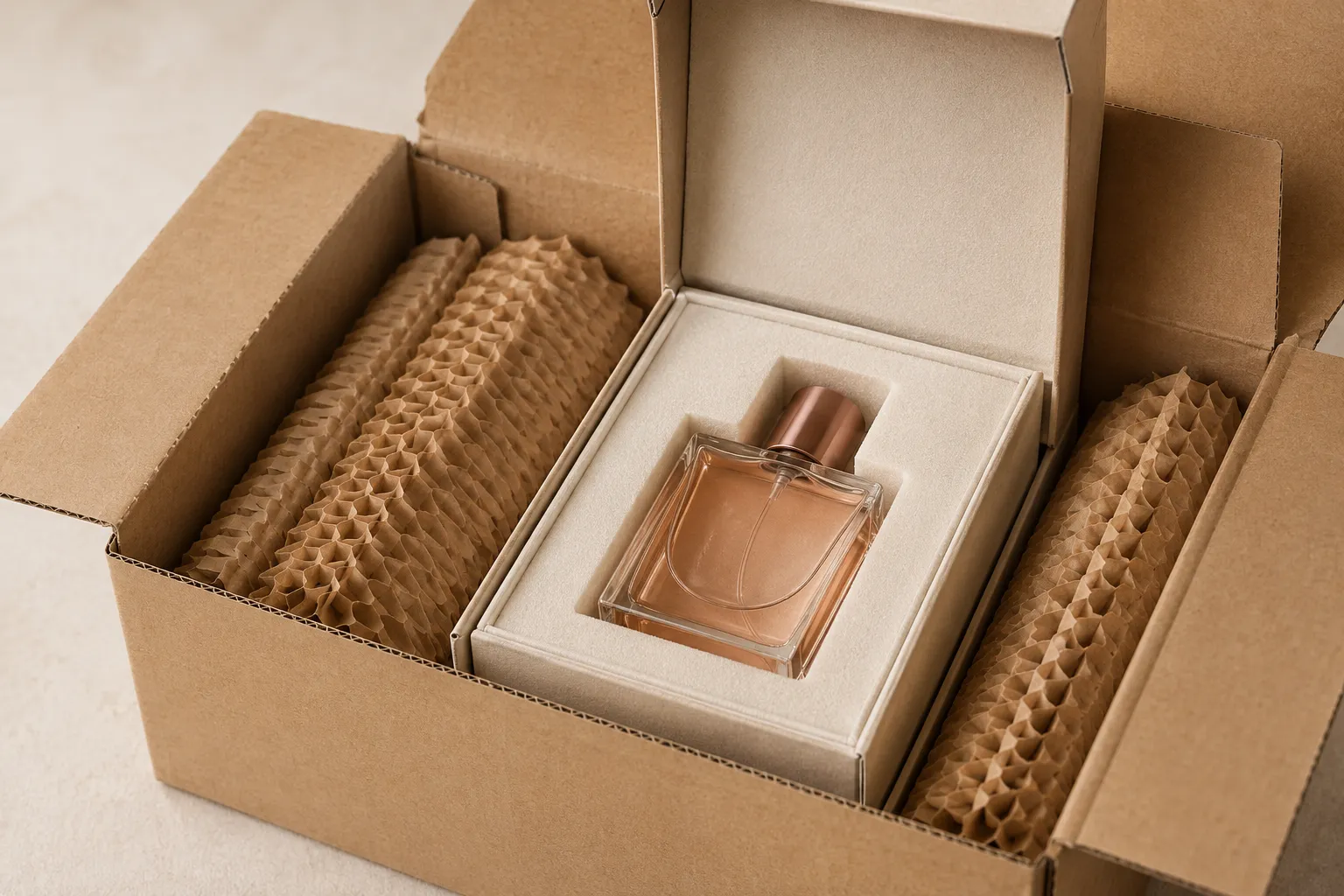
Customers do not see what happened during delivery; they see the result. The outer parcel may look intact while the bottle has moved inside the retail carton, or the cap may stay in place while a small sprayer leak damages the label. Ecommerce perfume packaging therefore has to work as a system from closure integrity to the protective shipper.
At Jasmine Factory in Turkey, we discuss how the bottle, sprayer, cap, label, and retail carton fit together within the selected project route. The additional protection for individual parcel fulfilment should then reflect the bottle’s sensitivity and the chosen logistics model. A fragile presentation may need better internal restraint or an additional protective layer, not simply a thicker decorative box.
- Check sealing and leakage after filling, not only with an empty bottle.
- Confirm that labels and finishes can tolerate expected handling and incidental moisture.
- Record the final unit dimensions and weight after every packaging layer is included.
Once the physical product is locked, photography and listing content can be built from something real rather than from a design file that may still change.
4. Plan images before the goods arrive
Waiting for the full shipment and then arranging photography in a rush creates an avoidable gap between inventory readiness and page readiness. A better approach is to approve a finished sample that matches production and plan the required image set from that unit. Content can then be prepared while manufacturing is underway.
The primary image should show exactly what the customer will receive, without props that imply extra items. Secondary images can explain the bottle, carton, size, set contents, or relevant packaging details. Lifestyle images belong only in placements where the platform allows them, and prices, warranties, or watermarks should not be added to product images.
Before the shoot, check the current image instructions for the exact Amazon or Noon market you will use. Jasmine can help you define the approved physical product and provide the information connected to it, but the platform decides which dimensions, backgrounds, and visual elements it will accept.
5. Write product content from real product data
Once the product and images are controlled, writing becomes easier. You do not need vague superlatives to fill missing information. You need clear answers to the buyer’s questions: What is the product format? What is the volume? Which scent family describes it? What is included in the pack? Who is it intended for, and how should it be used?
Treat the approved specification as the source for the listing, image captions, warehouse record, and distributor file. When a product fact changes, update the source first and then update every channel that depends on it. This prevents an old listing from continuing to sell a product definition that no longer matches the stock.
Use claims you can support. A clear scent description and honest usage context create a realistic expectation. Unsupported performance promises may win a click, but they also create the gap that leads to disappointment and returns. A good listing copy is not generic perfume poetry; it helps the right customer understand the exact product.
If you are preparing data for more than one channel, our perfume brand distributor readiness checklist shows how GTIN, case data, images, and controlled product records support retail and ecommerce onboarding.
6. Plan dangerous-goods review and documents early
For an alcohol-based perfume, the question is not only whether it can be listed. You also need to ask how it will be stored and transported. Depending on the formula, volume, destination, platform, and fulfilment route, the product may enter a dangerous-goods review and the seller may be asked for an SDS or related information.
Define the product format and volume, then ask the marketplace, fulfilment provider, and carrier what applies to your route. Close those questions before production and shipment booking. Approval for one size or formula should not be assumed to cover every variation automatically.
Jasmine discusses product and shipment information early and supports the manufacturing documentation available within the agreed scope. Final classification, listing eligibility, and local compliance remain decisions for the marketplace, carrier, importer, and relevant authorities. Keeping those responsibilities clear protects the project from unrealistic promises and late surprises.
7. Calculate ecommerce economics before locking MOQ
All earlier decisions eventually meet in one question: can the finished unit still earn an acceptable margin after it reaches the customer? Manufacturing price alone cannot answer it. Add the fragrance, bottle, sprayer, cap, retail carton, protective packaging, artwork, barcode, photography, and content, then include referral, fulfilment, storage, advertising, delivery, and return costs.
A larger carton may feel more premium but move the unit into a higher fulfilment tier. Six launch scents may create an impressive storefront but divide working capital and reviews across slow inventory. In that situation, three focused scents may give you better learning and a cleaner reorder decision than a broad collection that never gathers enough demand data.
Use the platform’s fee calculator only after the final packed dimensions and weight are known. Build a realistic allowance for advertising and returns, then choose MOQ and allocate quantities by scent. The right MOQ is not automatically the smallest or largest; it is the quantity you can sell and reorder before stock becomes a burden.

Private label perfume ecommerce readiness checklist
Before production approval, run every finished SKU through this checklist. If an answer is still uncertain, resolving it now is usually cheaper than correcting printed packaging, live listings, or imported inventory later.
- Pricing includes platform fees, fulfilment, storage, advertising, shipping, and returns.
- Reorder timing accounts for manufacturing lead time, shipping, and stock velocity.
- Each scent, size, and packaging version has the correct SKU and perfume GTIN status.
- Unit and master-carton dimensions, weights, case quantity, and handling data are documented.
- Brand, fragrance name, size, invoice, barcode record, and listing use the same approved identity.
- Relevant product, platform, dangerous-goods, and shipment questions were discussed before production.
- The approved sample, product images, and listing content describe the unit that will actually be produced.
- Bottle, sprayer, cap, carton, and protective pack have been reviewed for leakage, movement, and parcel fulfilment.
When these items align, private label fragrance ecommerce becomes easier to manage because manufacturing, content, warehousing, and sales are working from the same product definition.
How does Jasmine Factory help prepare your fragrance for ecommerce?
When you tell us the product is intended for marketplaces, we do not begin with the scent alone. We ask about the country, channel, fulfilment route, target customer, price position, scent count, sizes, and planned quantity. That commercial picture helps us discuss bottle, sprayer, cap, label, and carton choices that serve the product rather than appearance alone.
Through our Private Label service, we help develop the fragrance and coordinate selected packaging, labelling, filling, and packing decisions within the project scope. If you want fragrance, packaging, approvals, quality gates, and shipment preparation connected through a broader manufacturer-led route, review our Turnkey Private Label Perfume guide.
We can also help organize the manufacturing specification, SKU structure, and carton information discussed for the order, and we can address available shipment preparation from our facility in Istanbul. Jasmine does not manage your seller account or guarantee platform approval; the seller must verify current marketplace fields, eligibility, and destination requirements.
That clarity is part of our value. Instead of discovering after production that the packaging or product record does not suit the channel, we bring the questions into the project before the sample, artwork, and quantity are treated as final.
Ready to discuss your launch? Review our catalogs for an initial product and packaging direction, then send us via WhatsApp your market, platform, fulfilment route, scent count, size, and target quantity
FAQs about private label perfume for marketplaces
Can perfumes be sold on Amazon and Noon?
Yes, when the seller account, country, category, product information, and fulfilment route meet the platform’s current requirements. Check the relevant seller rules before manufacturing and shipping because the marketplace, not the factory, makes the final listing decision.
Do I need a GTIN or barcode?
A GTIN may be required for each scent and size, while exemptions may apply in specific cases. Verify the rule in your seller account, obtain identifiers from an appropriate source, and map each code to one finished product before printing.
Is perfume considered dangerous goods?
Some perfumes, especially alcohol-based products, may be reviewed under dangerous-goods storage or transport rules. The result depends on the formula, volume, platform, carrier, country, and fulfilment method, and an SDS or related information may be requested.
How is ecommerce packaging different from retail packaging?
Retail packaging focuses on shelf presentation and protection. Ecommerce packaging must also manage movement, pressure, leakage, final packed dimensions, barcode readability, parcel handling, and the possibility of a return journey.
Can Jasmine help with marketplace product data?
At Jasmine Factory, we can help define the fragrance, bottle, label, retail packaging, manufacturing specification, and carton information within the project scope. The seller remains responsible for checking the exact fields, eligibility rules, and final approval inside the marketplace account.