A perfume manufacturer sample kit should make your next decision easier, not leave your team with dozens of scents and no clear winner. The problem usually starts when samples arrive under different codes, concentrations, or formats and each person evaluates them using personal taste instead of one commercial brief.
This guide shows you how to request relevant private label perfume samples, compare perfume samples fairly, score them consistently, and approve the right fragrance without separating scent choice from the realities of production.
Why do buyers struggle to choose despite receiving many samples?
More samples do not automatically create a better decision. Without a clear brief, a factory may send popular fragrances that fit another market, customer, or price tier. Your team then compares options that were never designed to solve the same commercial problem.
The process becomes even weaker when buyers request too many fragrance families, compare stock samples with custom prototypes as if they were equivalent, test with different spray quantities, or approve a scent without recording its code and version. Choosing only from the opening or discussing packaging and MOQ after fragrance approval can create the same problem later.
At Jasmine Factory, we prefer to narrow the brief first. Your market, channel, positioning, product format, and packaging direction help us discuss whether the project is better served by a catalog shortlist, a faster stock-fragrance route, private label customization, or deeper custom development. If your scent direction is still vague, our guide on how to brief a perfumer helps you turn words such as “luxury” or “fresh” into more useful sampling instructions.
Stock sample vs. a custom prototype
Before you compare factories, prices, or sample quality, confirm what each factory actually sent. Private label perfume samples may be stock references or custom-development prototypes, and the two routes should not be judged as if they carry the same development scope.
Stock fragrance sample
A stock sample comes from an existing fragrance direction or formula in the manufacturer’s library. It can help you shorten scent selection, test demand faster, reduce development rounds, and move sooner into packaging and production planning.
This route can work well for retailers, distributors, and new brands that value speed, provided every sample has a traceable code and version. Our Stock Fragrance Library workflow explains how a focused library can connect sample choice with approval and production matching instead of treating stock fragrances as random ready-made options.
Custom-development prototype
A custom prototype is developed from your brief and may pass through several revisions before approval. It is more suitable when you need stronger olfactive differentiation, have a clearly defined target customer, or want a signature scent that existing options do not provide.
Custom does not automatically mean better. It usually requires more time, clearer feedback, and a realistic budget for development. When comparing a bespoke prototype with a stock sample, include development scope, revision rounds, lead time, ownership or exclusivity terms where relevant, and the route into production—not scent appeal alone.
For buyers building a differentiated brand rather than selecting from existing references, our Private Label Perfume Guide for B2B Business gives the broader context around sampling, packaging, approvals, and production.
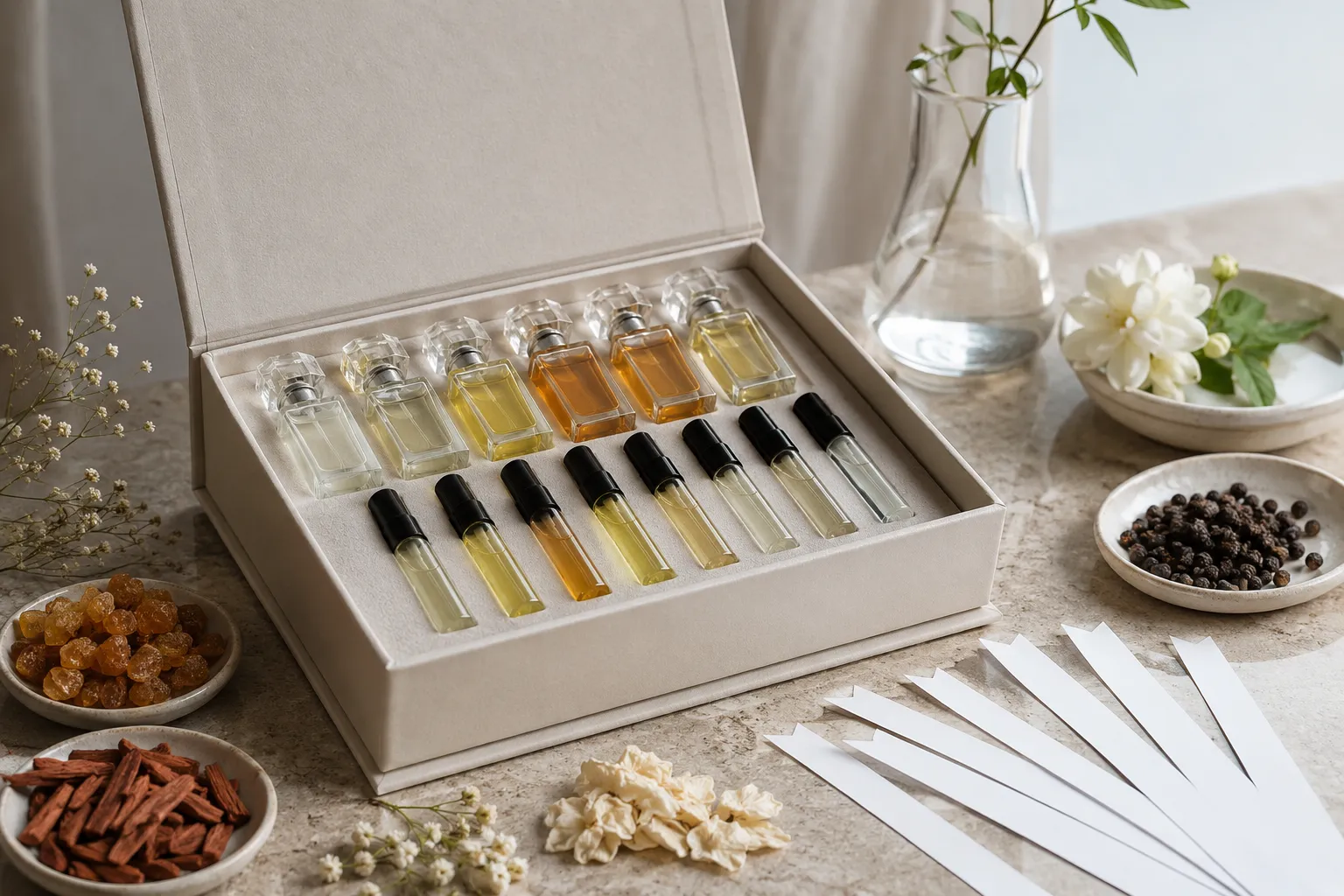
What should you send before requesting perfume samples?
You do not need a long presentation. You need enough information to stop the manufacturer from guessing. When you request fragrance samples from manufacturer sample libraries, a concise brief helps every supplier work from the same market, format, and positioning assumptions.
Target market and sales channel
State the destination country or region, whether you sell through retail, e-commerce, distribution, wholesale, hospitality, or another B2B channel, and the expected price tier. Add useful shelf or competitor context without asking for direct imitation.
A fragrance that fits a GCC distributor may not be the right first choice for a European e-commerce brand. Market and channel change what “commercially relevant” means.
Target customer
Describe the buyer practically: age range, gender positioning, daily or evening use, style preference, price sensitivity, familiar scent preferences, and main purchase occasion.
The goal is not to create a fictional persona. It is to give the factory enough context to avoid sending scents that have little chance of fitting your customer.
Product format
Specify whether the project is Eau de Parfum, Eau de Toilette, extrait, pocket perfume, body mist, reed diffuser, room spray, car fragrance, or another format.
Do not assume that one scent behaves identically in every base or use case. Performance expectations, packaging, and technical considerations change when the product format changes.
Preferred scent families
Choose two to four useful directions rather than requesting everything. For example: fresh and clean, floral soft musk, dry woods, amber and vanilla, oud and rose, citrus and herbs, gourmand, or aquatic.
Also tell us what to avoid. “Less smoke,” “no heavy powder,” or “avoid very sweet oud” is more useful than asking for a generic premium fragrance.
Launch architecture
Explain whether you need one hero fragrance, a small starter range, men’s and women’s options, daily and occasion scents, or a line designed for later expansion.
This helps us discuss a sample set in which each fragrance has a role instead of sending near-duplicates that compete with one another.
Packaging direction
Share the intended bottle size, packaging level, style, display channel, label languages, target price where available, and whether you want available components or deeper customization.
Scent and packaging should support the same market promise. A fragrance that requires an expensive concentration and premium pack may be commercially wrong for a value-led launch even when the sample itself is excellent.
Before requesting samples, read the How to Brief a Perfumer checklist to organize the information your team already knows. A better brief usually saves more time than asking for a larger kit.
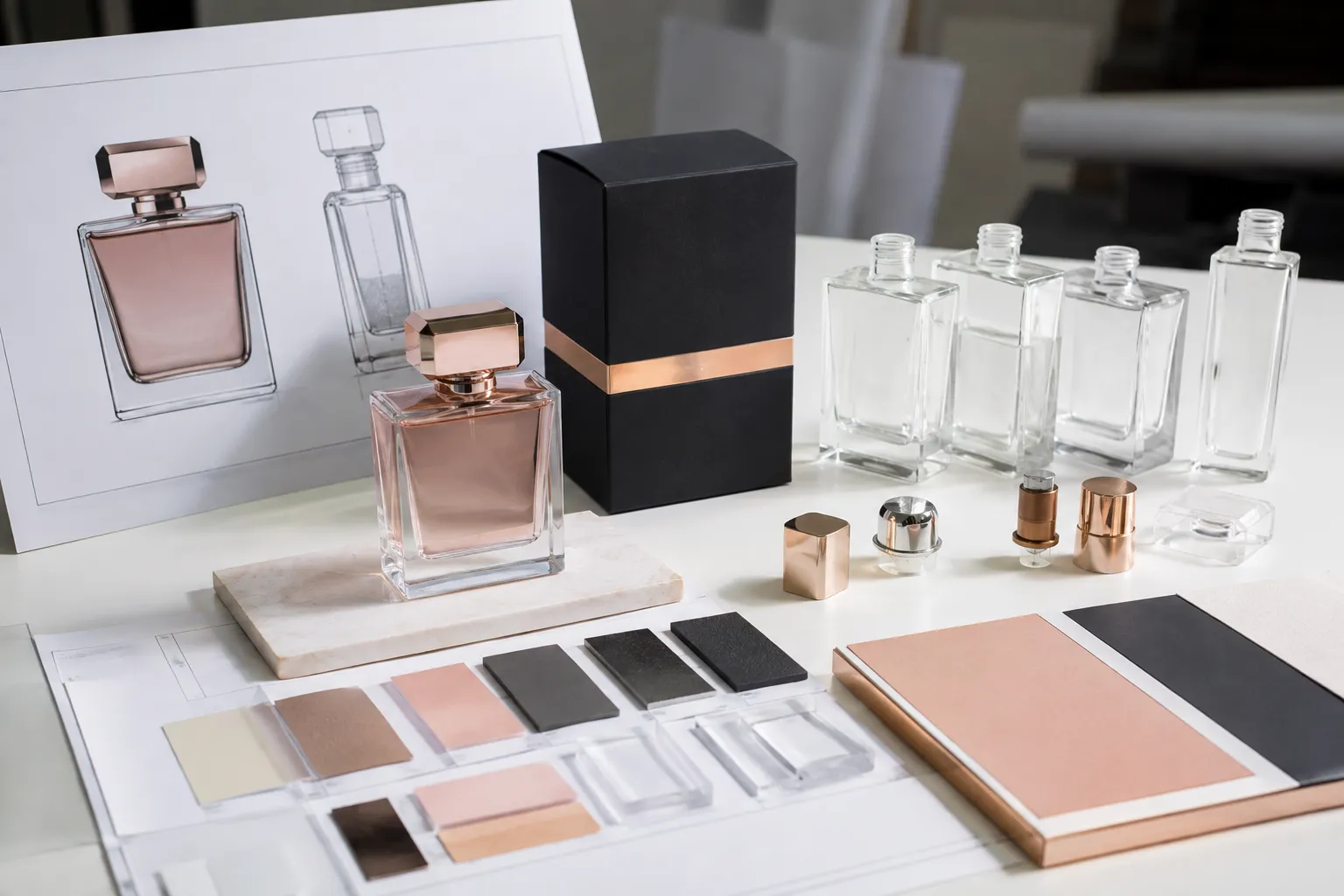
How many perfume samples should you request?
Request only as many options as your team can evaluate without losing decision quality. A focused first perfume manufacturer sample kit may cover two or three selected fragrance families, a balance of commercially accessible and more distinctive profiles, and one or two bolder options when the brand needs differentiation.
The important point is separation: each sample should have a reason to be in the kit. Ten clearly different candidates are more useful than thirty fragrances that blur together after the first testing session.
At Jasmine, our stock-fragrance discussion begins with market, channel, positioning, and shortlist logic. The objective is not to impress you with the size of a box; it is to help you understand why each option deserves evaluation and whether the preferred reference can move into production.
What should you ask before ordering a sample kit?
Before paying sample or courier fees, clarify the commercial and technical context of what you will receive:
- Are the options stock fragrances or project-specific prototypes?
- What code and version identifies each sample?
- Are the samples presented at the same concentration and in the same type of base?
- Is the sample fragrance oil only, or the intended finished product format?
- Can the approved sample become the production reference?
- Are development or revision fees involved, and how many rounds are included?
- Who controls formula, modification, or exclusivity terms where relevant?
- Can a pre-production perfume sample be reviewed in the intended bottle before production?
- What MOQ applies by fragrance, size, artwork, and packaging route?
- How are future changes and reorders controlled?
- Which product or export-related documents can be discussed for the target market?
Do not judge the factory by sample price alone. A free sample is not valuable if the finished route is commercially unsuitable, while a paid sample can be reasonable when it sits inside a clear development and approval process.
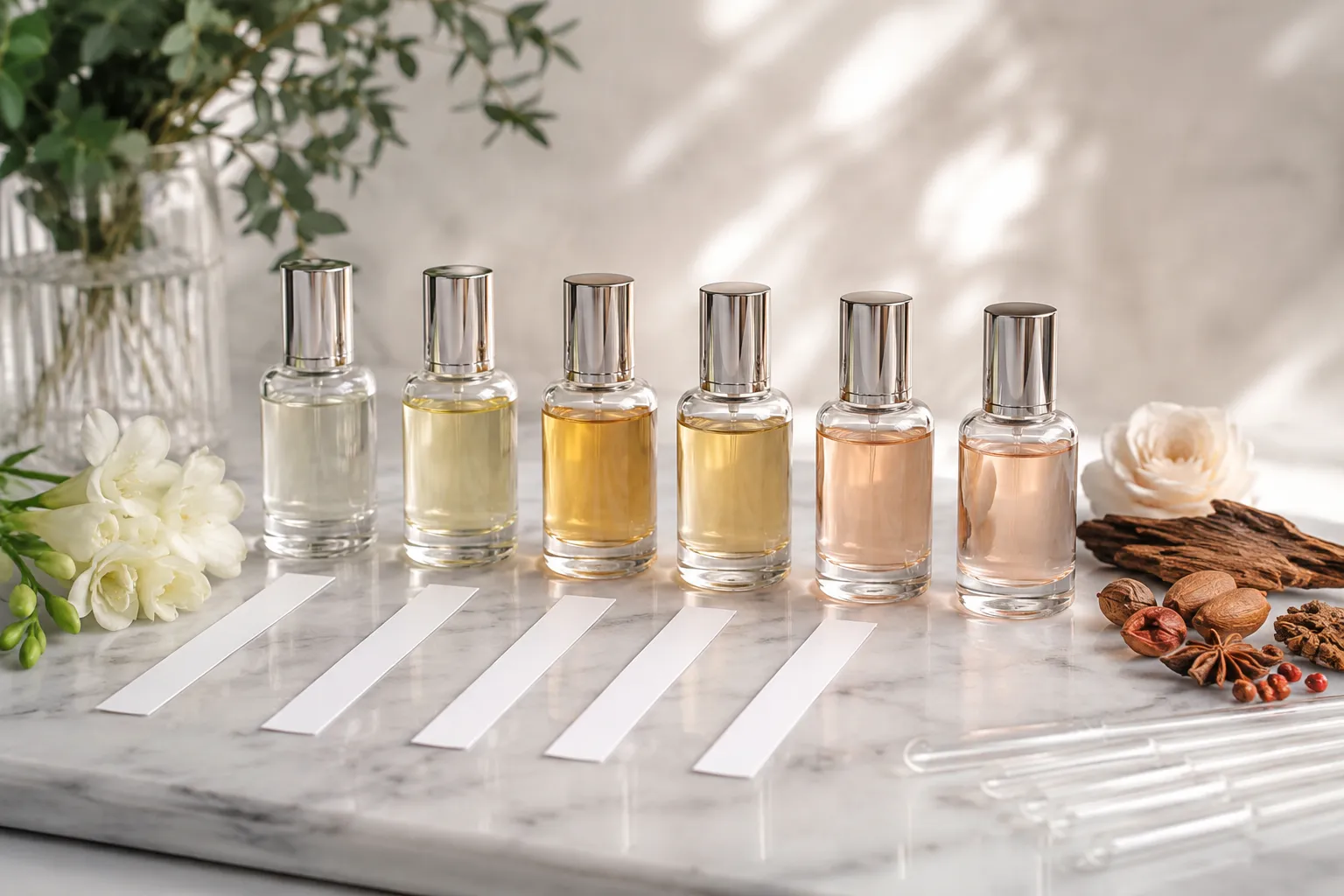
How do you compare samples from different manufacturers fairly?
A perfume sample evaluation is useful only when the conditions are reasonably consistent. To compare perfume samples fairly across manufacturers, standardize what you can before scoring the fragrance or comparing one factory with another.
Product format and concentration
Do not compare EDP with EDT, fragrance oil with a finished spray, or different bases without noting the difference. A stronger sample is not automatically a better fragrance; concentration and base can change the first impression.
Spray quantity and application
Use the same number of sprays, similar blotters, and comparable testing conditions. If one vial has a poor atomizer, separate hardware performance from scent performance rather than scoring both as one issue.
Testing schedule
Avoid testing the full kit in one session. Olfactive fatigue reduces discrimination. Divide samples into small groups, allow breaks, and record notes before moving on.
Blind coding
Use neutral codes during the first evaluation when practical. Knowing the factory, price, or country of origin can influence expectations. Blind coding will not remove every bias, but it helps your team judge the scent before commercial assumptions take over.
Consistent evaluation team
Keep the decision group small. Include people who understand the brand, target market, sales or distribution channel, and customer. Do not turn scent selection into an open vote among colleagues, friends, or family who do not share the same commercial criteria.
For a faster private label route built around controlled fragrance references, see our Stock Fragrance Library. It provides useful context for linking a selected sample to later approval and production matching.
How should you evaluate opening, heart and dry-down?
Do not approve perfume sample versions based on the opening alone. Test the fragrance as it develops, because the scent your customer remembers is not limited to the first minute.
Opening
Record freshness, sharpness or softness, sweetness, initial attraction, direction clarity, and whether the opening matches the intended product and package promise.
The opening matters for discovery and retail testing, but it is only the first stage of the fragrance.
Heart
As the opening settles, evaluate the dominant floral, woody, fruity, spicy, or aromatic character, the balance of the composition, its fit with the brand, and how clearly it differs from other planned SKUs.
Ask whether the heart continues the promise made by the opening or turns into a different product story.
Dry-down
Observe the remaining musk, amber, woods, vanilla, oud, warmth, sweetness, weight, and comfort on skin or blotter. The dry-down influences fragrance memory and the customer’s perception of how the scent wears over time.
Record the stage at which a sample wins or fails. “Good” is not enough feedback for a decision that must later be repeated in production.
Perfume sample scorecard
A fragrance sample scorecard gives everyone the same decision language. Use a 1–10 score for each criterion, then discuss the reasons behind large differences rather than simply averaging personal preference.
| Evaluation criterion | Commercial question | Suggested score |
| Market fit | Does it fit the target customer, country, and channel? | 1–10 |
| Brand clarity | Can you explain its role inside the brand? | 1–10 |
| Opening | Does it create a convincing first impression? | 1–10 |
| Heart | Does it maintain a balanced identity? | 1–10 |
| Dry-down | Does it leave a persuasive final impression? | 1–10 |
| Differentiation | Is it distinct from the other planned SKUs? | 1–10 |
| Sellability | Can the sales team describe and sell it clearly? | 1–10 |
| Packaging fit | Does it suit the package and expected retail price? | 1–10 |
| Extension potential | Can the scent support other sizes or formats? | 1–10 |
| Manufacturing fit | Are price, MOQ, lead time, and documentation workable? | 1–10 |
The highest olfactive score should not automatically win. A more creative scent can require a cost or packaging route the market cannot support. A slightly simpler fragrance may be the stronger commercial choice if it fits the customer, margin, positioning, and reorder plan better.
Need help narrowing a shortlist? Talk to our experts the sample codes you prefer, your market, and your product format. We can use that context to discuss the next development or production step.
How should you evaluate the manufacturer, not only the scent?
You are not selecting a fragrance in isolation. You are also selecting the team that must identify it, reproduce it, combine it with the correct components, and support future orders.
Shortlist quality
Ask whether the manufacturer understood your brief and sent relevant options. Six well-chosen samples with clear roles can tell you more about supplier fit than thirty unexplained fragrances.
Code and version control
Every sample should have a reference that can be retrieved later. If the team cannot identify which version you approved, the sample cannot reliably protect production or reorders.
Communication quality
Look for clear answers that distinguish confirmed information from items requiring project review. Speed is useful, but accurate communication protects decisions better than instant replies that later change.
Revision process
Clarify whether the scent can be refined, what is included in the revision process, and when requested changes become a new brief. Useful boundaries prevent an endless cycle in which every round starts again from zero.
Production transition
Ask the manufacturer to explain what happens after scent selection. You should understand the route into fragrance approval, packaging selection, artwork and carton development, a pre-production perfume sample, final quotation, MOQ confirmation, production scheduling, batch checks, and shipment handover.
Our Perfume Manufacturing service provides broader context for how fragrance, packaging, filling, and manufacturing fit together after the sample stage.
Reorder consistency
Ask how the approved reference will be preserved and what happens if a fragrance, bottle, pump, label, or carton component changes. A manufacturer should be evaluated by the second and third order as seriously as the first.
For the buyer-side checks that protect this transition, review our Perfume Manufacturing Quality Control Before Production guide.
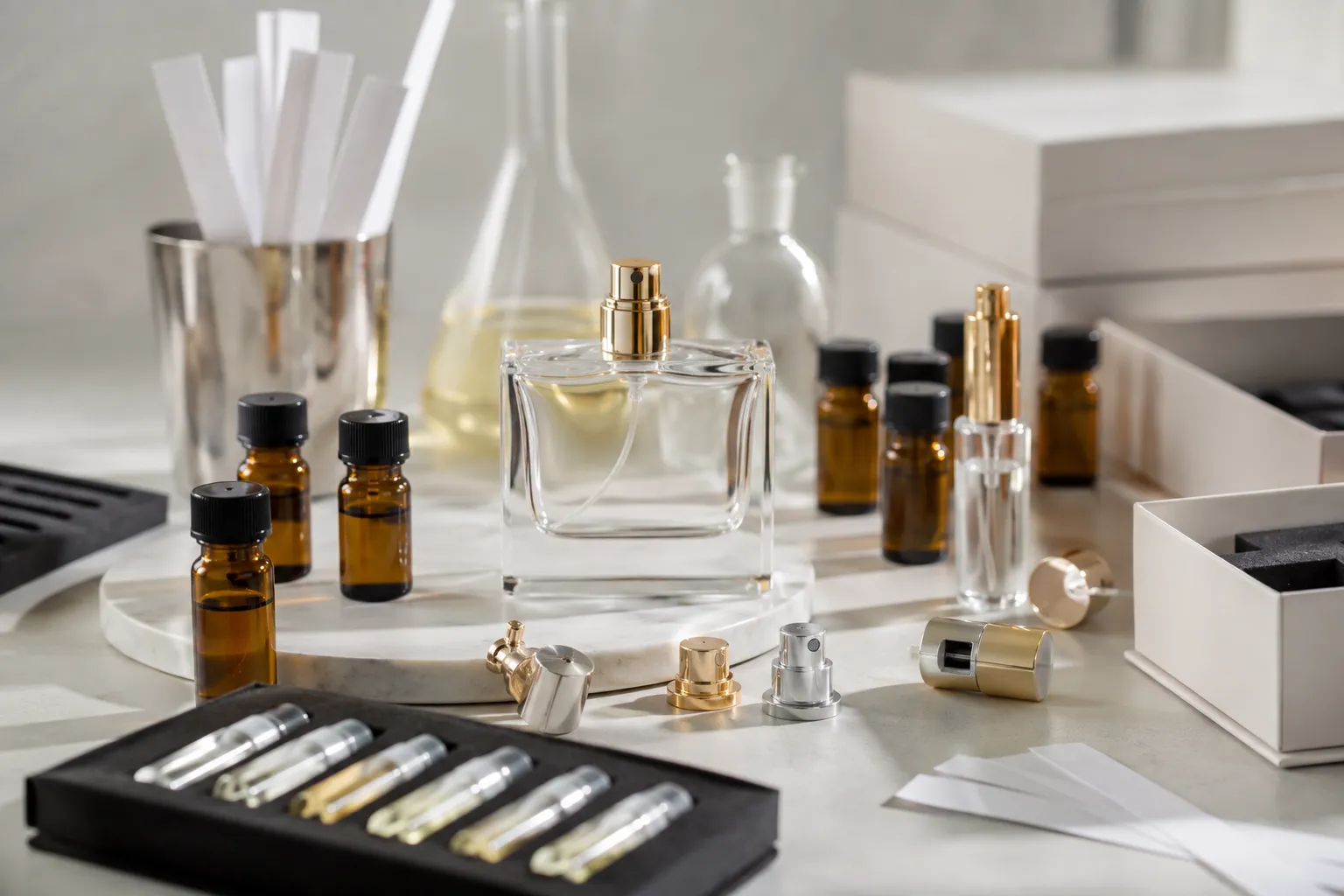
Should you choose the scent before the package and price?
No. These decisions influence one another and should not be treated as separate projects.
Start with a realistic target price and packaging range, then request fragrances that can fit that route. Once you have a shortlist, compare scent, package, quantity, MOQ, and cost together. Otherwise, you may approve a fragrance only to discover that the required concentration exceeds the target price, the bottle has a different minimum, or the packaging makes the finished product commercially unworkable.
At Jasmine, we ask about market, positioning, SKU plan, and packaging direction before we narrow the sampling route because our goal is not simply to send attractive fragrances. We want the preferred scent to have a credible path into a manufactured, packed, and export-ready product.
For a broader look at this route, see our Private Label Perfume Manufacturing service.
When should you request a revision?
Request a revision when the direction is close and you can explain what should change. Useful feedback describes the adjustment rather than replacing the entire brief.
Examples include:
- Keep the amber base but reduce sweetness.
- Make the opening fresher and less sharp.
- Reduce powder and increase clean musk.
- Option B fits the audience, but option A has the stronger opening.
- Keep the packaging fit but create a warmer dry-down.
- Maintain the woody direction with less smoke.
Avoid feedback such as “make it better,” “make it more luxurious,” “make it stronger,” or “send more options.” Those phrases do not tell the development team what to preserve or change.
Moving from a soft floral musk to a heavy oud-amber direction is usually not a revision. It is a new brief, and treating it that way saves time for both sides.
When should you reject a good-smelling sample?
Reject a sample you personally like when it does not fit the target customer, overlaps another SKU, is difficult to position, breaks the viable price, conflicts with the product format or packaging, or cannot be identified and reproduced reliably.
You should also reconsider it when the MOQ does not fit the launch, required documentation cannot be discussed for the project, or team disagreement reveals that the target customer was never defined. A scent based mainly on direct imitation is also a weak foundation for a brand that needs its own market identity.
The best sample is not simply the most beautiful scent in the room. It is the fragrance that has a clear role inside a business your team can actually launch, sell, and reorder.
How do you approve the final perfume sample?
When you approve perfume sample versions for production, do not rely on a message such as “sample three is fine.” Create a simple approval record that includes:
- Project name.
- Sample code and version.
- Product format and concentration.
- Receipt and approval dates.
- Authorized approver.
- Final comments.
- Photo of the sample label.
- Planned SKU assignment.
- Whether approval covers scent only or a wider finished-product reference.
- Any conditions still open before production.
Keep one physical reference sample and confirm which factory-held sample or coded reference will be used for production matching. Fragrance approval does not automatically approve the bottle, pump, label, artwork, carton, or finished product.
At Jasmine, our stock-fragrance and private label discussions connect the approved scent code with the next approval gates so a verbal choice does not become a production dispute. Before releasing a project into production, read our perfume manufacturing quality control checklist to review the fragrance reference, packaging, artwork, documents, and reorder controls together.
Checklist before placing the production order
- Market, channel, and target customer are defined.
- Product format, concentration, and size are clear.
- Every sample has a code and version.
- Samples were compared under consistent conditions.
- Opening, heart, and dry-down were evaluated.
- Commercial fit was considered alongside personal preference.
- Scent choice was connected to cost, MOQ, and packaging.
- Formula ownership or exclusivity was clarified where relevant.
- Final scent approval was documented.
- Bottle, pump, label, and carton have separate approval gates where needed.
- Destination-market document requirements were discussed.
- Production-matching method is understood.
- Change and reorder controls are defined.
- Production does not begin before the key approvals are closed.
This checklist is deliberately short. Its purpose is to stop a preferred sample from moving into production while important commercial or technical decisions are still open.
How do we build a more useful sample kit at Jasmine Factory?
At Jasmine Factory in Turkey, we do not treat private label perfume samples as a random box of scents. We first look at the market, channel, price position, planned SKU count, fragrance families, must-avoid notes, packaging direction, and expected quantity so the shortlist has a commercial purpose.
Depending on the project, the route may involve catalog and stock-fragrance selection, a faster ready-to-label direction, private label perfume manufacturing with deeper customization, custom fragrance development, a mixed perfume and freshener portfolio, or wholesale and distribution of existing products.
The value of the kit is what happens after selection. We connect sampling with the questions you will face next: what exactly is approved, how the fragrance fits the packaging and cost, what changes require another approval, and how the reference will be protected for production and reorders.
Request a sample kit built around your market
To make the first discussion useful, send us:
- Destination market.
- Sales channel.
- Price positioning.
- Planned number of fragrances.
- Product format, concentration, and size.
- Preferred fragrance families.
- Must-avoid notes.
- Packaging direction.
- Target launch date.
- Expected quantity per SKU.
We can then discuss which sampling route is commercially realistic and what information is still needed before we build or refine the shortlist.
Ready to discuss your project? Talk to us via WhatsApp to send your brief to our Istanbul team. If you are planning a brand-specific line, you can also review our Private Label Perfume Manufacturing service before you contact us.
Why Jasmine’s sampling process supports better production decisions
At Jasmine Factory, we see sampling as more than a fragrance-selection step. A useful sample should help the buyer understand how the scent fits the target market, packaging direction, expected price level, MOQ, and future production plan. That is why we connect sample selection with the commercial decisions that come next, rather than treating approval as the end of the process. By keeping fragrance references, packaging requirements, and production expectations aligned from the beginning, we help B2B buyers move from evaluation to manufacturing with fewer avoidable changes and a clearer basis for repeat orders.
FAQs about perfume manufacturer sample kit
How many perfume samples should I request?
Request a focused set across a limited number of fragrance families. The right number is the number your team can compare without losing decision quality; relevance to the brief matters more than the size of the kit.
Should I request stock samples or custom development?
Choose stock samples when speed and market validation matter most. Custom development is more suitable when you need stronger differentiation and can support a longer brief, revision, and approval process.
Can I compare samples from different factories?
Yes, but standardize the product format, concentration, application method, testing schedule, and scorecard as much as possible. Compare commercial factors such as MOQ, cost, packaging, documentation, and production transition alongside scent performance.
Should perfume be tested on blotter or skin?
Use blotters to screen and compare a larger set under consistent conditions, then test the shortlist on skin where appropriate. Skin chemistry varies, so do not use one person’s skin result as the only decision criterion.
When should I approve the final scent?
Approve it after evaluating the opening, heart, and dry-down and confirming that the scent still fits the market, packaging, target cost, and production route. Record the code, version, date, and authorized approver.
Does scent approval mean production can start?
No. Product specification, packaging, artwork, quantity, quotation, destination-market documentation, and pre-production approvals may still need to be closed before production starts.
Can Jasmine Factory help when my brief is incomplete?
Yes. Send the information you already have about your market, product format, fragrance direction, packaging, quantity, and launch timing. We can help structure the sampling discussion and identify which decisions need to be clarified before the next step.