The wrong perfume and air freshener manufacturing model can make a commercially sound fragrance project feel permanently difficult. Your team may be waiting for simple fragrance, packaging, or product-format changes inside a large-scale system built for fixed-volume efficiency, or paying for close development attention from a boutique perfume manufacturer that cannot protect replenishment once demand accelerates. The loss is not limited to production cost. It appears as excess inventory, slow approvals, missed retailer windows, inconsistent reorders, and a costly supplier change after your brand has already committed to the product.
This guide compares the boutique vs large-scale perfume manufacturer models based on customization, decision speed, order complexity, repeat production, and growth. It also explains when a hybrid route may be more suitable and how we at Jasmine Factory assess the right model for B2B perfume and air freshener projects in the GCC and global markets.
A boutique perfume manufacturer vs. a large-scale perfume factory
“Boutique” and “large-scale” describe how a manufacturer organizes decisions, people, purchasing, scheduling, and production. They do not prove that one factory is more premium, more reliable, or more creative than another. A boutique operation can be highly disciplined or dangerously dependent on informal knowledge. A large operation can be repeatable and responsive, or it can bury a smaller account inside a rigid system.
The practical distinction is the risk each structure is designed to control. A boutique model commonly protects access, interpretation, and controlled experimentation. A large-scale model commonly protects capacity planning, component coordination, and repeat execution. The correct choice depends on which risk could damage your next commercial stage.
A boutique perfume manufacturer
A boutique perfume manufacturer typically works through a shorter decision chain. The buyer may have direct access to the founder, perfumer, technical lead, or named project owner. That proximity is valuable when the brand brief is still evolving, feedback needs interpretation, or product decisions cannot be reduced to a standard selection form.
The model is strongest when focused access produces faster, better decisions. It is weaker when critical knowledge sits with one individual, purchasing options are narrow, or the supplier cannot explain how the approved product will be repeated after the first run. Boutique scale is therefore useful only when attention is supported by operational control.
A large-scale perfume factory
A large-scale perfume factory is generally organized around planned capacity, purchasing cycles, production schedules, component availability, and multiple projects moving through defined functions. This structure becomes commercially useful when the buyer needs predictable replenishment, several product or market versions, or coordination across commercial, technical, artwork, purchasing, and production teams.
Scale creates value only when the account receives sufficient ownership and the factory’s standardization supports the brand. A large production structure is not automatically safer if its minimums force premature inventory, its approval layers make every change impractical, or the project loses priority after onboarding.
A small batch perfume manufacturer is not automatically boutique
Batch size and operating model are separate variables. A small batch perfume manufacturer may be a large organization with a formal pilot route. A boutique facility may accept a focused quantity while restricting bottles, components, or fragrance routes. The useful question is not “Can you produce a small order?” but “Can your system manage the uncertainty and future scale attached to this order?”
For a deeper distinction between production systems rather than supplier size, review our article on the perfume production line and the role of manual and automated execution.
Planning a fragrance project but unsure which operating model fits? Send us your target market, sales channel, customization priorities, expected quantity range, and reorder assumptions. We will use those inputs to discuss a route that fits the project rather than applying one factory label to every buyer.
Also read: Bespoke Perfume Creation for B2B Brands: Complete Manufacturing Guide
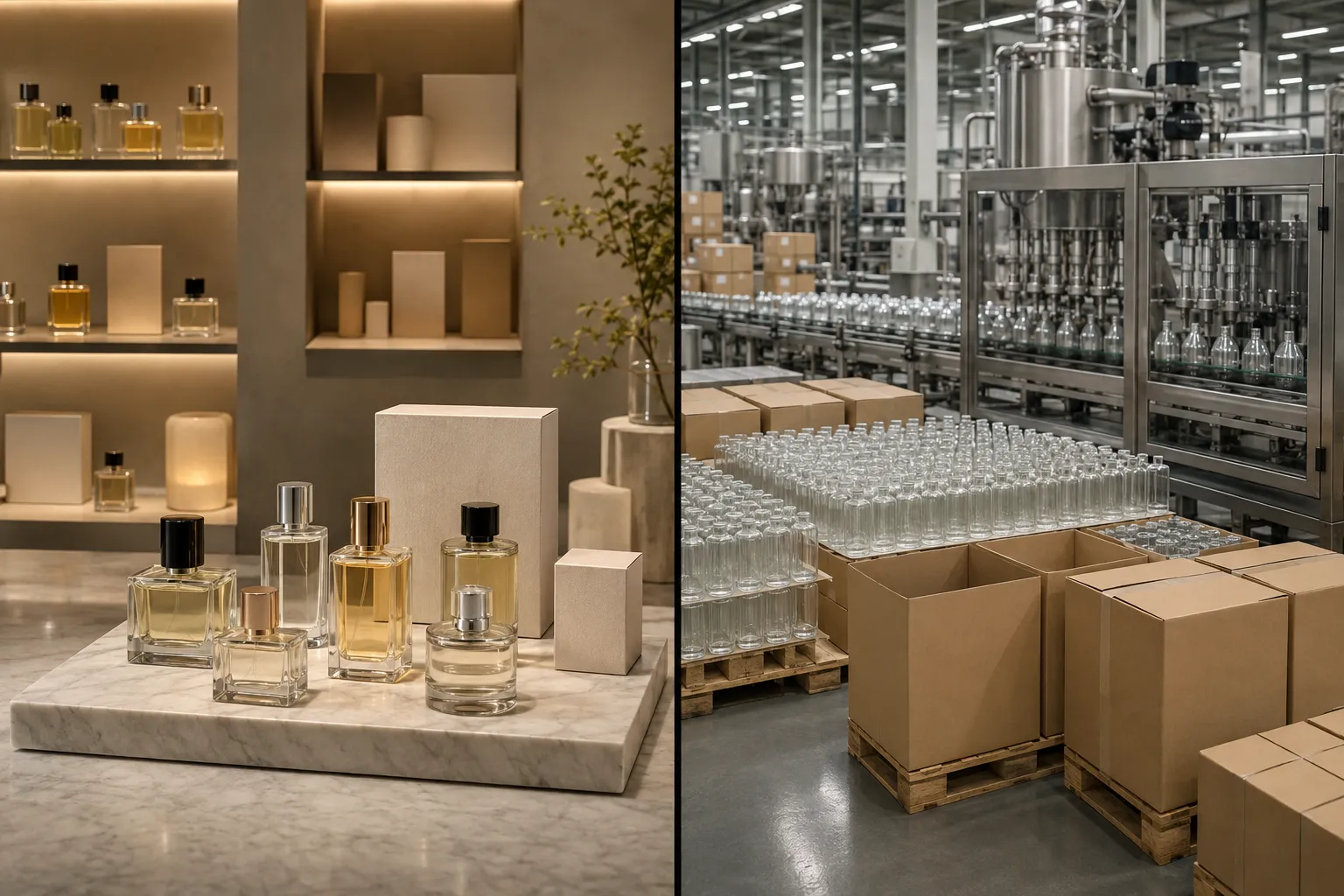
7 key trade-offs between boutique and large-scale perfume manufacturers
There is no universal winner. The stronger model changes according to the commercial condition being managed. Comparing both models under the same seven conditions prevents the buyer from choosing on reputation, factory size, or first-order convenience alone.
Development access vs. formal project structure
A boutique perfume manufacturer often gives buyers direct access to the people shaping the product, which helps when the brief is evolving or feedback requires interpretation. A large-scale perfume factory usually relies on account managers, technical teams, and production planners, creating stronger coordination across functions. Choose direct access when decisions are still changing, and a formal structure when several teams must execute the same approved direction consistently.
Customization freedom vs. repeatable standardization
Boutique manufacturers may offer more flexibility for distinctive scent directions, packaging combinations, or brand-specific details. Large-scale factories tend to favor options that can be sourced, scheduled, and repeated with fewer exceptions. Customization is valuable when it strengthens the brand proposition, while standardization is valuable when consistency and repeat production matter more. The key question is whether the factory can manage your chosen level of customization without compromising future continuity.
MOQ flexibility vs. unit economics
A lower entry quantity can reduce inventory exposure while demand is still uncertain. A higher-volume structure may improve unit economics by spreading purchasing, setup, and production costs across more units. However, a lower unit price is not commercially useful if it creates stock the sales channel cannot absorb. Compare minimums across fragrances, bottle sizes, cartons, languages, and finished SKUs rather than relying on one headline MOQ.
Fast changes vs. controlled continuity
Boutique teams may implement changes faster because fewer people are involved in approval. This is useful during early testing, but it becomes risky when decisions remain in messages or personal memory. Large-scale factories may require more formal approvals, which can feel slower but supports consistent purchasing, artwork, production, and reorders. Choose speed when controlled experimentation is the priority, and documented continuity when the approved product must be repeated reliably.
Focused attention vs. account prioritization
A boutique supplier may give the project frequent access to senior decision-makers, but that attention can become dependent on one person. A large factory may offer broader resources while prioritizing accounts according to volume or production efficiency. In both cases, confirm who owns daily execution, who can resolve issues, and whether another team member can continue the project without rebuilding its history. Personal attention matters only when it is supported by shared responsibility.
Pilot responsiveness vs. repeat-order capacity
Boutique production can suit a controlled first launch that requires close review and selective refinement. Once demand is validated, predictable replenishment, component availability, and scheduled capacity become more important. A large-scale route may be less flexible during an unusual pilot but stronger when the approved product must be reproduced frequently or in larger quantities. Before the first order, ask how the project will move from pilot production to repeat orders.
Early flexibility vs. supplier-switch risk
A highly flexible supplier can simplify the first launch, but the brand may later outgrow its production or coordination capacity. Changing factories can require the transfer or recreation of fragrance references, packaging details, artwork versions, approvals, and commercial expectations. A more scalable system may demand greater discipline from the beginning, yet reduce the risk of rebuilding the product later. Evaluate the likely second and third orders, not only the easiest route to launch.
Also read: Backup Perfume Manufacturer: Is One Supplier too Risky?
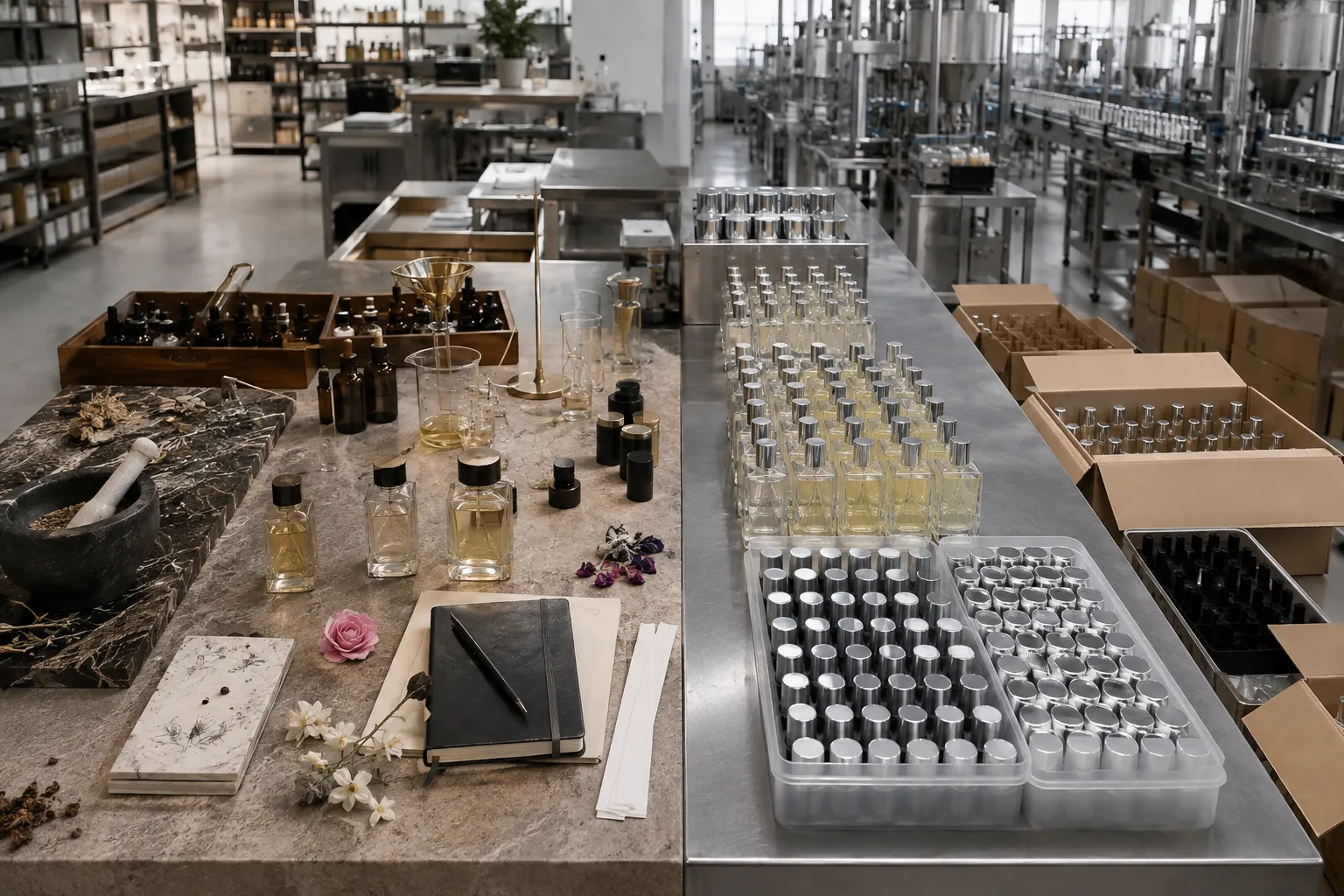
Choose a perfume factory by project stage, not company size
Company size does not determine the right manufacturing model. A new brand may already have proven demand, while an established distributor may still be testing an uncertain concept. The better choice depends on demand confidence, coordination needs, and the project’s next commercial stage.
Early demand testing
A boutique or hybrid model may fit when the customer, fragrance direction, packaging, price, or sales channel is still being tested. Close communication allows the project to respond to market feedback without locking decisions too early. A large-scale factory can also work if it offers a defined pilot route and a clear transition into repeat production.
Validated product with predictable reorders
A large-scale or hybrid model becomes more valuable when the product is stable and reorders can be planned. At this stage, component continuity, production scheduling, and repeatable execution usually matter more than frequent changes. A boutique manufacturer can still fit specialist or limited-edition projects if its capacity supports the expected reorder rhythm.
Multi-market distributor or retail rollout
Selling across several markets increases coordination complexity even when total volume remains moderate. Artwork languages, importer details, barcodes, cartons, and delivery plans must remain aligned across versions. A large-scale or hybrid model is often better suited to this structure, although a well-organized boutique supplier may still support a focused rollout with limited variation.
Premium niche project with planned volume
Premium positioning does not automatically require a boutique manufacturer. Distinctive packaging, decoration, fragrance references, and multiple market versions may need substantial purchasing and production coordination. A scalable model can protect consistency at higher volumes, while a boutique partner remains suitable when its specialist capabilities are central to the product and its capacity matches the growth plan.
Also read: Perfume Factories in Istanbul: Your Guide for the Best Manufacturer
A hybrid model supports more controlled fragrance production scaling
A hybrid model combines boutique-style access with the systems needed for fragrance production scaling. It allows a brand to test and refine its concept while building a clear route into repeat production, reducing the risk of changing suppliers after launch.
Boutique access with scalable production systems
The buyer keeps a named project owner and direct access to the team interpreting the brief. At the same time, approved components, artwork, and production references remain accessible to the teams responsible for purchasing, scheduling, manufacturing, and packing future orders.
This structure preserves project context while adding the discipline required for consistent production.
A controlled transition from pilot to repeat orders
Repeat orders should not depend on messages or personal memory. The manufacturer should define what was approved, what remains unchanged as volume grows, which changes require new validation, and who manages the transition.
A controlled handoff helps ensure that the commercial product remains consistent with the approved pilot.
Packaging growth without rebuilding the supply chain
A hybrid route may allow the brand to begin with a practical packaging configuration and add justified variations as demand becomes clearer. Existing components and approvals can remain in place where possible, while new bottles, labels, cartons, or market versions are introduced only when commercially necessary.
The buyer should confirm which changes create new minimums, approvals, or sourcing requirements.
Capacity growth with clear accountability
Scaling should not remove personal ownership of the project. A credible hybrid model combines greater production coordination with a named person or team responsible for approved references, buyer requests, and changes across commercial and operational functions.
At Jasmine, we review the product format, customization level, quantity range, target markets, and expected reorder pattern before discussing whether a hybrid route is suitable for the project.
Need close project communication now and a credible route to larger repeat orders later? Contact Jasmine with your launch assumptions and expected scale path so we can discuss whether a focused, scalable, or hybrid route is commercially realistic for your project.
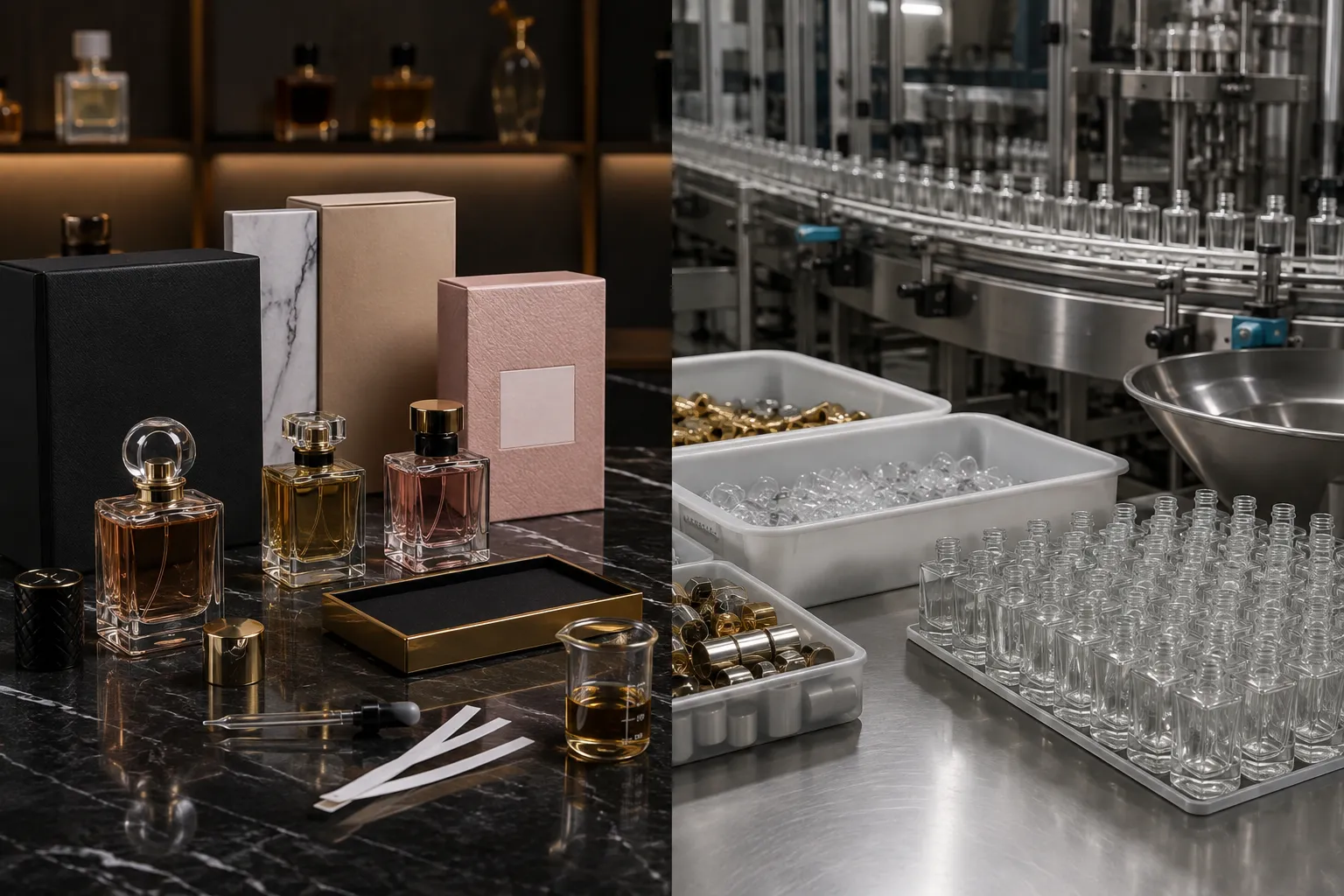
Warning signs of a poor fit between factory model and project needs
A warning sign matters only when it shows that the supplier’s operating model does not match the project’s current or future requirements. It should not be used to assume that every boutique factory is fragile or every large-scale factory is inflexible.
When a boutique model becomes risky
- Critical project knowledge depends on one person.
- Component availability cannot support the expected reorder cycle.
- The supplier cannot explain how production will scale.
- Multiple market or artwork versions exceed its coordination capacity.
- Repeat orders depend on informal memory rather than controlled references.
These signs suggest that the supplier’s strengths may not support the project’s next stage.
When a large-scale model becomes risky
- Minimums create inventory exposure before demand is validated.
- The account loses priority after onboarding.
- Reasonable changes move through slow approval layers with no clear escalation owner.
- Standardization weakens the intended brand identity.
- The buyer must commit to scale before key assumptions are stable.
A large-scale factory is not the safer choice when its efficiency requires decisions the buyer is not ready to finalize.
When a hybrid model is only a claim
- Pilot and repeat production operate as separate systems.
- Volume triggers and responsibility changes are unclear.
- Teams do not share one project owner or approval reference.
- Pilot components cannot support the expected commercial stage.
- The supplier cannot explain how the approved product will be reproduced at higher capacity.
A credible hybrid route should define what remains unchanged, what requires new approval, who manages the transition, and how accountability continues as production grows.
How to choose a perfume factory model in five steps
Choose the operating model by evaluating the project’s demand, decision stability, coordination needs, reorder risk, and growth path—not by factory size alone.
Step 1 – Assess demand certainty
Classify demand as untested, partly validated, or supported by recurring orders. Untested demand increases the value of flexibility, while predictable reorders increase the need for capacity, continuity, and structured coordination. Partly validated demand often supports a hybrid route.
Step 2 – Identify decisions that may change
List the assumptions that may still move, including fragrance direction, packaging, label languages, product format, sales channel, and market positioning. The more decisions remain open, the greater the risk of choosing a rigid production model too early.
Step 3 – Measure coordination complexity
Review how many markets, SKUs, artwork versions, channels, and components the factory must manage. A focused one-market launch may suit a simpler structure, while a multi-market project can require formal coordination even at a moderate volume.
Step 4 – Evaluate reorder risk
Consider the commercial effect of a late, inconsistent, or incorrectly produced reorder. The impact may be limited during a small test, but it can become serious when retailer launches, distributor commitments, seasonal sales, or several markets depend on timely replenishment.
Step 5 – Ask how the project will scale
Request a clear explanation of:
- What remains unchanged as volume grows.
- Which components or processes must change.
- What requires new approval.
- Who manages the transition.
- How approved references are protected.
- Whether pilot and repeat production remain within one controlled system.
Do not accept “we can scale” without understanding the operating process behind the claim.
- Choose a boutique when uncertainty is high, decisions are still changing, and close development access matters most.
- Choose large-scale when demand is validated, coordination is complex, and reliable repeat production is the priority.
- Choose hybrid when the project needs flexibility during development and structured continuity as demand grows.
These directions support the initial decision, but the manufacturer must still demonstrate that its systems can deliver the selected model in practice.
Also read: Turnkey Private Label Perfume Manufacturing for B2B
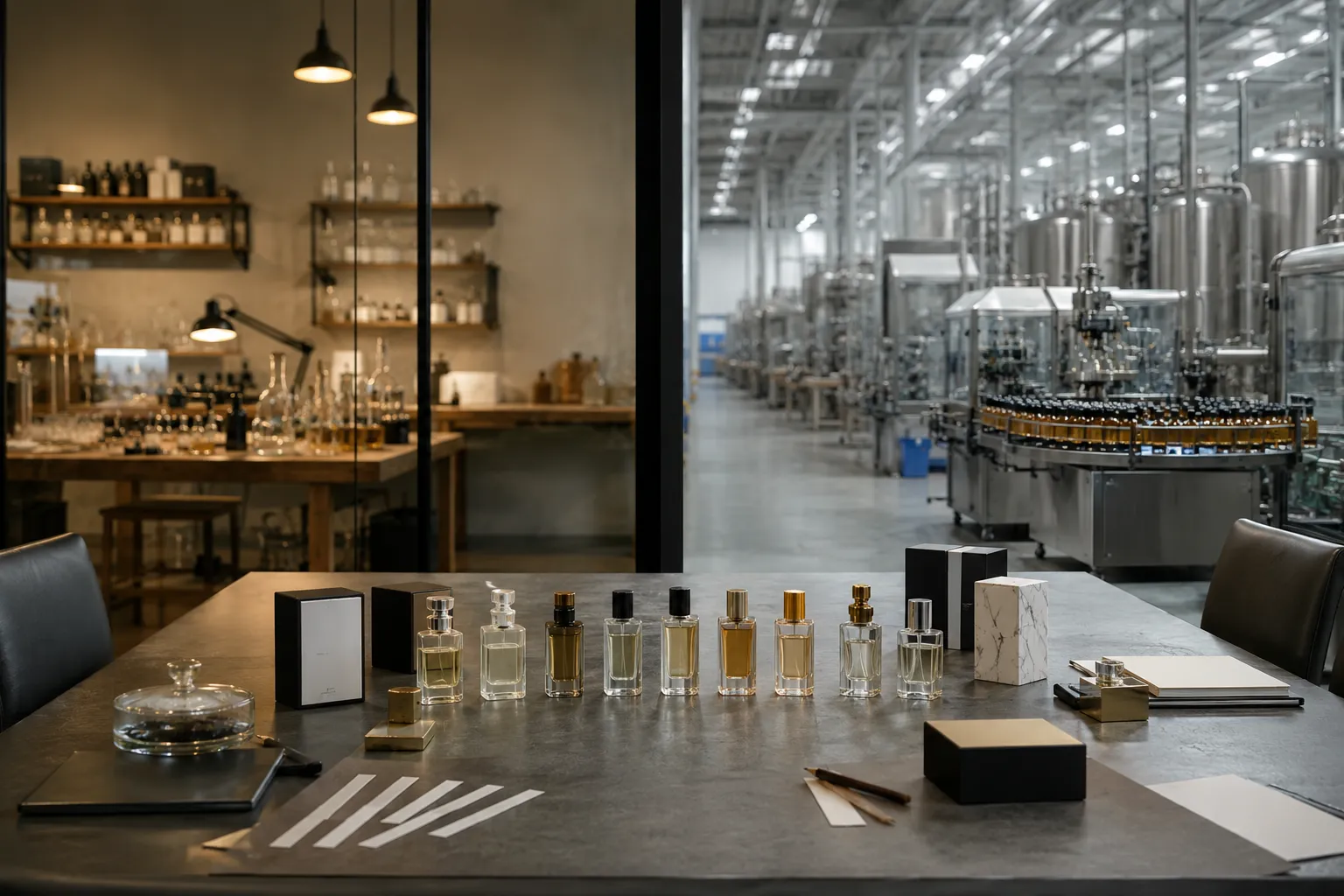
Why do brands choose Jasmine for scalable private label perfume manufacturing?
At Jasmine Factory in Turkey, we assess each project by its market, sales channel, customization level, expected quantity range, and reorder plan. From our manufacturing base in Istanbul, Turkey, we work with B2B buyers serving the GCC and other international markets.
As a private label perfume manufacturer and perfume manufacturer in Turkey, we can discuss focused launch routes, scalable repeat-production routes, and hybrid models based on the project’s actual requirements. MOQ, lead time, capacity, and production structure vary according to the fragrance, packaging, finished SKUs, destination markets, and approval needs.
To assess the most suitable route, share:
- Target country or markets.
- Main sales channel.
- Product format and positioning.
- Fragrance and packaging customization needs.
- Expected quantity range.
- Launch timing and reorder expectations.
- Language, artwork, and market-version requirements.
- Decisions that remain open before the first order.
Our discussion should identify whether your project needs:
- A focused route for testing uncertain demand.
- A scalable route for predictable reorders and multiple versions.
- A hybrid route that connects early flexibility with production continuity.
We also clarify which decisions must be finalized before production, which can remain flexible, and where inventory or supplier-switch risks may arise.
For a broader overview of outsourcing, review our Private Label Perfume Guide for B2B Business and private label manufacturing service page. You can also explore Jasmine’s homepage and online catalogs before sending your project details via WhatsApp
Contact us so we can discuss a manufacturing route aligned with your present uncertainty and commercially realistic growth path.
FAQs about boutique vs large-scale perfume manufacturer models
Is a boutique perfume manufacturer always better for a small launch?
No. Opening quantity is only one factor. Demand uncertainty, change frequency, development access, component structure, and the expected reorder route may make a boutique, large-scale, or hybrid model more suitable.
Does a large-scale perfume factory always offer less customization?
No. A large factory may offer substantial customization. The practical difference is often how changes are approved, what they affect operationally, and how the revised version enters production control.
Can a small batch perfume manufacturer support large reorders later?
Sometimes. Verify the scale route before launch: capacity planning, component continuity, approval transfer, responsible teams, and whether the approved product can remain inside one controlled system.
When should a brand move from boutique to large-scale production?
A move becomes more logical when demand, product definition, packaging, and reorder requirements are stable enough for greater capacity and coordination to create more value than continuous flexibility.
Can one private label perfume manufacturer support both models?
Yes, when the manufacturer has a genuine hybrid route. It must preserve approved references and accountable communication while adapting production planning and coordination as the project grows.
What is the main question before you choose a perfume factory?
Ask which operating system can manage the project’s current uncertainty while supporting its next commercially realistic stage. That question is more useful than asking whether the supplier is simply boutique or large-scale.