An approved fragrance can still become the wrong commercial product. The scent sample may be correct, yet the 50 ml bottle receives the 100 ml artwork, the GCC carton carries an outdated importer line, or a reorder follows a superseded component reference. These are not creative failures. They are document-control failures that put launch dates, inventory, and capital at risk. A perfume product specification sheet prevents those decisions from remaining scattered across emails, quotations, sample labels, and artwork folders.
At Jasmine Perfumes, we manufacture perfumes and fragrance products in Turkey for B2B buyers in the GCC and international markets. This guide shows you how to turn an approved concept into one controlled reference for each SKU: what fields to include, how to identify packaging and artwork, who approves changes, and how the effective version supports production and reorders.
What is a perfume product specification sheet, and why does it matter?
A perfume product specification sheet links a finished commercial SKU to the approved fragrance, packaging, artwork, market and revision references required to execute it. Its commercial value is simple: everyone should work from the same product definition, not from the latest email someone happens to find.
A useful private label perfume specification sheet may include the finished SKU code, scent reference, concentration, bottle and pump references, label and carton files, target market, packing configuration, approvers and effective revision. It may sit beside a Technical Data Sheet, but the documents are not interchangeable. A Technical Data Sheet communicates defined technical properties or handling information; the product specification controls the approved configuration of the finished commercial item.
How is it different from a fragrance brief or QC checklist?
A fragrance brief guides creation while options are still open. The specification records the decision after the fragrance and product direction have been narrowed. For the development document itself, read how to brief a perfumer.
A quality-control checklist answers a different question: how conformity will be checked. The specification answers what must be produced.
| Document | Primary question | What it controls | What it should not replace |
| Fragrance Brief | What should we create? | Audience, olfactive direction, positioning and development inputs | The approved finished-product record |
| Product Specification Sheet | What exactly has been approved? | SKU, fragrance reference, components, artwork, market, packing and revision | Testing methods, contracts or regulatory review |
| Quality-Control Checklist | How will conformity be checked? | Inspection points and acceptance checks | The master definition of the approved product |
Keep testing procedures in the dedicated perfume manufacturing quality control process. Overloading the specification with inspection instructions makes the file longer without making the product definition clearer.
What information belongs in the specification header?
The header establishes document identity and tells the team whether the copy in front of them is a draft, an approved revision or an obsolete version. Without this control layer, even accurate product data can be used at the wrong time.
Use concise fields that identify the product, market, owner and point of effect. The examples below are educational and do not describe a published Jasmine internal numbering system.
What should a controlled header identify?
A controlled specification header should identify:
- Document title and ID: separates the controlled specification from informal notes and attachments.
- Product family or project: connects the document to the correct collection.
- Finished SKU: identifies the exact commercial product.
- Market and language: prevents one market version from replacing another.
- Document owner: shows who maintains and distributes the current revision.
- Revision and status: distinguishes draft, approved and superseded versions.
- Approval and effective point: identifies who released the document and the order from which it applies.
Also read: Leading Private Label Perfume Manufacturer in Turkey
How should the approved fragrance reference be documented?
The fragrance section should identify the accepted scent without turning the specification into a sampling guide. The goal is traceability: the commercial SKU must point to one approved reference that can be located and understood.
- Approved scent or sample reference: use a traceable code rather than a description such as “final floral sample.”
- Product format and concentration: record the agreed EDP, EDT, body mist or other format and the approved strength.
- Sample version and approval date: show which version was accepted and when the decision became effective.
- Supporting file or storage location: point to the approved sample record or attachment without embedding uncontrolled duplicates.
- Approval notes: include only comments that form part of the final decision.
Any comment that can change the product must move out of chat or email and into the current controlled revision. Two samples should never remain described as “final,” and a concentration change should never be assumed to carry across sizes or markets unless the specification says so.
This clarity protects the value of the approved fragrance. It reduces the chance that later packaging work, quotation updates or reorders refer to a different scent version than the one your team selected.

How should packaging components be controlled as one system?
A bottle, pump, cap, label and carton should not be managed as unrelated visual choices. Together they form the packaging component specification for the finished SKU, so each approved part needs an identifiable reference.
A compact Bill of Materials is more reliable than a folder of photographs. It helps the buyer, manufacturer and purchasing team distinguish visually similar parts and understand whether an alternative is allowed.
| Code | Component | Approved reference | Finish / quantity | Alternative status |
| BTL-50-02 | 50 ml bottle | Supplier or catalog reference | Clear glass / 1 per unit | Current approved revision |
| PMP-15-01 | Spray pump and dip tube | Supplier reference | Silver / 1 per unit | No alternative unless approved |
| CAP-02 | Cap | Catalog reference | Black / 1 per unit | Approved alternative recorded separately |
| LBL-F01-EN | Label or decoration | Artwork file and print reference | English GCC / 1 per unit | Revision-controlled |
| CTN-F01-50 | Retail carton | Dieline and artwork reference | P2 finish / 1 per unit | Market-specific |
Record each component’s code, name, supplier or catalog reference, material or finish, color, quantity per unit, allowed alternative and revision status. Similar-looking pumps, caps or bottles can differ in compatibility, decoration area, assembly method or supplier identity.
The specification should identify what was approved. Compatibility, leakage, spray performance and transport checks remain part of the quality-control scope, not a substitute for a controlled component reference.
Add inserts, protective supports or master-carton components only when they form part of the approved pack configuration. Each additional part should receive the same reference and alternative-control treatment as the primary packaging components.
How should each perfume SKU and artwork version be identified?
The scent name alone cannot control size, concentration, language, barcode, importer information or packaging version. A perfume SKU specification must distinguish every finished commercial variation that needs separate inventory, market or file control.
A separate SKU may be required when the fragrance, size, concentration, language, barcode, importer line, carton or packaging version changes. The final structure should follow the buyer’s inventory, registration and destination-market requirements; the responsible importer must verify what applies in each market.
The following educational matrix shows why one fragrance can create several finished commercial SKUs when size, language, packaging or barcode references change.
| Finished SKU | Fragrance / size | Market / language | Packaging version | Artwork and barcode reference |
| BRAND-F01-50ML-EN | F01 / 50 ml | GCC / English | P2 | SKU-F01-50-EN-R5.pdf / BC-001 |
| BRAND-F01-100ML-EN | F01 / 100 ml | GCC / English | P2 | SKU-F01-100-EN-R3.pdf / BC-002 |
| BRAND-F01-50ML-AR | F01 / 50 ml | GCC / Arabic | P2 | SKU-F01-50-AR-R4.pdf / BC-003 |
| BRAND-F02-50ML-EN | F02 / 50 ml | International / English | P1 | SKU-F02-50-EN-R2.pdf / BC-004 |
What must artwork version control record?
For every label or carton, record the final filename, artwork revision, print dimensions, language, barcode reference, batch-code area, approval date and location of the approved production file. Avoid filenames such as final-new-approved-2.pdf. A useful filename connects the file to one SKU and one revision.
Archive earlier artwork as superseded instead of leaving multiple apparently final files in circulation. This reduces reprinting risk and makes it easier to confirm which language and importer data belong to each destination.
Send us via WhatsApp your current SKU list, fragrance references, bottle and packaging choices, artwork status, target countries and unresolved decisions. At Jasmine, we can then discuss the project around the actual commercial variations instead of a general request for “one perfume line.”
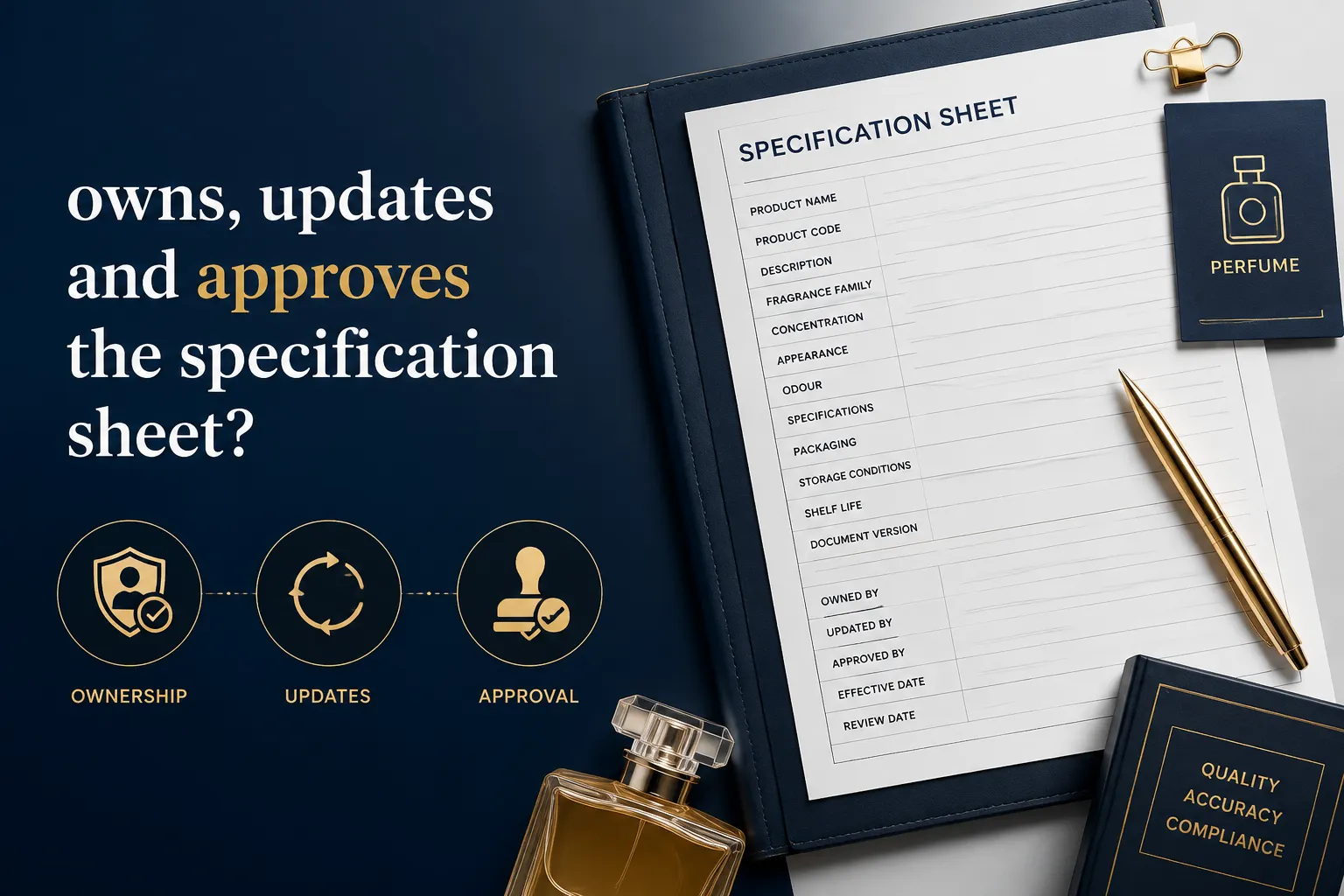
Who owns, updates and approves the specification sheet?
Document control works only when responsibility is visible. One person may hold several roles in a small company, while a larger importer or retail group may divide them, but the file must show who requests, reviews and releases a change.
Assign clear document-control roles
Role names may differ between a small brand and a large procurement team, but the responsibility behind each decision must remain visible.
Document owner
Maintains the current controlled version and distributes it to the relevant parties. This reduces the risk of teams working from different files.
Commercial owner
Confirms the market, sales channel, quantities and SKU requirements. This protects the project from product-market mismatches.
Technical reviewer
Checks that the references are sufficiently clear and usable for the agreed manufacturing scope. This helps expose missing or conflicting inputs before release.
Artwork approver
Confirms the final language, barcode and visual files connected to each SKU. This reduces the risk of printing the correct design for the wrong product or market.
Final approver
Authorizes the effective revision for the stated order or project stage. No production-changing revision should become active without a named approval point.
In smaller projects, one person may perform several roles. The important requirement is to record who requested the change, who reviewed its impact and who released the final revision.
The specification identifies document roles; it does not replace the commercial and legal allocation of responsibility. When ownership, confidentiality, artwork rights or acceptance terms need to be defined, address them in the private label manufacturing agreement rather than trying to turn the product sheet into a contract.
How should specification changes and perfume revision history be controlled?
A specification becomes most valuable after the first approval, because products continue to change. Perfume revision history prevents an updated carton, component or fragrance reference from moving forward while the master file still describes the old product.
Create a new revision whenever an edit can change what is purchased, manufactured, printed, packed, released or reordered. Even a small barcode, language or packing-quantity change can affect the commercial unit.
| Revision / date | Change | Affected item | Previous -> new reference | Approval and Effective Order |
| Rev 04 / YYYY-MM-DD | Updated English carton artwork | BRAND-F01-50ML-EN | R4.pdf -> R5.pdf | Approved for PO-XXXX |
| Rev 05 / YYYY-MM-DD | Changed pump finish | PMP-15-01 | Silver A -> Silver B | Effective after approval |
| Rev 06 / YYYY-MM-DD | Added Arabic market version | SKU matrix | No SKU -> BRAND-F01-50ML-AR | Effective for GCC order |
The change log should record the revision number, date, reason, affected SKU or component, previous reference, new reference, requester, reviewer, approver and effective order or batch. Mark old copies as superseded and preserve their history; do not allow them to support a new release.
For a reorder, the current document becomes the reorder specification file. It allows the buyer and manufacturer to decide whether the order is an exact repeat of the effective version or a controlled change that requires a new revision before release.
How the specification supports each project decision
Quotation
The document clarifies the requested SKU and component scope, allowing the manufacturer to understand what is confirmed and what remains provisional. Pricing formulas and detailed MOQ analysis should remain outside the specification.
Sampling approval
The sheet connects the accepted scent reference to the future commercial SKU. Sensory evaluation and sample-testing methods belong in the development and quality-control processes.
Packaging sourcing
It records the bottle, pump, cap, artwork and carton references required for the approved product. Detailed compatibility tests should remain in the appropriate quality-control records.
Production release
It identifies the effective product revision that should be manufactured. It does not replace a complete pre-production or inspection checklist.
Change request
It shows what changed, which SKU or component is affected and when the new revision becomes effective. Contractual disagreements remain governed by the manufacturing agreement.
Reorder
It allows the buyer and manufacturer to reuse approved references and determine whether the next order is an exact repeat or a controlled revision.
This progression makes quoting more accurate, protects the production decision and reduces the time spent reconstructing the product at reorder. It also keeps open decisions visible instead of allowing an incomplete product to look approved.
What does a reusable perfume product specification template include?
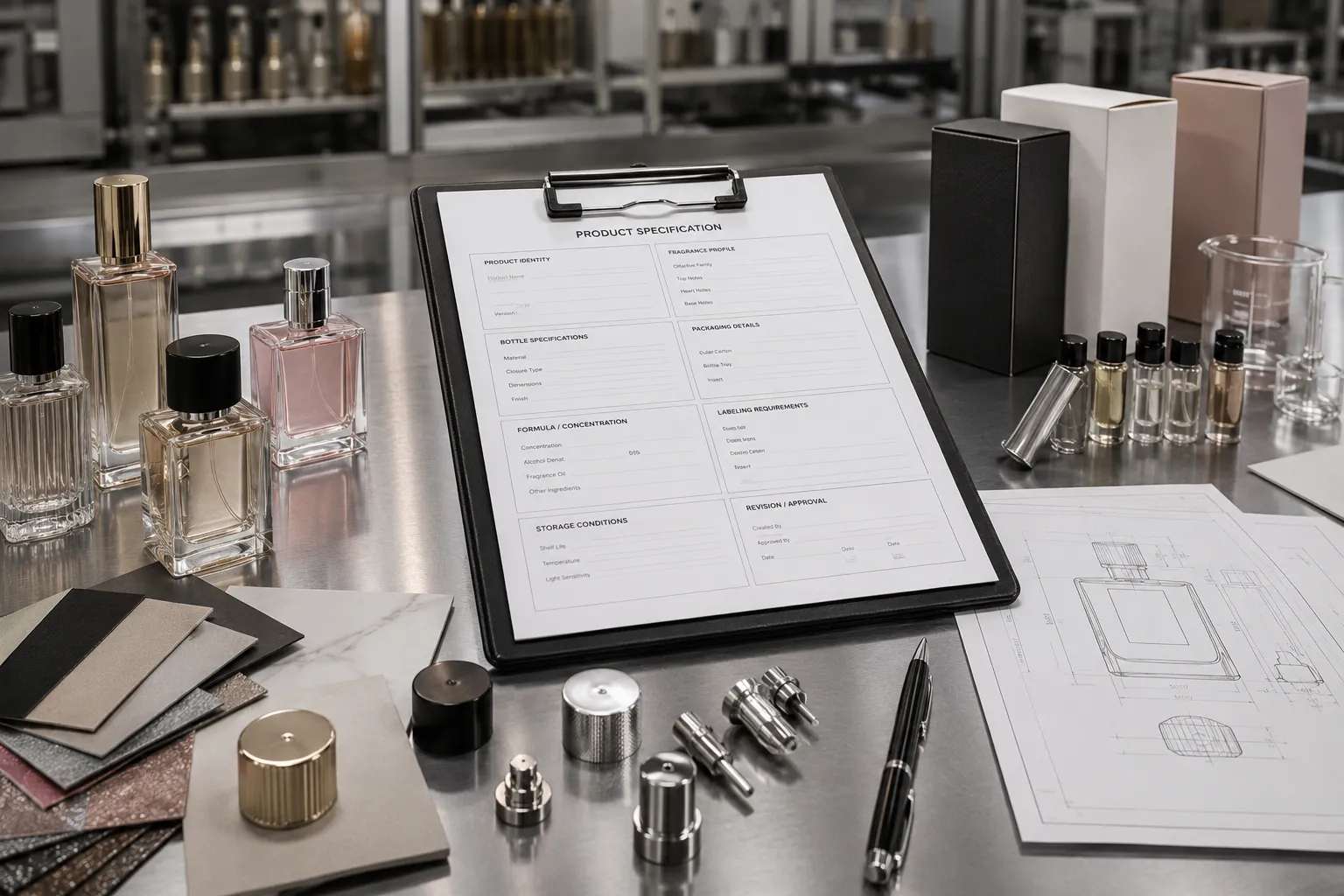
A reusable template should be short enough to maintain and complete enough to locate every approved reference. The objective is not paperwork volume; it is one reliable definition of the finished product.
- Document header, owner, status and revision
- Commercial product name, finished SKU and target market
- Approved fragrance or sample reference
- Concentration, product format and bottle size
- SKU matrix for sizes, languages and packaging versions
- Bill of Materials for bottle, pump, cap, label, carton and inserts
- Artwork, barcode and print-file references
- Packing configuration and master-carton reference
- Controlled attachments and file locations
- Approval block and effective order or batch
- Revision history and superseded-version record
This is an educational model. It does not state that our factory uses these exact document names, codes, fields, approval roles or internal procedures. The appropriate format depends on the agreed product and project scope.
What should you send Jasmine Factory for a useful project review?
A useful review starts with current references, not a general request for price. When your product information is structured, we can focus the discussion on what is approved, what is missing and which decisions can change the manufacturing scope.
- Company name, country and buyer type
- Target market and sales channel
- Product format, concentration and bottle size
- Number of fragrances and expected quantity per SKU
- Current fragrance or sample references
- Preferred bottle, pump, cap and packaging references
- Artwork status, languages, barcode and importer data
- Target launch date and destination
- Known documentation or registration questions
- A clear list of unresolved decisions and authorized approver
From our perfume and fragrance manufacturing base in Turkey, we work with importers, distributors, retailers and private-label buyers serving the GCC and other international markets. Through our private label service, we can discuss how your approved fragrance, packaging, artwork and SKU references fit the project you want us to review.
Send us via WhatsApp the current files and identify every unresolved point. We will keep the discussion tied to your actual products and destination requirements, while final execution details remain subject to the agreed scope and applicable market requirements.
FAQs about perfume product specification sheet
What is a perfume product specification sheet?
It is a controlled record defining the approved configuration of a finished perfume product. It links the SKU to the fragrance reference, concentration, packaging, artwork, market version, approvals and effective revision.
Is a product specification sheet the same as a fragrance brief?
No. The brief guides creation while options may remain open. The specification records the approved finished product and connects that decision to the commercial SKU and production references.
Is it the same as a Technical Data Sheet?
No. A Technical Data Sheet may communicate defined technical or handling information. The product specification controls the approved commercial configuration and its connected files.
Does every fragrance, size or language need a separate SKU?
Not automatically, but many variations create distinct commercial units. Review fragrance, size, concentration, language, barcode, importer data and packaging against inventory and destination-market requirements.
Who should approve the final specification?
The sheet should name one authorized final approver and tie approval to a revision, date and effective order or project point. Commercial, technical and artwork reviewers may support that decision.
When does a product change require a new revision?
Use a new revision whenever a change can affect purchasing, manufacturing, printing, packing, market identification or reordering, including changes to fragrance, concentration, components, artwork, barcode or SKU structure.
How does the specification support a reorder?
It shows the last effective product references and revision history. The buyer and manufacturer can then confirm whether the new order repeats the current version or introduces controlled changes before release.