An approved scent and product specification do not prove what happened during actual production. Your team may know which perfume should have been made, yet still lack a reliable link between the finished bottles, the materials issued, the packaging version used, the actual quantity produced, and any difference reviewed during the run. A perfume manufacturing batch record closes that gap. Without it, complaint investigations and reorders can depend on memory, old emails, or incomplete shipping documents.
At Jasmine Perfumes, we manufacture perfumes and fragrance products in Turkey for B2B buyers serving the GCC and international markets. This guide explains what a useful batch record should identify, how it links material and packaging lots to finished units, how deviations and release decisions are recorded, and what traceability information a private-label buyer can discuss with the factory.
Why does an approved specification not prove what happened in one batch?
The specification and the batch record control two different risks. One defines the target product; the other records the execution of a specific run. Treating them as interchangeable leaves the buyer with an approved design but no reliable history of what was actually issued, packed or reviewed.
A perfume product specification sheet should identify the approved product, SKU, fragrance reference, concentration, components and artwork revision. A perfume batch record should point back to that effective specification and capture actual batch data. This distinction is the foundation of perfume batch traceability.
| Control point | Product Specification Sheet | Batch Manufacturing Record |
| Main question | What should be manufactured? | What happened in this batch? |
| Scope | The approved product or SKU | One identifiable production batch |
| Timing | Before production and during approved changes | During execution and batch closeout |
| Core evidence | Approved fragrance, components, artwork and revisions | Actual quantities, lots, results, deviations and status |
| Business use | Production authorization | Traceability, investigation and reorder comparison |
Invoices and packing lists are also insufficient. They confirm commercial quantities, cartons and shipment references, but they do not normally show which material lots, component versions or production observations sit behind the finished goods. That operational history belongs in controlled perfume batch documentation.
Also read: Perfume Development Timeline: From Concept to Shelf
Which fields make a batch record retrievable?
A batch record header should identify the production run before anyone reads the detailed entries. Include:
- Product name and finished SKU: identifies the exact commercial item, size, concentration and market version.
- Batch or lot number: provides the primary retrieval reference for the production run.
- Production-order reference: connects the batch to the manufacturing instruction.
- Customer-order reference: links it to the relevant purchase order or project.
- Approved product reference: identifies the applicable specification, fragrance sample and packaging revision.
- Planned and actual output: shows the target quantity and the quantity accepted after execution.
- Production and packaging dates: establish when the relevant activities occurred.
- Review or release status: indicates whether the batch is open, held, reviewed or released.
- Artwork and language version: links the batch to the correct market-facing files.
How should material and packaging lots be linked to the batch?
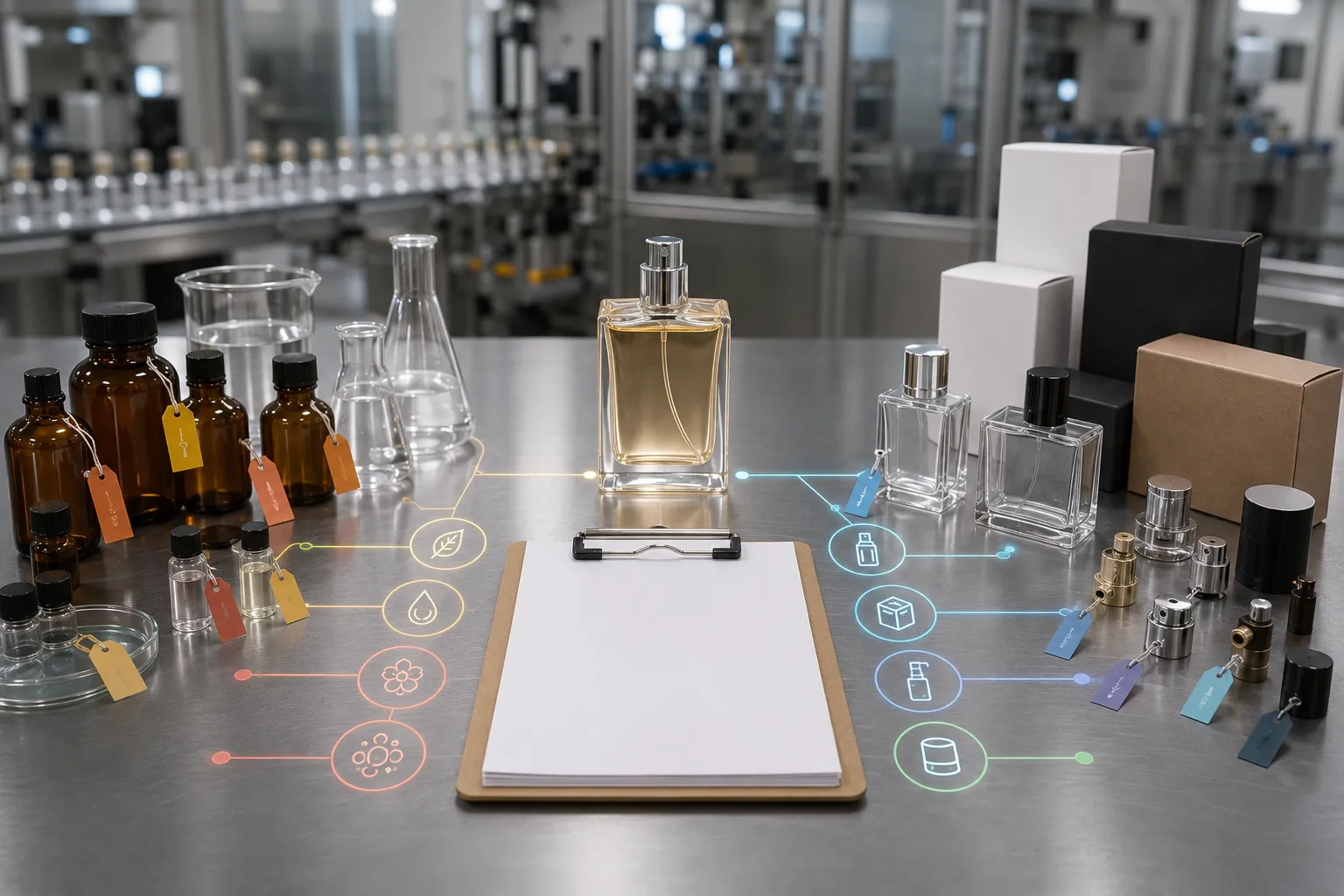
Material and component references create the traceability chain between incoming items and finished units. The purpose is not to disclose a confidential formula or every supplier detail; it is to retain enough controlled linkage to investigate an affected batch fairly.
Which fragrance and base-material data may be recorded?
Depending on the factory’s controlled method and the agreed scope, fragrance manufacturing records may include the material or internal reference, material lot, quantity issued, actual quantity used, status, and responsible reviewer. A quantity difference should show whether it was corrected, reviewed or escalated.
Which packaging components need batch linkage?
The bottle, pump, dip tube, collar, cap, label, carton, insert and master-carton configuration may each require a component reference or lot link. This matters because a packaging complaint can affect a narrower quantity than a fragrance concern.
- Material or Component Lot
- Production Batch
- Filled Units
- Master Cartons
- Shipment
Component linkage helps separate scent issues from packaging issues, define the affected quantity and identify obsolete versions. The article should not become a full inspection guide; for the tests and approval gates themselves, use our perfume manufacturing quality control guide.
Before you approve bulk production, send us your product type, SKU list, bottle and packaging references, label languages, quantities, target market and the batch information your team may need for complaints or reorders. We can then discuss the relevant project and handover scope instead of making assumptions after production.
How should stage data be recorded without turning the file into a manufacturing manual?
1. Issuing and compounding record
Identify the approved product reference, material lots, quantities issued, actual quantities used, execution date, responsible reviewer and any observation requiring follow-up.
2. Resting and filtration record
Record the relevant dates, bulk-container reference where applicable, completion status, observations and the decision to proceed. The purpose is to link the completed stage to the correct bulk batch, not to explain the technical process.
3. Filling and closing record
Connect the batch to the fill size, bottle and sprayer references, planned units, accepted units, rejected units and any quantity requiring rework or review.
4. Labeling and packing record
Identify the artwork revision, language, barcode, carton version, packing configuration and final carton count for each applicable SKU.
5. Batch review and release record
Summarize open issues, reviewed deviations, affected quantities, final disposition, reviewer and date. The status should make clear whether the batch was released, held, reworked or rejected.
How should results, deviations and release decisions be documented?
A record that captures only successful steps is incomplete. Buyers need to understand how a meaningful difference is described, which quantity it affected and what decision followed.
A deviation is a documented difference between the approved instruction or reference and actual execution. It can involve a quantity, component version, interrupted stage, unexpected observation or result requiring review. A deviation does not automatically mean rejection; it requires an evaluated and recorded disposition.
| Checkpoint | Expected vs actual | Status | Recorded decision |
| Packaging version | Expected: Carton Rev 05. Found: Rev 04 before use. | Hold | Segregate obsolete cartons and confirm the approved stock. |
| Filled quantity | Planned: 5,000 units. Accepted: 4,920 units. | Review | Reconcile rejected and reworked quantities before closeout. |
| Sprayer reference | Approved: PMP-15-01. Proposed: alternative pump. | Pending | Do not use the alternative until documented approval is issued. |
| Label language | Required: Arabic GCC version. Confirmed: correct file and barcode. | Pass | Continue packing under the approved SKU reference. |
A deviation entry should identify the affected quantity, immediate containment, final disposition, approver and date. A difference does not automatically mean rejection, but it should never disappear without a recorded decision.
How does a perfume batch code support lot traceability and complaints?
A perfume batch code is the retrieval key connecting the finished product to the relevant production history under the manufacturer’s controlled system. The code itself is not traceable; its value depends on the records it can retrieve.
What should the batch code connect to?
- The finished bottle or commercial unit to an identifiable batch.
- The batch to the relevant manufacturing and packing records.
- The finished cartons to an order or shipment reference.
- The market and language version to the correct SKU.
- A complaint sample to the quantity and component lots that may be affected.
Batch-level and unit-level traceability are different models. Before production, clarify the code format and placement, how it appears on retail packaging and master cartons, what reference a customer should provide when reporting a problem, and what retention approach applies to the project.
How does the record guide a complaint investigation?
- Capture the batch or lot number from the affected product.
- Confirm the SKU, bottle size, language and destination version.
- Review the linked fragrance, material and packaging references.
- Check recorded observations, results, deviations and decisions.
- Define the affected quantity, cartons or shipment references.
- Document the conclusion, action and communication to the buyer.
A scent difference points the review toward the approved fragrance reference and batch observations. A sprayer issue points toward the component lot and filling records. Wrong artwork or cap color may be limited to one SKU or component lot rather than the complete order. This is the practical value of perfume lot traceability.

Does a perfume batch record need to be digital?
No. A controlled paper record can be reliable, while an uncontrolled digital form can still fail. The essential controls are correct linkage, attributable entries, review, retention and retrieval.
| Record format | What it can offer | What still determines reliability |
| Paper | Simple completion at the point of work | Controlled forms, legible entries, review and protected retention |
| Digital | Faster search, permissions and linked records | Correct master data, access control and approval discipline |
| Hybrid | Flexibility between production and document teams | One effective version, clear ownership and no uncontrolled duplicates |
A digital system can support permissions, timestamps, linked orders and faster retrieval, but technology does not make an incorrect record reliable. For manufacturing due diligence, ask how the factory controls versions, links the batch to the approved product and retrieves information when a complaint or reorder occurs.
What batch information can a private-label buyer reasonably request?
Private label perfume traceability should be discussed before production, not assumed after a complaint. Access depends on the product, agreement, factory policy, confidentiality, purpose of the request and documents agreed for the destination market.
Information that can be discussed in advance
- Batch or lot number, production date and product or SKU reference.
- Approved fragrance or sample reference and packaging version.
- Quantity produced, accepted and packed where applicable.
- Review or release status and available product-specific outputs.
- Batch-code placement and the reference required for complaints.
- Selected traceability evidence or an investigation summary when justified.
Information that should not be assumed
Do not assume that every buyer receives the complete internal batch file. Confidential formulas, all supplier names and prices, internal procedures, records belonging to other customers and unrestricted factory documents may remain protected.
Documentation rights, complaint handling, approvals and handover should be aligned within the agreed commercial scope. Our private label manufacturing agreement guide explains where operational records end and contractual responsibilities begin.
How do perfume batch records protect reorders?
A reorder should not depend on an old invoice or someone remembering which cap was used. Perfume reorder records become more reliable when the new order is compared with both the current approved specification and the previous batch record.
What can the previous batch confirm?
It can show the executed product revision, fragrance reference, packaging and artwork versions, actual accepted output, reviewed issues and any change that should not be repeated. This gives the buyer and factory a factual starting point for the next order.
What must still be rechecked?
- Current bottle, pump, cap and carton availability.
- Any new language, barcode or importer information.
- Proposed substitutions or changed supplier references.
- Added or removed SKUs, sizes or concentrations.
- New destination-market or channel requirements.
- Whether the reorder should repeat the last batch or follow a new revision.
First-order closeout checklist
- Every product and SKU has a clear commercial code.
- Every batch has a retrievable lot number.
- The approved fragrance or sample reference is identified.
- Bottle, pump, cap, label and carton versions are controlled.
- The correct artwork, language and barcode are recorded for every SKU.
- Both parties know which references will be retained for reorders.
- A complaint contact path and required batch information are defined.
- All changes made after sample approval are documented.
Closing the first order this way reduces the cost of reconstructing the product later. It also makes the second order a controlled comparison rather than a new project disguised as a repeat.
How can Jasmine Factory support a traceable private-label perfume project?
Traceability begins with a clear commercial brief. Before we discuss manufacturing and handover, we need to understand the product, SKU structure, packaging, quantity, destination and the evidence your team expects to retrieve later.
Our history states that our production journey began in 2009. Through our private label perfume service, we support B2B discussions around fragrance direction, packaging and finished branded products from Turkey. Our certificates display ISO 9001 and ISO GMP materials; buyers should confirm which documents and records apply to their specific product and destination market.
What should you send us?
- Company, country, buyer type and sales channel.
- Product type, concentration and number of fragrances.
- Bottle sizes, SKU count and language or market versions.
- Bottle, pump, cap, label and carton direction.
- Approximate quantity per SKU and destination.
- Approved sample or current product references.
- Batch-code, complaint and reorder expectations.
- Any product-specific documentation requested by your importer or channel.
Send your product, SKU, packaging, quantity, destination and traceability requirements to contact our factory team. We can discuss which batch identifiers and product-specific documentation outputs are relevant to the agreed manufacturing route, without promising access to confidential formulas or a complete internal record by default.

FAQs about perfume manufacturing batch record
What is a perfume manufacturing batch record?
It is a controlled record for one batch, linking the product and lot number to materials, components, quantities, results, deviations and review status.
Is a batch record the same as a perfume product specification sheet?
No. The specification defines the approved product; the batch record documents what happened in one production run.
Does a private-label buyer receive the complete batch record?
Not automatically. Available records or summaries depend on the agreement, factory policy, confidentiality, product and purpose of the request.
How does a perfume batch code support traceability?
It connects the finished product to an identifiable batch and the records retrievable under the manufacturer’s controlled system.
Can a fragrance batch record help with reorders?
Yes. It helps compare the previous executed version and reviewed issues with the new order.
Does a batch record have to be electronic?
No. Paper, digital or hybrid records can work when they are controlled, reviewed, correctly linked and retrievable.