While the Saudi East-West pipeline has reached its full capacity of approximately 7 million barrels per day, and Yanbu’s Red Sea exports have surged to nearly 5 million, Saudi Arabia has simultaneously been testing an alternative logistics infrastructure. This network involves over 500,000 trucks and a rail capacity exceeding 2,500 containers daily. These figures aren’t just about energy; they reveal a critical insight for the fragrance and cosmetics market: when maritime routes are throttled, the entire market shifts toward alternatives that offer faster decision-making, less operational fragility, and better control over costs and lead times.
At Jasmine Perfumes and Fresheners, we view this phase through the dual lens of manufacturing and supply. The challenge is no longer just rising ocean freight costs; it’s about your ability to launch on time, protect your margins, and maintain reorder stability. This is why partnering with a fragrance factory in Turkey is becoming increasingly vital. In this article, we’ll explore what you need to know before shipping these products across multiple borders and how we at Jasmine help you transform this logistical risk into a clear execution plan for wholesale, white-label, and private-label operations.
How the Hormuz Crisis is Impacting the Fragrance & Cosmetics Sector
It might seem that the Hormuz crisis is primarily an oil-related issue, but in today’s fragrance and cosmetics market, that perspective is no longer sufficient. With the strait remaining effectively semi-closed, the impact has shifted from oil and gas to industrial energy costs, shipping, insurance, and ultimately, the product fulfillment cycle itself. The United Nations Trade and Development (UNCTAD) warns that this disruption is no longer confined to energy; it has cascaded into global trade, transport, and inflationary pressures within supply chains. Specifically in the beauty sector, Reuters reports that companies are already absorbing higher costs for raw materials, packaging, and logistics, coupled with longer lead times and reduced container availability.
For the fragrance and cosmetics industry, a crisis doesn’t need to shut down a factory to jeopardize your business. A simple delay in packaging, a spike in freight costs, or an extended lead time is enough to squeeze your launch schedule, margins, and reorder stability. At Jasmine, we believe the strategic question today is no longer, “Who offers the cheapest quote?” Instead, it is, “Who possesses a more transparent manufacturing and supply chain, faster alternative options, and a higher readiness to navigate fluctuations without passing the full operational cost onto you?”
The Importance of Fragrance Manufacturing During Maritime Crises
When reliance on maritime routes alone becomes unstable, the advantage no longer belongs simply to those who find an alternative transport method. Instead, it belongs to those who partner with a fragrance and cosmetics factory that possesses a clearer vision of product formulation, packaging, compliance, and shipping alternatives. In this sector, the challenge is not limited to the fragrance oil itself; it extends to the bottles, labeling, shipping documentation, reorder cycles, and the factory’s agility in adjusting these details rapidly as routes shift.
This is why the significance of land-based or multimodal solutions increases when they are part of a disciplined manufacturing ecosystem, rather than just a reactive response to a crisis. At Jasmine, we do not approach this phase with a “quick bypass” mentality. Instead, we focus on operationalizing safer, more controllable alternatives. Speed alone is insufficient if it comes at the expense of compliance, shipment integrity, or delivery stability.
Guide to Cross-Border Land Shipping for Fragrances & Cosmetics
Not all fragrance or cosmetic shipments are identical in terms of classification or requirements. Certain products, ingredients, or associated operational materials may demand higher regulatory compliance due to flammability or specific handling and shipping conditions. Therefore, the correct starting point is not the booking itself, but a comprehensive review of the shipment’s regulatory and operational profile from the outset.
- Shipment Classification First: Before any cross-border land transport, it must be determined whether the shipment—or any part of it—is subject to additional packaging, labeling, and documentation requirements. In Europe and connected corridors, the ADR 2025 framework remains a vital reference for the international carriage of dangerous goods by road, governing packaging conditions, labeling, and vehicle construction and operation.
- Permits and Authorized Routing: Having a truck and a driver is not enough. For instance, the UAE maintains an independent regulatory framework for the road transport of dangerous goods under Cabinet Decree 154-2024, supported by federal traffic laws that enforce safety and regulatory requirements for vehicle movement and road driving.
- Vehicle Preparation and Inspection: Executive regulations in Oman, for example, stipulate clear requirements regarding warning placards, safety equipment, speed logs, and working hours. Vehicles must be equipped with fire extinguishers, warning triangles, and first-aid kits, ensuring the vehicle is fit-for-purpose and secured against falls or leaks.
- Driver Conduct and En-Route Discipline: Omani regulations, for instance, mandate periodic stops for inspection to ensure no leakages occur, alongside specialized training for drivers on handling hazardous materials and strict adherence to safe loading and unloading procedures. These are not minor details; they are essential elements for protecting the driver, the cargo, and the schedule.
- Documentation Before Departure, Not After: Invoices, packing lists, certificates of origin, compliance papers, and any specific requirements for the target market must be prepared based on the proposed route rather than being left until after the booking. In wholesale and private label projects, many delays originate not from the factory, but from missing documents or non-compliant phrasing.
- Speed Does Not Justify Overlooking Safety: A crisis is no excuse to skip the checklist, exceed regulated speeds, or accept an ill-equipped vehicle. At Jasmine, we believe that any land-based solution that disregards safety and compliance from the start will ultimately result in higher costs, regardless of how “fast” it initially appeared.
If you are considering shifting part of your supply to a land-based or multimodal route, start with us by reviewing your shipment’s operational profile before finalizing prices or launch dates. Contact us today or explore our Private Label Guide.
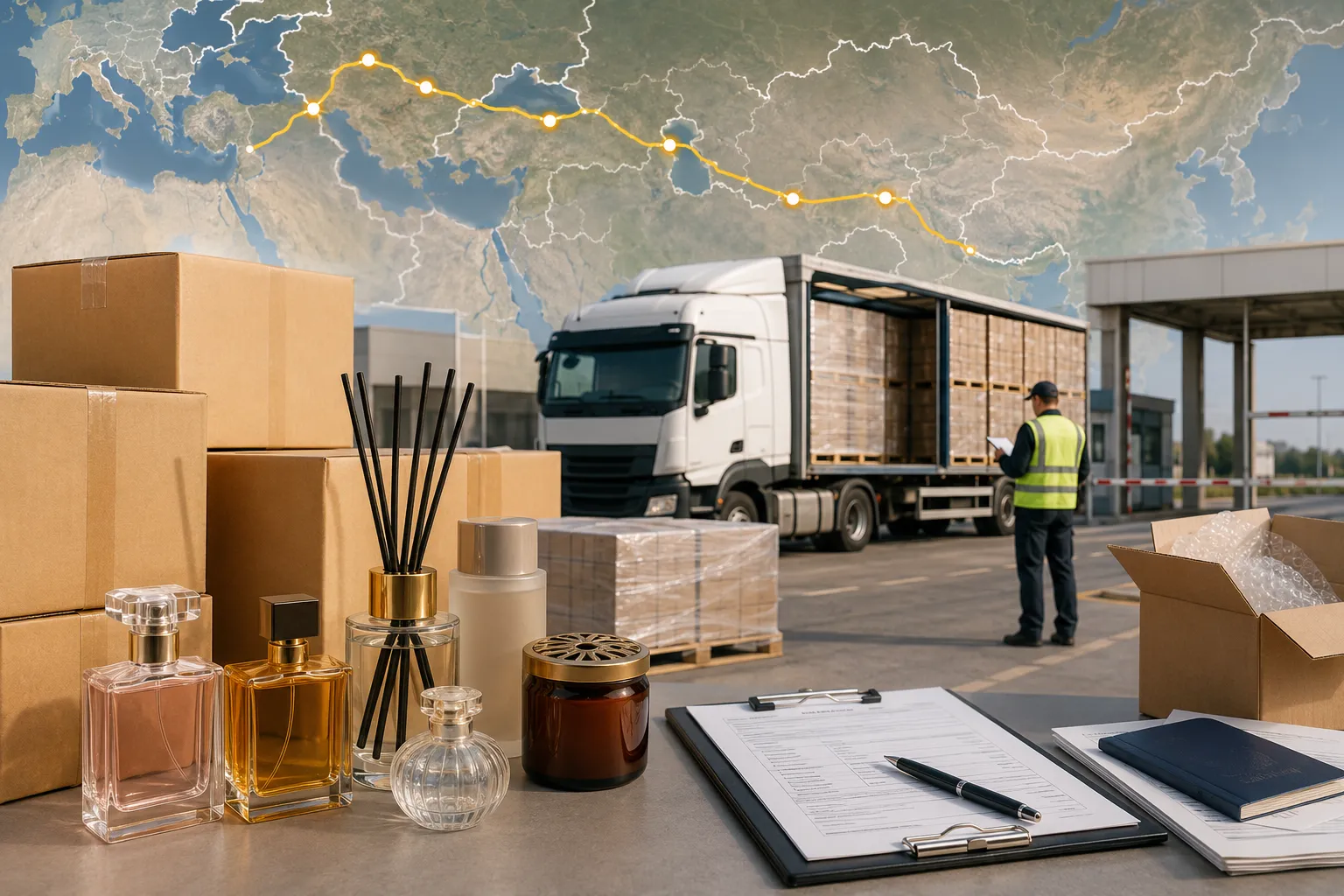
Strategic Advantage of Manufacturing Fragrances in Turkey
In an era of disrupted maritime routes, the location of your supply source is no longer a mere geographical detail; it becomes a core factor in selecting the right fragrance and cosmetics manufacturer. Turkey stands out as a pragmatic choice, acting not just as a manufacturing hub but as a critical logistics node connecting Europe, Africa, Central Asia, and Russia. According to Invest in Türkiye, Turkey is within a four-hour flight radius of 67 countries, representing a combined GDP of approximately $30 trillion and a population of 1.3 billion.
For fragrance and cosmetics clients, the value of this location manifests in daily execution, not just on a map. The shorter the relative distance to regional and European markets, and the higher the flexibility of land-based or multimodal transport, the more manageable it becomes to adjust samples, packaging, or reorder cycles. Therefore, when searching for a manufacturing base that helps you safeguard lead times, minimize surprises, and enhance responsiveness; Turkey emerges as a more balanced and resilient option compared to longer, more fragile supply routes.
How does Jasmine Factory Mitigate Supply Chain Risks During Global Crises
At Jasmine Fragrance & Cosmetics, we don’t just position ourselves as shipping coordinators; we are a fragrance and cosmetics manufacturer in Turkey that helps you manage your project from formulation to final delivery. We start by designing the logistics path itself: Is a ready-made wholesale solution, white label, or private label most suitable for your needs? Is the chosen packaging durable enough for land transport? Are the documentation and compliance standards aligned with the requirements of your target market? And is the proposed lead time realistic if the route shifts from maritime to land or a multimodal model?
This comprehensive role is built on a solid foundation. We provide you with Private Label and White Label solutions, supporting everything from custom bottle design and labeling to packaging and production. You can connect with us directly via WhatsApp, and our manufacturing expertise is further detailed on our about us page. For us, value doesn’t start with the scent alone; it begins with managing the project as a cohesive whole.
For you as a business owner, this translates into three practical values:
- Total Cost Visibility: A clearer view of the total landed cost rather than focusing solely on the unit price.
- Proactive Packaging Solutions: A higher capacity to discuss alternative packaging and bottling options before they become an operational hurdle.
- Disciplined Execution: A more rigorous path for documentation, compliance, and shipping, minimizing surprises that could jeopardize your launch or reorder cycles.
How Does Jasmine Factory Transform Geographical Location into Operational Value for Your Brand?
The significance of our factory at Jasmine doesn’t stem solely from our Istanbul location; it arises from our ability to translate this geographical advantage into actual operational value. Through direct communication, wholesale services, and our White Label and Private Label solutions—supported by robust documentation and compliance—we help you consolidate your supply chain, enhance execution transparency, and discuss the optimal route for your shipment before a crisis escalates into a financial burden on your project.
From our perspective at Jasmine, this is the true meaning of a “crisis solution”: it’s not just selling you a product and leaving you to navigate the logistics alone. Instead, it’s about helping you build a more resilient, low-friction option with clear costs, documentation, and lead times. When combined with a Turkish manufacturing base that is closer to regional and many European markets, land-based or multimodal solutions become a logical part of your procurement strategy, rather than just a temporary reaction to a maritime crisis.
Are you planning to launch a private label or purchase fragrance and cosmetics wholesale from Turkey? Talk to us at Jasmine to review your product, packaging, compliance, and the most suitable transport options before finalizing any purchasing decision. Contact us now or explore our private label solutions.
How to Choose a Reliable Fragrance Partner Amid Supply Chain Volatility
If your question today is “How do I choose a reliable fragrance and cosmetics factory while supply chains are in turmoil?” the answer doesn’t start with price alone. It begins with manufacturing transparency, batch consistency, customization capabilities, document readiness, and reorder efficiency. In this market, scent quality is not enough; you need an organized factory that can seamlessly integrate production, bottling, packaging, documentation, and shipping options into a clearer, more stable path.
Start from the right source with us at Jasmine: Learn About Importing Perfumes: Complete Checklist for Turkish Suppliers
In conclusion, the closure of the Strait of Hormuz doesn’t just rearrange shipping costs; it reshapes how you choose the right fragrance and cosmetics manufacturer. As maritime routes become increasingly fragile, there is a greater need for a factory that provides higher clarity in production, packaging, documentation, and supply options—rather than a supplier who sells you a product and leaves you to face operational complexities alone.
From this perspective, the smartest decision today doesn’t start with “Who gives me the cheapest price?” but rather, “Which fragrance factory in Turkey can help me build a more stable path from the manufacturing stage until the product reaches the market? ” At Jasmine, this is exactly the role we play for our wholesale, white-label, and private-label clients.
If you want to work with a fragrance and cosmetics factory in Turkey that helps you fine-tune your product, packaging, lead times, and the most suitable shipping options, message us now and let’s review your project step-by-step.
Also read: Perfume Shipping from Turkey: The Best Options for Traders
FAQs
Is Land Transport Always Cheaper Than Maritime Shipping?
Not necessarily. Often, the advantage of a land-based solution lies in reducing lead times, enhancing execution transparency, and lowering the cost of “surprises,” rather than being strictly cheaper in every case.
Are All Fragrance Shipments Classified as Dangerous Goods?
No. It depends on the nature of the product, the percentage of ingredients, the requirements of the target market, the shipment classification, and the documentation required for it.
What are the benefits of working directly with a factory vs. intermediaries?
An organized factory can discuss the product, packaging, documentation, route, and lead times from a single point of contact, instead of fragmenting responsibility across multiple parties.
How to Start Your Wholesale or Private Label Journey with Jasmine
Start by requesting our catalog and contacting us directly. Share your target market, product type, and required level of customization, and we will help you choose the most suitable path.
External sources
- UNECE – ADR 2025
- Invest in Türkiye – Logistics & Transportation
- Oman – Executive Regulations of the Land Transport La
- UAE Legislation – Federal Decree-Law No. 14 of 2024 on Traffic Regulatio
- MOIAT UAE – Cabinet Decree 154-2024 Transport of dangerous goods by roa
- Asharq Al-Awsat – Saudi transcontinental logistics network after Hormuz disruptio
- Reuters – Beauty industry costs rise with transport and packaging disruption (1 Apr 2026
- UNCTAD – Hormuz disruption deepens global economic strain across trade, prices and financ
- Reuters – Saudi pipeline pumping 7 million bpd and Yanbu exports near 5 million bpd (28 Mar 2026)