A perfume project can look commercially promising long before it is operationally safe. In global B2B launches, many problems do not start with the fragrance itself; they start when ownership, approvals, packaging files, confidentiality, and export responsibilities are scattered across emails instead of locked into one private label manufacturing agreement. That is when a routine sampling phase can later become a dispute over who owns the artwork, who approves the final files, or what happens when the first reorder does not follow the original understanding.
At Jasmine Factory, we manufacture in Turkey and support international B2B buyers through Private Label, Perfume Contract Manufacturing, Perfume Manufacturing, and other export-oriented routes from our Istanbul-based operation. In this guide, we explain what global buyers should lock in before production starts: scope, brand ownership terms, artwork ownership rights, quality and approval controls, the right use of an NDA for private label, and when a white label manufacturing agreement may be the better fit.
This article is commercial guidance for B2B buyers and brand owners. It is not jurisdiction-specific legal advice, and any final agreement should still be reviewed for the countries and commercial model involved.
Why does a private label manufacturing agreement matter for Global B2B perfume projects?
Purchase orders are useful for quantities, prices, and shipment references, but they are weak tools for disputes about ownership, approvals, confidentiality, packaging revisions, or post-termination file handover. A strong private label manufacturing agreement brings those rules into one document before production begins. For importers, distributors, retailers, and private label brand owners, that clarity is a commercial safeguard.
This matters even more in perfume projects because the relationship often includes scent direction, packaging support, label approvals, documentation, repeat-order logic, and destination-market coordination. At Jasmine, we see this every day in export-focused discussions: the more clearly the scope and approval ladder are defined at the start, the easier it is to sample, approve, produce, and reorder without confusion.
How does Jasmine in Turkey support global buyers before agreement drafting starts?
At Jasmine, we help buyers define the operational side of a manufacturing relationship more clearly. Our site positions us as a perfume manufacturer in Turkey serving wholesalers, importers, retailers, and entrepreneurs in international markets.
That matters because a better agreement starts with a better production route. If you already know you need deeper customization and stronger brand control, our Private Label path is the logical starting point. If your team needs broader execution support from brief to shipment, compare it with our Perfume Contract Manufacturing workflow.
And if you are still deciding between models, our White Label Perfume Manufacturer and OEM vs ODM pages help clarify which route matches your commercial stage before draft clauses start circulating.

What should a private label manufacturing agreement define before production starts?
A useful private label manufacturing agreement should define the relationship in operational language, not just legal labels. For perfume and fragrance projects, that means the agreement should answer three questions clearly: what Jasmine is expected to produce, what the buyer is expected to approve or supply, and how both sides handle changes once the project moves from concept into production.
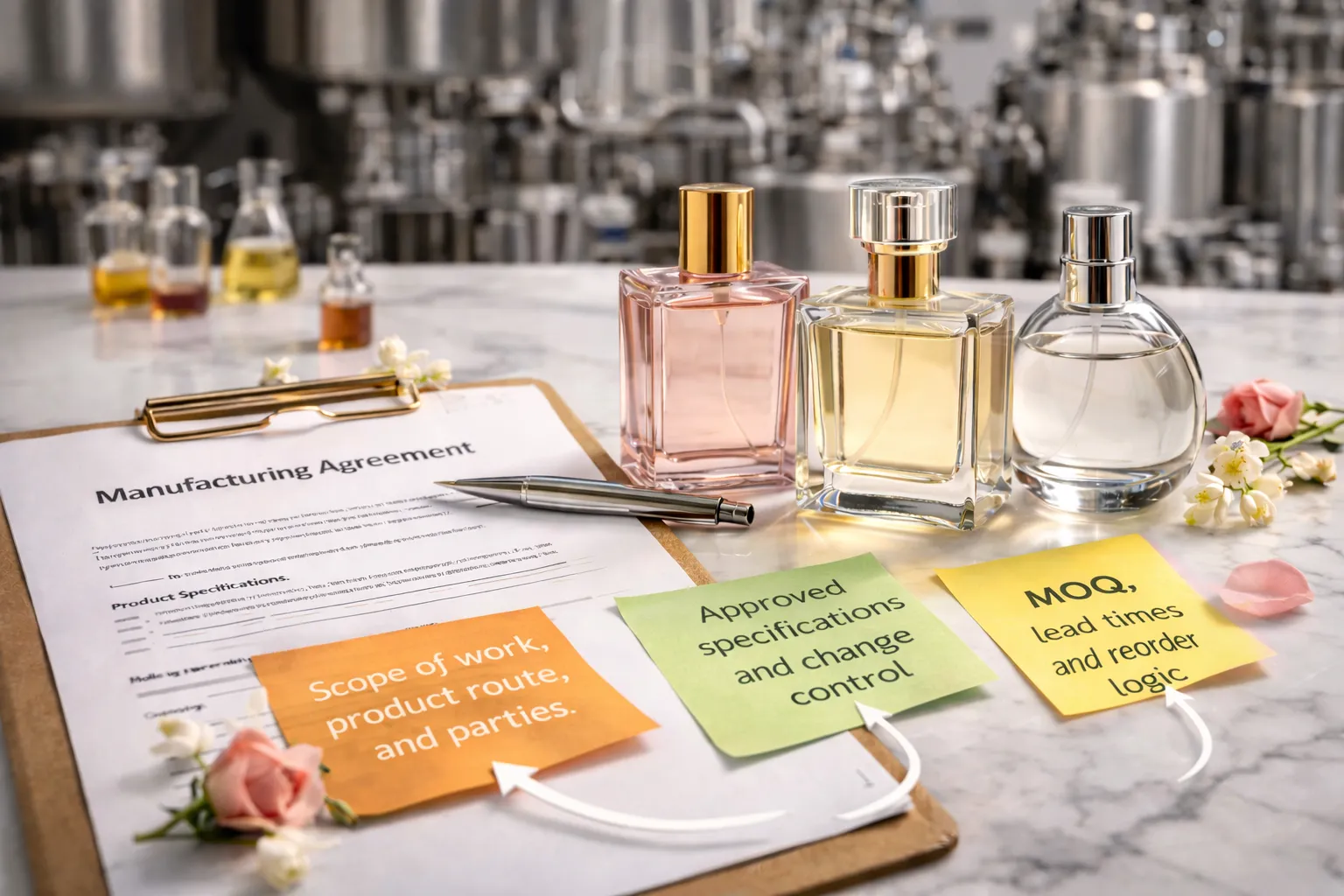
1) Scope of work, product route, and parties
The agreement should define the parties and the exact route being purchased. “Manufacturing” can mean very different things: fragrance development, component sourcing, filling, labeling, carton packing, and shipment preparation—or a much narrower execution model with lighter customization. When scope stays vague, the revision stage becomes expensive.
At Jasmine, we recommend identifying the product route from day one: private label, white label, contract manufacturing, or another defined path from our site. That prevents one side from assuming a full-service packaging and documentation workflow while the other expects product supply only.
2) Approved specifications and change control
The agreement should tie production to approved specifications, not to verbal assumptions. That includes the approved scent direction, bottle selection, carton format, label language, barcode placement, artwork version, and any market-specific packaging requirements. If a buyer changes the label text after files are approved, or updates packaging after sourcing has started, the agreement should state how that change is requested, approved, costed, and documented.
This is especially important in international projects. A packaging revision that looks minor at briefing stage can affect print timelines, stock allocation, documentation, and delivery. We advise buyers to align these points early, then use our Catalogs and Contact pages to structure the product and packaging conversation before bulk production begins.
3) MOQ, lead times, and reorder logic
The agreement should distinguish between first orders and repeat orders. Launch orders typically involve more development work, additional file approvals, and increased uncertainty. Reorders should be easier because the approved references, packaging path, and documentation flow already exist.
Instead of guessing every future number too early, buyers should lock in the structure: MOQ logic, lead-time framework, forecast expectations, reorder triggers, and what happens when demand scales faster than expected. If you want Jasmine to help define the route before drafting goes deeper, start with Private Label or Perfume Contract Manufacturing, then send us your brief through our contact path.
What should the brand owner keep under written control?
One of the most important sections in a private label manufacturing agreement is the ownership section. Brand owners often assume that paying for development or packaging means owning everything. Manufacturers sometimes assume the opposite. The safest way forward is to separate each asset category in writing.
At minimum, brand ownership terms should address who owns the trademark, logo, label copy, packaging identity, trade dress, and other outward-facing brand assets. In most private label projects, the brand owner should keep those rights, while Jasmine receives only a limited operational right to use them for production, labeling, packing, and supply under the agreement.
That license should be narrow in purpose and time. It should not become an open-ended right to reuse the buyer’s branding for another customer, another channel, or marketing outside the agreed project. If your goal is long-term differentiation rather than quick market entry, review our Private Label Perfume Guide and confirm how the route supports your brand-building goals.
Artwork ownership rights vs. packaging approvals
Which Files Must Be Controlled in Writing
In fragrance projects, artwork ownership rights deserve their own section. Too many teams treat labels and cartons as a late design step, when in reality they are a production-control issue. The agreement should state who creates the artwork, who owns the final files, who supplies print-ready assets, who approves print proofs, and how packaging changes are handled when production constraints require revision.
For Jasmine projects, this usually means controlling the approval ladder for label copy, multilingual versions, barcode placement, carton layout, and final print-ready packaging files. If we provide packaging support, the agreement should still say exactly which materials remain the buyer’s assets, which files are technical production files, and who signs off before printing starts.
This is why we advise buyers not to leave packaging approvals until the final week. Our Perfume Manufacturing and Private Label pages already frame packaging as part of the production route, not as a decorative add-on. The agreement should mirror that same logic.
What to protect before samples, quotes, and file exchange
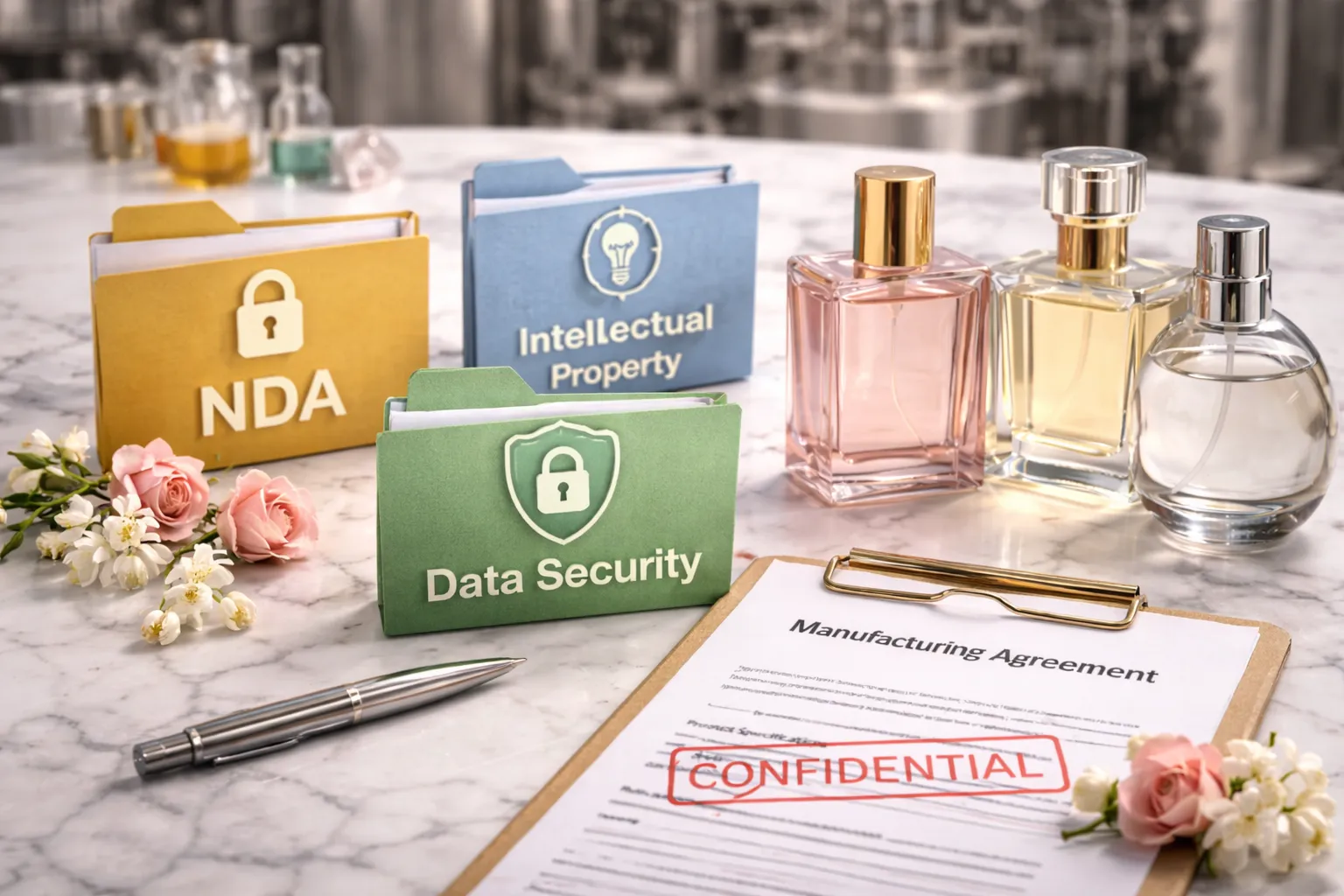
An NDA for private label usually belongs earlier than the main production contract. Buyers often need to share concept boards, product plans, artwork drafts, retailer requirements, target-market details, or launch timing before they have chosen the final factory route. That is exactly where the NDA helps: it protects early-stage disclosures before the broader private label manufacturing agreement takes over.
The NDA should define confidential information broadly enough to cover the materials that matter in real fragrance discussions: sample references, formula-related information, packaging layouts, artwork files, pricing, channel plans, forecasts, documentation expectations, and any non-public process information shared during qualification.
For many international buyers, a mutual NDA is more practical than a one-way NDA because both sides may disclose commercially sensitive information. If you are still in that qualification stage, begin the conversation through Contact and clarify the route before exchanging deeper project material.
Responsibilities in a private label manufacturing agreement
Quality language should never stay generic. A private label manufacturing agreement should connect production to a measurable benchmark: an approved scent sample, approved packaging version, approved label proof, or a documented final specification set. It should also explain inspection rights, non-conforming goods, correction paths, and what counts as acceptance before shipment release.
For export-focused perfume projects, documentation also belongs here. At Jasmine, we position manufacturing as a controlled route that connects product, packaging, and documentation, and our site repeatedly directs buyers toward Certificates, Catalogs, and Contact so the right trust materials and project details are aligned early.
The agreement should therefore separate responsibilities clearly. We can support product and manufacturing documentation within our operational scope, but the buyer should still confirm destination-market requirements, importer expectations, and final label content for the countries where the product will be sold.
Private label manufacturing agreement vs white label manufacturing agreement
A white-label manufacturing agreement is usually simpler because the product base is more standardized and the customization layer is lighter. A private label manufacturing agreement usually needs deeper language around ownership, approvals, packaging control, and exclusivity because the project is intended to become a stronger brand asset. At Jasmine, this is why we separate private label, white label, and broader contract manufacturing routes on our site instead of treating them as interchangeable labels.
| Decision point | private label | white label |
| Customization | Custom scent and stronger packaging control | Standardized base and lighter branding |
| Ownership | More focus on brand and artwork control | Usually narrower ownership scope |
| Confidentiality | Often deeper when custom work is involved | Still important, but lighter |
| Best fit | Long-term brand building | Faster testing and simpler execution |
If your objective is faster entry with lighter customization, review our White Label Perfume Manufacturer route first. If your goal is deeper brand control and a stronger packaging identity, stay on the private label path and define the agreement accordingly.
What to send Jasmine before agreement drafting begins
The fastest way to improve contract clarity is to improve the first brief. Before legal drafting goes too far, send Jasmine the commercial and operational facts that actually shape the route, approval logic, and documentation flow.
- Target market and country or countries
- Sales channel: distributor, retailer, chain, online brand, or another route
- Product type and planned SKU count
- Level of customization: white label, private label, or broader contract manufacturing
- Scent direction or reference style
- Packaging scope: bottle, cap, carton, labels, barcode, multilingual requirements
- Artwork status: concept only, draft ready, or print-ready files available
- Approximate order scale, timeline, and documentation expectations
Once we receive that brief, we can help you decide whether the correct path is Private Label, White Label, or Perfume Contract Manufacturing, and point you toward the most relevant support pages, including Catalogs, Certificates, and WhatsApp.
In conclusion, A good private label manufacturing agreement does not exist to slow a project down. It exists to protect the project before production creates cost, momentum, and risk. For fragrance buyers, the four issues to lock in early are scope, ownership, confidentiality, and acceptance. When those are written clearly, the project is easier to sample, approve, produce, reorder, and, if needed, unwind without avoidable disputes.
At Jasmine, we manufacture in Turkey for global B2B buyers and help structure projects around the route that fits the commercial goal, whether that is private label, white label, or wider contract manufacturing. If you are preparing a new launch, send us your target market, product type, packaging scope, artwork status, and documentation needs through Contact. We will help you identify the right production route, the right internal resources, and the practical points that should be clarified before agreement drafting becomes time-sensitive.
FAQs about private label manufacturing agreement
What is the difference between a private label manufacturing agreement and a white label manufacturing agreement?
A private label manufacturing agreement usually covers deeper customization, ownership, packaging approvals, and stronger brand-control questions. A white label manufacturing agreement is often simpler because the product base is more standardized and the branding layer is lighter.
Should I sign an NDA for private label before sharing artwork or sample references?
Usually yes. An NDA for private label is useful when you need to share concepts, packaging drafts, launch plans, or commercially sensitive project information before the main production contract is finalized.
Who should control artwork ownership rights in a private label perfume project?
That should be written explicitly. The agreement should define who creates the files, who owns the final artwork, who controls revisions, and how technical production files are handled if the relationship ends or the project changes.
What brand ownership terms should be clear before the first production run?
The agreement should state who owns the trademark, logo, label copy, packaging identity, and other outward-facing brand assets, while also limiting how the manufacturer may use those assets during the project.