Global B2B buyers rarely lose time because the fragrance idea is weak. They lose time because the route behind the fragrance is unclear. In halal-sensitive markets, that confusion becomes more expensive because importers, distributors, retailers, and private label owners need a manufacturing path that is commercially workable from the first brief onward.
In this guide, we explain how halal perfume production should be evaluated from a B2B perspective, where natural fragrance production aligns with the core halal principles without compromising the fundamental logic, and how we at Jasmine in Istanbul, Turkey, support private label, ready-to-label, and wholesale projects for international markets. If you are comparing manufacturers for GCC channels, European retail, or wider export distribution, this article will help you ask sharper questions and move faster with less risk.
Why does halal perfume production in Turkey matter for global B2B buyers?
For global buyers, halal perfume production is not only a formula question. It is a market-entry question. A fragrance may smell right and look attractive on the shelf, but if the manufacturer cannot support ingredient review, process control, packaging alignment, and export documentation, the project becomes slower and riskier than it should be.
That is where location and manufacturing structure matter. Turkey is a practical base for buyers who want a supplier that can connect product development, packaging, and export support inside one workflow rather than across disconnected vendors. At Jasmine, we position halal perfume production as a launch system, not as a vague label claim. From our Istanbul-based operation, we help B2B buyers align fragrance selection, packaging, documentation, and shipment preparation for global markets.
Start your supplier review by visiting our website
What should you verify before approving halal perfume production?
A serious halal perfume project requires more than a simple alcohol-free message. Buyers should evaluate halal perfume production as a controlled manufacturing route built on ingredient screening, contamination prevention, traceability, packaging accuracy, and document readiness. The manufacturer should be able to explain the logic clearly, not hide behind broad marketing language.
Check ingredients and raw material sources
The first review point is the formula itself. Buyers should ask what the alcohol source is, whether any animal-derived inputs are present, how sensitive materials are documented, and whether raw material changes are controlled before they reach production. In B2B projects, the right question is not only whether the sample smells good. The right question is whether the formula can be repeated, documented, and approved for the destination market.
Evaluate process control and contamination prevention
Ingredient suitability alone is not enough. Buyers also need to understand how the manufacturer manages production controls, cleaning logic, storage separation, and batch tracing. A halal-suitable formula can still become a problem if the production environment is poorly controlled. Strong suppliers can explain how they protect product integrity from receiving to filling to packing, and they can do so in operational language that procurement teams can verify.
Check documentation that support Halal Perfume Production for export markets
Documentation should be prepared early, not after bulk production is already under pressure. Depending on the project and destination market, buyers may need certificates, technical support files, ingredient-origin documentation, label review inputs, and shipment support papers. The sooner this document workflow is clarified, the easier it becomes to reduce approval delays and avoid last-minute surprises.
If documentation is part of your supplier approval process, review our Certificates and our Perfume Manufacturing route before requesting samples.
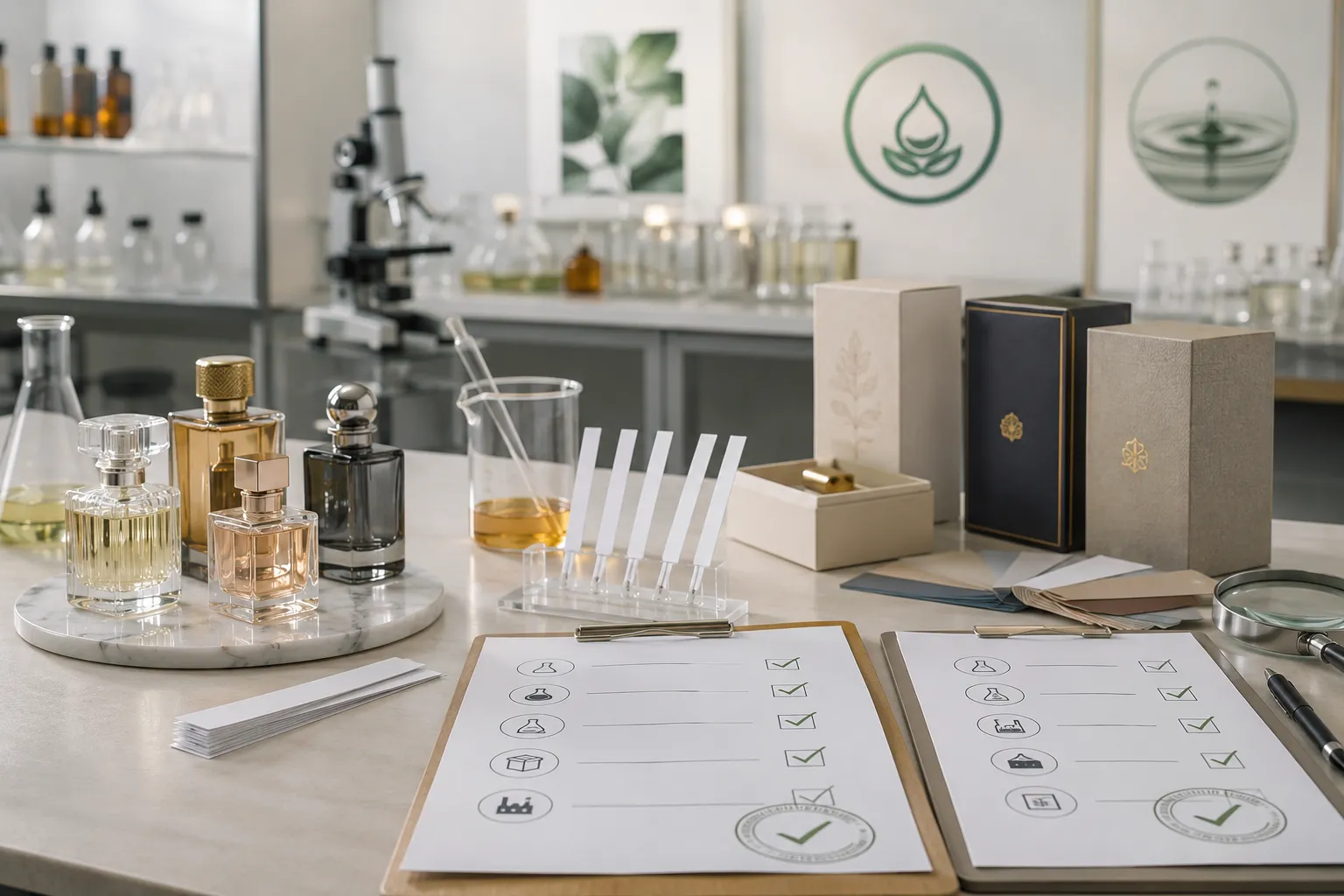
Where does natural fragrance production fit in a halal perfume project?
Natural fragrance production should remain a supporting angle in this article, not the main target. It can strengthen positioning, help shape a more botanical scent story, and support premium brand communication. But it does not replace the core halal questions around permissibility, process control, and documentation.
Why can natural fragrance production support positioning but not replace halal checks?
A formula can lean natural and still create approval problems if its sensitive ingredients are not documented well, if its alcohol pathway is unclear, or if the production controls are weak. For global buyers, natural fragrance production is mainly a brand and sourcing conversation. Halal perfume production is a sourcing, control, and compliance conversation. The overlap is real, but the decision logic is not identical.
How should buyers choose raw materials for a natural yet halal-oriented concept?
The best approach is to work backwards from the target market. Buyers should assess whether the scent direction fits the channel, whether key materials are documentable, whether substitutes may be needed later, and whether the supply chain can maintain consistency at scale. In practice, a commercially strong formula is not only one that smells attractive. It is one that can be repeated, explained, and shipped with confidence.
The difference becomes clearer when you screen a supplier through four practical questions:
- Ingredient origin: Can you prove the source and status of sensitive materials, or are the claims still generic?
- Alcohol pathway: How is the alcohol source documented for the target market, and who is responsible for clarifying it?
- Manufacturing controls: What line-cleaning, segregation, and traceability practices protect the formula from cross-contamination?
- Commercial message: Is the launch led primarily by halal-market suitability or by a natural/botanical brand story?
Use this distinction before sampling. If a supplier speaks more confidently about being natural than about process control, traceability, and export support, the halal route may still be too weak.
How do we at Jasmine in Turkey manage halal perfume production from brief to shipment?
We structure projects in a sequence that international B2B buyers can actually use. That matters because most delays do not come from one technical issue alone. They come from poor sequencing between product choice, packaging decisions, document collection, and shipment planning. Our role at Jasmine is to connect those pieces inside one clearer workflow from Turkey to your target market.
Define the market, channel, and scent direction first
We begin by clarifying the destination market, sales channel, scent direction, price level, estimated SKU count, and preferred format. This step matters because the best route for a GCC distributor may not be the best route for a European retailer or a fast-launch reseller. A sharper brief reduces wasted sample rounds and helps us recommend the right commercial path from the start.
Handle samples, packaging, and labeling approvals
Once the direction is clear, we move through scent evaluation and packaging alignment together. That includes bottle selection, cap style, box structure, label language, and artwork review. In B2B terms, packaging is not decoration added at the end. It is part of the approval route. The earlier buyers align packaging with the target market, the easier it becomes to protect timing and avoid unnecessary revisions.
Connect production, quality Checks, and shipment preparation
After approvals are locked, we focus on controlled execution. The production output should match the approved direction as closely as possible, while documentation and packing details stay aligned with the export route. That is one reason Turkey matters strategically for Jasmine: from Istanbul, we can keep manufacturing, packaging, and dispatch discussions tighter for buyers who do not want fragmented handoffs.
Compare our these routes before you decide: Private Label, Private Label Perfume Manufacturer, Ready-to-Label Perfume, and Catalogs.
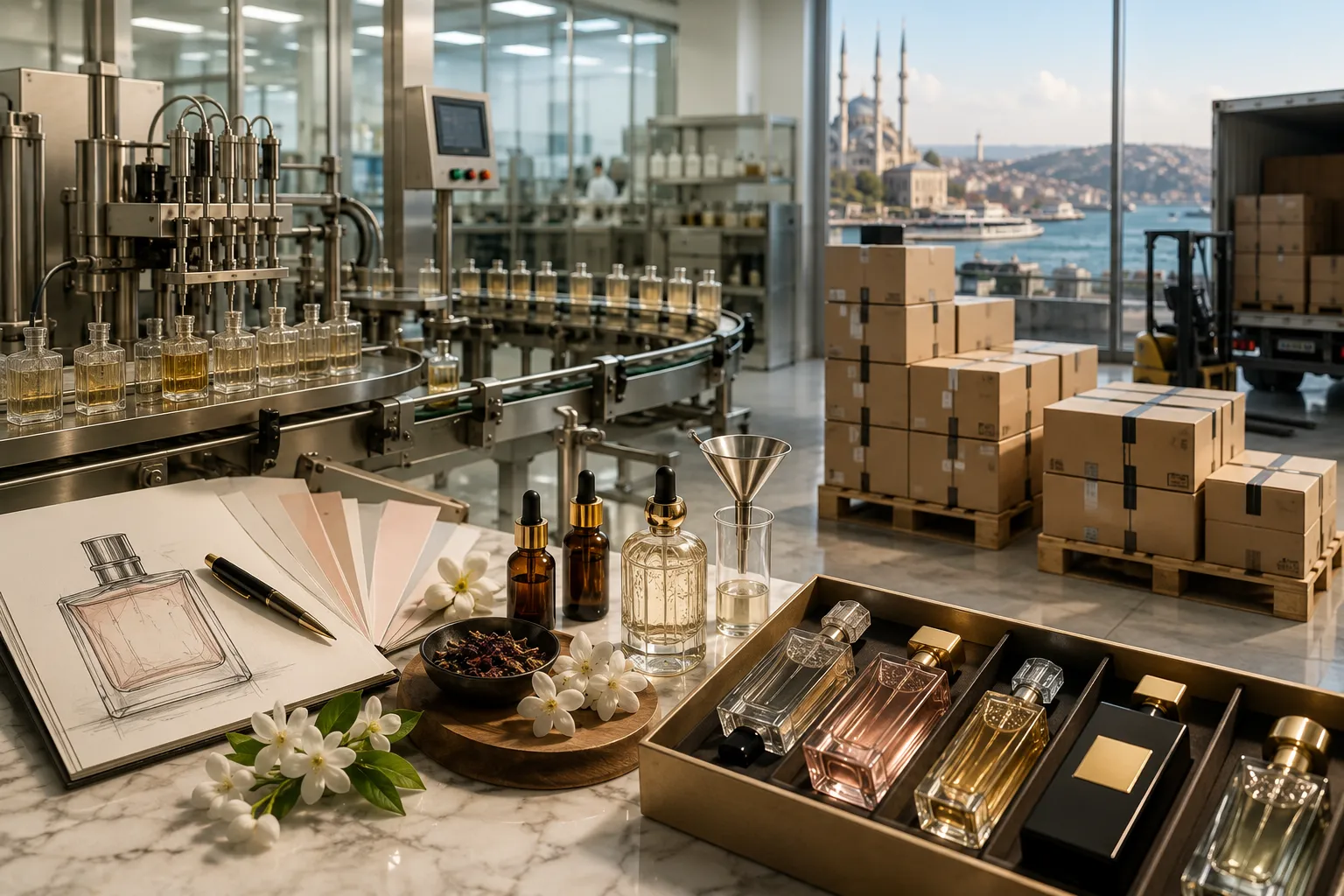
Which does commercial route fit your halal perfume production project best?
Not every buyer should follow the same route. The right model depends on how much control you need, how fast you want to launch, and how much development risk makes sense for your stage.
When is private label the better route for halal perfume production?
Private label is usually the stronger fit when you want deeper brand ownership, stronger packaging control, and clearer long-term differentiation. It suits buyers who do not want to compete on the same ready-made assortment everyone else can access. It also gives more room to shape a fragrance proposition that aligns with your market, your shelf strategy, and your brand identity.
If brand control is the priority, review our Private Label service and Private Label Perfume Manufacturer page.
When is ready-to-label better for faster B2B launches?
Ready-to-label is better when launch speed matters more than starting from zero. It gives buyers a faster route to market while still keeping brand presentation, packaging, and export planning under control. This is often the smarter first step for teams that want to validate demand before they expand customization.
If speed is more important than deep customization on the first order, explore Ready-to-Label Perfume and tell us what market you are targeting.
When does a wholesale discussion make more sense?
Some buyers need to test the market first, build assortment faster, or compare a lower-friction entry route before investing in a more developed private label project. In those cases, a wholesale conversation can be commercially sensible, especially when the buyer already has a channel but wants to reduce launch complexity.
If you want us to help compare the route options, start from our Homepage and continue through Contact with your project brief.
Why is Jasmine in Turkey a practical halal perfume production partner for international buyers?
At Jasmine Factory, we are not presenting ourselves as a distant third-party broker. We are a Turkish manufacturer with a route that connects product development, packaging, certificates, and export support more directly. That matters for B2B buyers because speed is not only production speed. Speed is the ability to move from decision to dispatch without losing momentum across disconnected teams.
Our wider site structure supports that positioning clearly. We present manufacturing, private label, ready-to-label, catalogs, certificates, and direct contact as connected parts of one commercial route. For procurement teams, this makes supplier evaluation easier because they can assess not only fragrance direction, but also operational readiness and export logic.
Global buyers often find our structure useful for five reasons:
- We operate from Istanbul, Turkey with a manufacturing-led rather than purely trading-led position
- We support multiple routes, including private label, ready-to-label, and broader manufacturing discussions
- We make certificates and trust materials visible during supplier evaluation
- We provide catalogs and direct contact options that help qualification move faster
- We frame projects around export readiness, not only product appearance
To qualify our factory more thoroughly, review About Us, Mission & Vision, Perfume Manufacturer in Istanbul, and Certificates.
What should you send us in your first message about halal perfume production?
To give you a commercially useful reply faster, we recommend sending a short project brief instead of asking only for a price list. The clearer your first message is, the easier it becomes for us to recommend the right route and identify the likely approval points early.
- Target market and destination country
- Sales channel, such as distribution, retail, e-commerce, or chain stores
- Scent direction or reference style
- Preferred format and estimated SKU count
- Packaging scope and label language
- Approximate quantity range
- Any documentation expectations linked to the market
When we receive that level of clarity, we can advise whether the best fit is private label, ready-to-label, or a broader manufacturing route from Turkey. That shortens the qualification cycle and makes the next conversation more productive.
Ready to move from research to a real discussion? Contact us and send us your brief, or review our Catalogs before the first call.
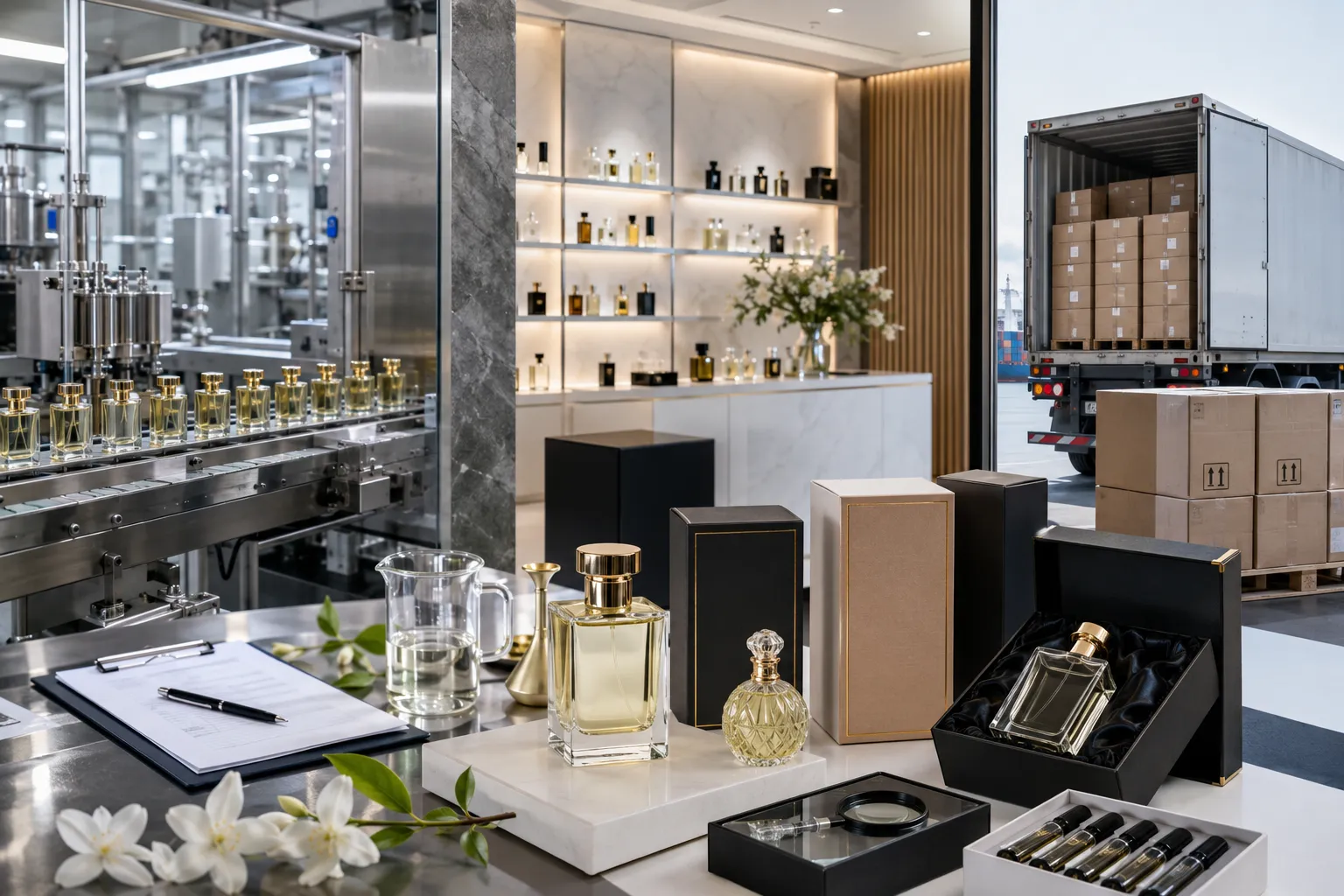
How can global B2B reduce risk in halal perfume production?
Halal perfume production works best when it is treated as a controlled commercial route rather than a simple product label. Buyers need a manufacturer that can explain ingredient logic, process control, packaging alignment, and export documentation with the same level of clarity. Natural fragrance production can support the formula story, but it should remain a supporting layer rather than the core decision lens.
At Jasmine, we approach halal perfume production from Turkey as a B2B launch route for global markets. We help buyers connect scent direction, packaging scope, documentation expectations, and shipment readiness inside one practical workflow. If you are planning a private label, ready-to-label, or wholesale project, send us your market, quantity range, and packaging needs so we can recommend the most suitable route for your stage.
Contact us for route guidance, or compare Perfume Manufacturing, Private Label, and Ready-to-Label Perfume before requesting samples.
FAQs about halal perfume production
What MOQ should I expect for halal perfume production in Turkey?
MOQ depends on the route, packaging depth, number of SKUs, and the level of customization involved. A private label launch usually has a different commercial structure from a ready-to-label or wholesale project, so the best way to estimate feasibility is to share your target market, packaging scope, and quantity range early.
Is natural fragrance production the same as halal perfume production?
No. Natural fragrance production can support the scent concept and brand story, but halal perfume production is broader. It also depends on ingredient suitability, process control, traceability, and documentation that can support the destination market.
Can we customize scent, bottle, and packaging in a halal perfume project?
Yes, but the level of customization changes the workflow. Deeper customization can be the right strategic choice for long-term brand building, while a faster route may be better for initial market validation. We help buyers compare those options based on speed, control, and launch risk.
Why does a Turkish manufacturer matter for global halal perfume buyers?
For many buyers, Turkey offers a practical manufacturing base that connects product development, packaging, and export support more efficiently. The advantage is not geography alone. It is the ability to manage a clearer route from approval to dispatch through one coordinated manufacturing structure.
What should buyers request before approving a bulk halal perfume order?
Buyers should align the formula direction, packaging approvals, label details, and relevant trust or support documents before bulk release. That helps prevent delays between sample approval, production, and shipment preparation.