Searching for eau de parfum manufacturing is about finding a reliable supply system, not just a scent. For B2B buyers, the real risks are inconsistent batches, leaking packaging, or customs delays.
Whether you choose a fast white label eau de parfum or a custom private-label eau de parfum, you need EDP production that is shelf-ready and margin-protected.
In this guide by Jasmine, you will find:
- The B2B Roadmap: How to choose between White Label (Speed) vs. Private Label (Brand).
- The 8-Step Process: From scent stability to export-ready documentation.
- Risk Mitigation: How we solve the common “bottleneck” issues in EDP production.
Why EDP manufacturing matters for importers and retailers?
You’re looking for a repeatable supply system: consistent batches, clear approvals, packaging control, and shipment-ready output that won’t create costly surprises after you’ve already committed to labels, cartons, and a launch date.
In B2B, EDP (eau de parfum) becomes a commercial tool, especially for importers and retailers, because it sits at a familiar “strong enough for customers” position in many markets, while still allowing you to manage margin, packaging, and assortment strategy.
Most buyers end up choosing one of three routes:
- White label eau de parfum: fastest way to launch using ready options, branded with your label.
- Private label eau de parfum: built around your brand direction (scent + packaging identity) for stronger differentiation.
- OEM/contract manufacturing: a spec-driven route where your requirements define the workflow and controls.
At Jasmine, the fast launch idea is framed as managed execution—selection, labeling, packing accuracy, and export readiness treated as one workflow, not separate headaches. (Jasmine Perfumes)
If you want to scope your project quickly, send your target market, sales channel, and preferred scent direction to us via WhatsApp and ask which route (white label vs private label vs OEM) fits your goal.
Also read: White Label Perfume Manufacturer for Fast Market Entry
What is Eau de Parfum (EDP) in manufacturing terms?
In manufacturing, EDP (eau de parfum) is not marketing language. It’s a spec category that typically refers to a fragrance mixture with a higher share of aromatic compounds than lighter formats like eau de toilette.
Many educational references commonly list EDP around 10–20% aromatic compounds, with conventions varying by brand and market expectations. Check the Wikipedia Article on Eau de toilette
For B2B buyers, the practical point is this:
EDP = a spec sheet discussion, not a label discussion.
When you brief an EDP manufacturer, align on what you actually need to standardize:
- Scent profile: families (fresh, floral, amber, woody, oud-inspired), key notes, intensity direction
- Performance target: how you want it to wear in your market (without overpromising)
- Stability mindset: clarity, separation risk, and how product behaves over time and temperature swings
- Packaging compatibility: bottle/atomizer performance, leakage risk, label adhesion, carton protection
- Regulatory & documentation readiness: what your destination market requires (varies by country)
If you want a broader factory overview context beyond EDP, we, at Jasmine Factory, also maintain a general Perfume Manufacturing guide—useful to avoid reinventing fundamentals while keeping this project EDP-specific.
Also read: Private Label Perfume Guide for B2B Business

EDP vs EDT vs Parfum: which concentration should you manufacture?
Choosing between EDP, EDT, and Parfum is rarely about which is better. In B2B, it’s a decision about:
- Positioning (premium vs everyday)
- Customer expectation (strong presence vs lighter wear)
- Cost structure (formula and packaging choices influence the business case)
- Channel fit (mass retail vs boutique vs gifting vs online)
- Operational risk (returns, leakage complaints, and consistency issues often come from process + packaging more than the label)
Concentration conventions vary, but educational references often summarize typical ranges like:
- EDT roughly 5–15%
- EDP roughly 10–20%
- Perfume extract / Parfum higher still (commonly listed beyond EDP)
The Istanbul Advantage: Premium Quality, Global Compliance Manufacturing your EDP with Jasmine in Turkey means you get the creative heritage of Istanbul blended with strict ISO 9001 & GMP standards. We ensure your private label eau de parfum is not just beautiful, but fully compliant for EU, US, and Gulf markets, reducing your regulatory risks from day one.
EDP vs EDT vs Parfum: B2B decision table
| Concentration label | Typical positioning | Customer expectation | Best for channels | Notes for packaging/QC |
| EDT | Lighter, everyday | Freshness, re-application OK | Mass retail, office/daywear assortments | Often lower perceived “strength”; still needs spray consistency + leakage control |
| EDP | Stronger presence, mainstream premium | Longer wear feel, richer profile | Import/distribution, gifting, hero SKUs | Stability + atomizer performance matter; packaging must protect product reputation |
| Parfum / Extract | Premium/statement | Intensity, depth, luxury signal | Boutique, premium gifting, limited lines | Higher expectation = tighter QC discipline; packaging experience is part of value |
If you’re unsure, a practical approach is to start with a focused assortment (e.g., 2–4 SKUs), then scale the winners into a deeper private label strategy, especially if you initially launch with a faster model.
Also read: Private Label vs White Label Perfume: Retailer & Distributor’s Roadmap
Private label eau de parfum vs white label eau de parfum
These terms are often used loosely, but for procurement they mean very different workflows. Here’s the simplest way to choose:
- White label eau de parfum = best when you need speed and a controlled launch using ready options.
- Private label eau de parfum = best when you want defensibility (brand ownership, differentiated scent direction, packaging identity).
- OEM/contract manufacturing = best when you have defined specs and want production run like a controlled program.
Jasmine’s own B2B content highlights the idea of choosing a route (white label vs relabel vs private label) based on speed-to-market and control, then upgrading strategy later.
Which EDP model fits your business?
Upgrade path that works in real life: Many buyers launch white label to validate demand, then move top sellers into private label for stronger ownership once the market proves itself.
Our expertise isn’t just theoretical; Jasmine Factory has developed and manufactured several successful Perfume Collections and independent Fragrance Brands that are currently competing in international markets. You can view our finished work in the product page to see the quality of our perfumes, fresheners, and scent performance in action.
Also read: White-Label Perfume Manufacturer (Complete Guide)
Eau de parfum manufacturing process
A strong EDP manufacturer doesn’t just produce. They run a stage-gated workflow that protects your timeline and reduces rework. Here’s a procurement-friendly view of eau de parfum manufacturing from first brief to cartons ready for export.
1) Brief and scent direction
Your brief should answer:
- Target market + climate reality (hot/cold matters for expectations)
- Channel (retail chain, distributors, e-commerce, gifting)
- Scent families + reference direction (what customers already like)
- Label language needs + barcode plan
- Packaging direction (bottle look, cap style, carton feel)
2) Sampling & iteration
Sampling isn’t a formality—it’s your cheapest “risk insurance.”
- Give structured feedback (what to intensify/reduce/shift)
- Align on the scent direction before packaging is printed at scale
- Confirm how revisions are managed and approved
3) Pilo & batch alignment
You want confidence that “sample success” can become “batch success.”
- Confirm approval gates (scent approval, packaging approval, pre-production approval)
- Ask how batch consistency is checked across runs
4) Maceration & aging
Many manufacturers include an aging/maceration stage to let the blend harmonize. The key for buyers is not the romance of the step. It’s that the factory can explain:
- Why it’s used,
- How it fits the schedule,
- What it’s meant to stabilize.
5) Filtration & QC
This is where issues like haze/particles (and future complaints) are reduced.
- Confirm filtration steps and in-process checks
- Ask what triggers rework or holds
6) Filling, crimping, & atomizer checks
This is where many “return reasons” are born. At Jasmine, we provide leak-proof pressure testing for every bottle-cap combination. Whether you choose our elegant standard EDP bottles or custom molds, we ensure the vacuum-crimp is engineered to withstand the pressure changes of international air and sea transit.
7) Labeling & boxing
Jasmine’s white label guidance stresses dielines/spec clarity and packing accuracy as launch-killers when handled vaguely.
- Confirm dielines, approvals, and print workflow ownership
- Confirm packing standards (how units are boxed/master-cartoned)
8) Carton specs, palletization, & documents
Export success is often decided before the truck arrives.
- Confirm master carton labeling and pallet standards
- Align paperwork timing (invoice/packing list basics + destination needs)
Internal link to add: A Trader’s Journey with a Turkish Perfume Manufacturer
If you want a manufacturer-led process not just a product list, ask our team for an end-to-end plan that covers sampling, packaging approvals, and shipment-ready packing for your destination market.
Also read: White Label Perfume Manufacturer for Fast Market Entry
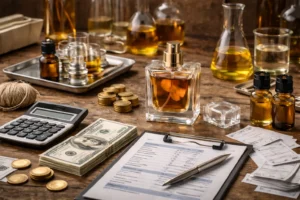
Customization options for private label EDP at Jasmine Factory
Private label only works when customization is broken into clear workstreams, so you know what you must provide, what the factory controls, and where approvals happen.
Customization menu
1) Scent direction
- Choose families (fresh/floral/amber/woody, etc.)
- Define the “brand feeling” you want the scent to communicate
- Build a small, consistent line architecture (hero + daily + premium)
2) Bottle & cap
- Shape, visual language, and shelf presence
- Cap fit and usability (a hidden “quality signal” for customers)
3) Label & dielines
- Label language(s)
- Barcode plan and mandatory labeling elements for your market
4) Box & carton
- Box finish direction (matte/gloss/texture feel)
- Master carton standards for shipping protection and warehouse handling
Beyond EDP – Product Extensions To build a cohesive brand, Jasmine also offers manufacturing for Home Air Fresheners and Reed Diffusers. We can match your signature EDP scent across an entire home fragrance line, ensuring your brand has a consistent aromatic footprint across different products. Review our Catalog to request assortments early.
Also read: Leading Private Label Perfume Manufacturer in Turkey
How to choose the right EDP manufacturer?
When you shortlist an EDP manufacturer, don’t evaluate them like a consumer would. Evaluate them like an operator.
Process transparency
- Can they explain the workflow end-to-end (brief → sample → pack → ship)?
- Do they use clear approval gates?
QC discipline (in practical terms)
- Can they describe checkpoints for batch consistency, clarity, leakage, and spray performance?
- Do they have a “hold/rework” mindset when something fails?
Packaging control
- Do they manage dielines and print workflow clearly?
- Can they help you avoid packing mistakes that delay launches?
Export readiness
- Can they explain packing standards and document coordination?
- Do they ask about your destination requirements early?
Communication speed
- One clear point of contact
- Structured sampling feedback loop
- Written confirmations of key approvals
Jasmine’s fast route” content calls out the same buyer-risk red flags repeatedly: vague QC, unclear print workflow, and no export documentation clarity. (Jasmine Perfumes)
Quick red-flag checklist
- “Yes, yes, we can do everything” — but no process detail
- No written approval steps (everything is informal)
- No clarity on dielines/specs or who signs off on printing
- No explanation of packing standards
- No questions about your destination market requirements
Also read: OEM Perfume Manufacturer: Your Guide to OEM Perfume
Start with Jasmine: the practical way to launch an EDP line
If you want speed and control, the easiest way to start is to send the right inputs on day one, so the factory can recommend the best route white label vs private label vs OEM and prevent delays later.
Jasmine’s own white label workflow framing is straightforward: send your market + channel + scent direction, then align labeling/packaging workflow so the order moves toward shipment-ready packing.
Contact us today to request the catalogs, and ask Jasmine to map the best route (white label vs private label vs OEM) for your destination market.
Request the Jasmine Product Portfolio today. This includes our latest Trend-Setter Catalog featuring our best-selling EDP formulations, as well as our Home Fragrance & Air Freshener collections. See what we have built, so we can build something better for you. Contact our team via WhatsApp to map the best route for your destination market.
FAQs about eau de parfum manufacturing
What is the typical lead time for eau de parfum manufacturing (EDP)?
Lead time depends on the route. White label can be faster because you start from ready options, while private label usually adds time for sampling and packaging approvals. The most reliable way to get a realistic plan is to share your market, SKU count, and packaging requirements up front so we can map the workflow.
Can I do private label eau de parfum with my own branding and packaging?
Yes. Private label typically includes scent direction plus label/box/carton customization. The key is aligning dielines, print workflow, and packing accuracy early, because packaging delays are a common reason launches slip.
What’s the difference between white label eau de parfum and private-label eau de parfum?
White label is a ready-to-launch route designed for speed, Private label is built around your brand direction. Many B2B buyers start white label to validate demand, then upgrade into private label for their best sellers.
Do manufacturers help with shipping and export documents?
Many manufacturers can support standard export paperwork and shipment readiness, but requirements vary by destination. Confirm your country’s needs early and ask the factory what documents are commonly prepared versus what’s market-specific.